











Human Futures
AI with Empathy, Critical Thinking, and Responsible Creativity

“I am more confident in solving a problem in a much more in-depth manner.”


“Through this programme, students not only strengthened their problem solving skills, but also discovered how empathy and service can give lasting purpose.”

Principal of Methodist Girls' Secondary School
“I saw myself grow to be open to more ideas and use my creativity more freely.”
- DT understanding: 76.47% → 95.45%
- Ideas generated: 56
- Prototypes built: 41
Student of Secondary 4, Methodist Girls’ School


Learning Outcomes
Human Futures helps students develop the mindsets and skills to navigate AI’s growing role in their lives, not as passive users, but as thoughtful, responsible creators. Through EDIT Design Thinking®, your students will build critical thinking, empathy, and collaborative confidence by working on challenges that matter.
Think Critically About AI
Your learners will question assumptions about AI, evaluate AI-generated content for bias and accuracy, and develop the judgement to know when AI helps and when it replaces thinking.
Build Human-Centred Empathy
Your learners will practise listening deeply, observing carefully, and putting themselves in others’ shoes to understand how AI and digital technologies are experienced by real people – peers, teachers, families, and communities.
Design Responsibly with AI
Your learners will develop ideas that define clear roles for AI and humans. They will create an AI + Human Design Brief for each solution – specifying what technology should do, what people should do, and why.
Navigate Misinformation and Digital Trust
Your learners will explore how AI-generated content, deepfakes, and algorithmic recommendations shape what people see, believe, and share – and design interventions that build trust and digital resilience.
Collaborate and Communicate with Confidence
Your learners will work in diverse teams, build on each other’s ideas through structured brainstorming and convergent thinking, and present their concepts to authentic audiences including school leaders, peers, and community partners.
Become Future-Ready Problem Solvers
Your learners will follow a clear, step-by-step process from empathising, defining, to ideating, prototyping, and testing – building a transferable problem-solving approach they can apply to any complex challenge beyond school.
Design Thinking Outcome in Numbers

Of students reported stronger empathy after the programme, up from ~44%
Felt confident solving problems without clear answers, up from ~65%
Average improvement in design thinking competence, independently assessed across 300+ students
Developing Future-Ready Learners with EDIT Design Thinking®
Design thinking is not just a set of tools and techniques; it is a way of understanding people first. In Human Futures, we apply this principle to one of the most important questions students face today: how should AI be designed, used, and governed to serve people well?
We focus on your learners, their growth, and the meaningful connections they build through empathy, collaboration, and real-world problem solving. We empower students to become active shapers of technology, not passive consumers of it.

Empathise
Your learners will explore how real people – peers, teachers, families – are experiencing AI in their daily lives. Through observation, interviews, and empathy tools, they surface genuine needs, concerns, and behaviours around AI, digital trust, and technology dependence.
Define
Your learners will synthesise their empathy insights into clear, student-owned problem statements. They identify specific tensions – between convenience and critical thinking, personalisation and privacy, AI efficiency and human creativity – and frame focused “How might we” questions.
Ideate
Your learners will generate and refine a wide range of human-centred AI solutions. Using C-Academy’s Random Cards and Idea Dice, they practise both divergent and convergent thinking – exploring bold possibilities before selecting ideas that are desirable, feasible, and responsible.
Test
Your learners will build low-fidelity prototypes of their solutions and test them with real users. Each team creates an AI + Human Design Brief that specifies what AI should handle, what humans should handle, and why – then gathers feedback and iterates.
Human Futures Programme Outline
Every school’s context is unique. The programme can be customised to your timetable, student level, and school priorities. Below is the standard 6-session learning journey.
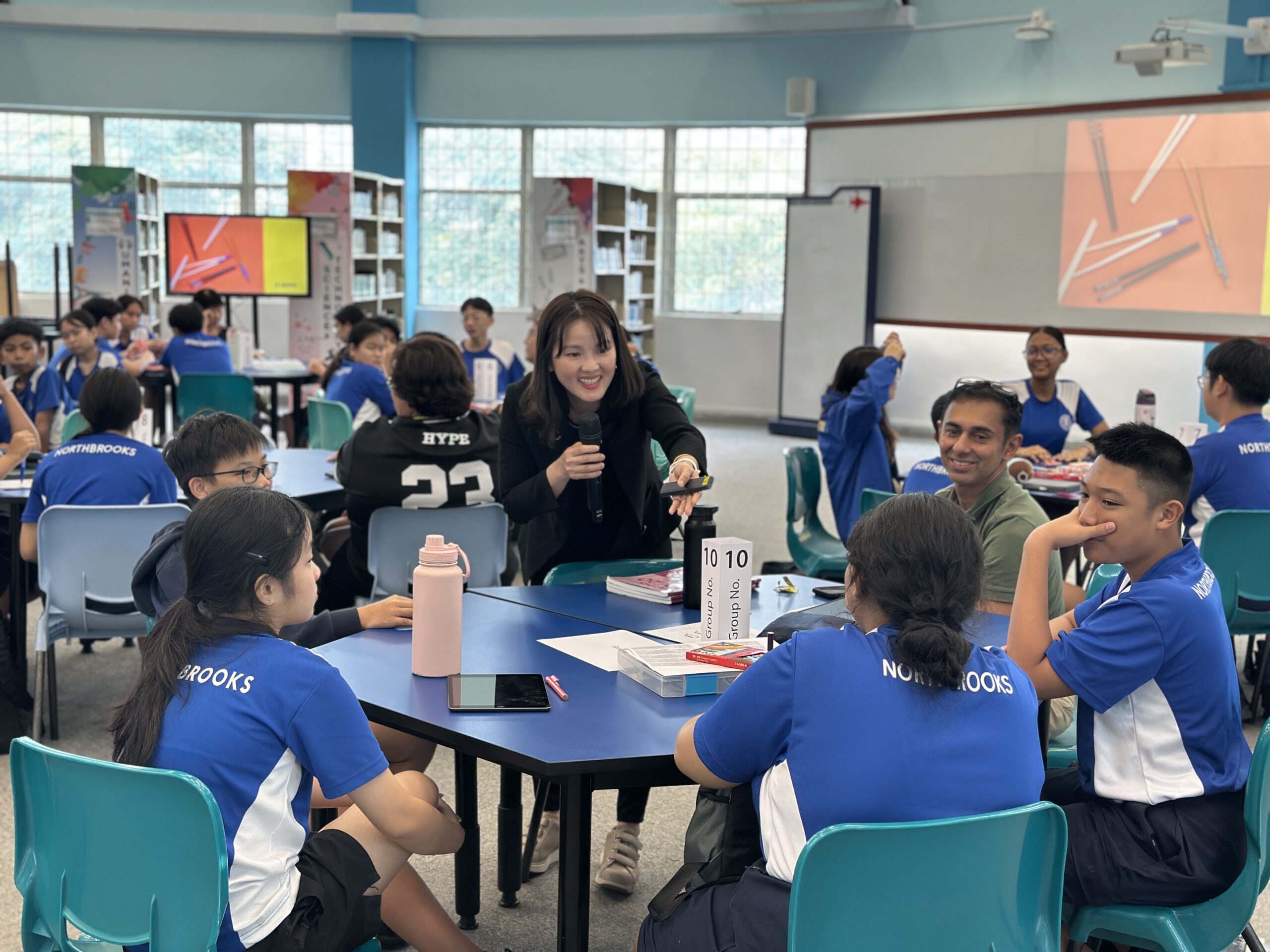
Introduction to Design Thinking and Human Futures
Your learners are introduced to EDIT Design Thinking® and the fundamentals of human-centred innovation in an AI-shaped world. They explore the key stages of Empathise, Define, Ideate, and Test while experiencing AI first-hand – interacting with a generative AI tool, comparing AI output with their own thinking, and discussing when AI helps versus when it replaces critical thought.
Through guided activities, students begin identifying real tensions between convenience, originality, trust, responsibility, and human connection, and start framing early opportunity areas for their Human Futures project.

The AI Futures Walk
Your learners conduct a structured observation activity to discover how AI and digital technologies operate in their daily environment. Using C-Academy’s Future Signals framework, they document where AI appears in school systems, apps, public services, and social interactions – and identify patterns, tensions, and opportunities that others overlook.
Students use AI to help analyse and categorise their observation data, then compare AI-generated insights with their own human-generated findings. This builds a foundational understanding of algorithmic reasoning and its limitations.

Empathise and Define: What Do People Actually Need?
Your learners identify a target group – peers, younger students, teachers, or families – and explore their needs, concerns, and behaviours in relation to AI, digital life, originality, trust, or future readiness.
Using simple interviews, observations, empathy maps, and insight clustering, students turn what they have learned into clearer opportunity statements and focused “How might we” questions. They also prompt an AI chatbot to generate empathy insights and compare results with their real interview data – discovering what AI can understand about human feelings and what it fundamentally misses

Ideate Human + AI Solutions
Your learners generate a wide range of possible solutions using C-Academy’s structured brainstorming and ideation tools, including Random Cards and Idea Dice. They also use AI as a brainstorming partner, then critically evaluate AI-generated suggestions against their own ideas.
Students compare, refine, and select ideas based on desirability, feasibility, responsibility, and potential impact. Each team develops an AI + Human Design Brief – C-Academy’s signature deliverable for this theme – that clearly defines what AI should do, what humans should do, and why.

Make It Real but Keep It Human
Your learners turn their selected ideas into quick, tangible prototypes such as storyboards, mockups, posters, role plays, mini campaigns, or low-fidelity digital concepts. They may use AI image generation for rapid visual prototyping where appropriate.
They test these ideas with peers, teachers, or invited reviewers to gather feedback on clarity, usefulness, originality, and responsible AI use. Based on what they learn, they refine their concepts, strengthen their AI + Human Design Brief, and prepare for the final showcase.
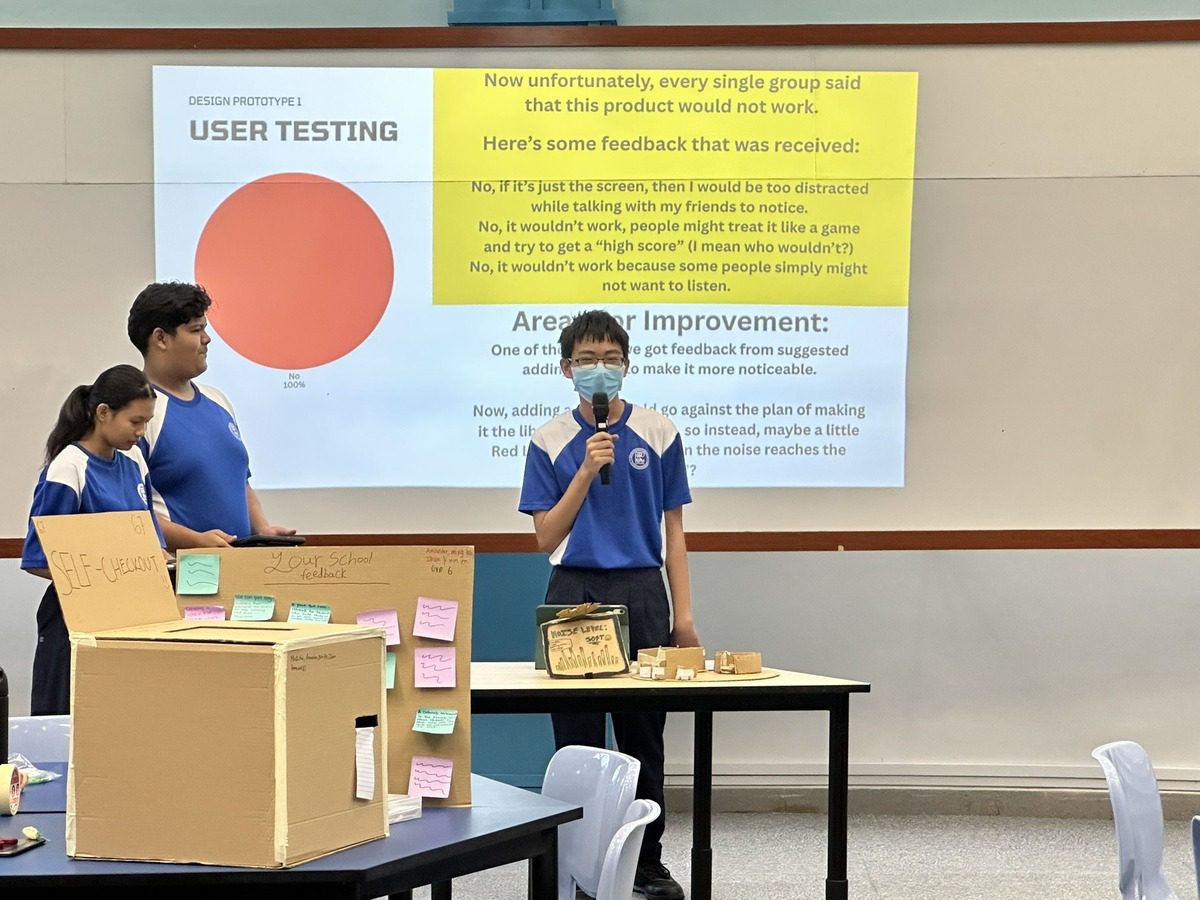
Showcase and Reflection of Our Human Futures
Your learners present their final Human Futures concepts through a team showcase. They explain the problem they explored, the users they considered, the insights they uncovered, and how their solution responds to a real human need in an AI-shaped world – with their AI + Human Design Brief as a centrepiece.
Students also reflect on what they learned about empathy, critical thinking, collaboration, responsible creativity, and how their own relationship with AI has changed through the programme.

Download Impact Report
Get the full 2024-2025 Impact Report with measured results from five Singapore secondary schools and discover how C-Academy’s design thinking programmes enable 300+ students to develop design thinking competence through real-world learning.
What Schools Receive
Our AI design thinking workshop goes beyond the classroom session, becoming more than just a memorable experience. Students walk away with tangible deliverables that demonstrate their learning, while educators receive practical resources they can reuse in future lessons.
Student AI + Human Design Briefs and tested prototypes
Each team produces a tangible deliverable that documents what AI should do, what humans should do, and why – alongside a tested low-fidelity prototype. These artefacts support ALP documentation and reporting.
A final showcase presentation and reflection
Students present their concepts to school leaders, teachers, and peers, explaining their empathy journey, the human need they identified, and how their solution balances AI and human roles.
Classroom-ready prompts and activity structures
Educators receive templates, facilitation prompts, and AI reflection activities they can reuse in everyday lessons to continue developing students’ critical AI thinking beyond the programme.
Frequently Asked Questions
What is a design thinking and AI programme for schools?

An AI design thinking programme teaches students to apply human-centred problem-solving methods to challenges involving artificial intelligence. Rather than focusing on coding or technical AI skills, students learn to empathise with real users, critically evaluate how AI affects people’s lives, and design solutions where AI and human roles are clearly defined and ethically grounded. C-Academy’s AI design thinking workshop, Human Futures, guides students through this process using our EDIT Design Thinking® methodology.
Who This Programme Is For
Human Futures is suitable for schools that want to help students:
- Think critically about AI rather than just use AI tools
- Strengthen empathy, collaboration, and creative problem-solving through real-world challenges
- Explore misinformation, digital trust, and responsible technology use in a structured, hands-on way
- Build confidence in presenting ideas and communicating solutions to authentic audiences
- Develop future-ready skills aligned with MOE’s 21st Century Competencies and EdTech Masterplan 2030
For young adults aged 18 to 35, see Human Edge, a single intensive built on the same method.
How is Human Futures different from MOE's AI for Fun programme?
IMDA’s AI for Fun modules provide 5–10 hours of hands-on exposure to AI tools such as generative AI and smart robots. Human Futures is an 18-hour AI design thinking workshop that goes deeper — teaching students to think critically about what AI should and shouldn’t do, build empathy with real users, and create responsible, human-centred solutions. While AI for Fun introduces AI capabilities, our AI design thinking approach focuses on ethical reasoning and solution design. The two programmes complement each other well.
What AI tools do students use in this programme?
In our AI design thinking workshop, students interact with generative AI tools for text and image generation, use AI as a brainstorming partner during ideation, and compare AI-generated empathy insights with their own human research. The focus is not on mastering any specific tool but on developing the critical thinking skills to evaluate AI output and design responsibly with it — a core principle of AI design thinking.
Does this AI design thinking programme align with MOE's 21st Century Competencies framework?
Yes. Our AI design thinking workshop directly develops all three emerging 21CC clusters: Critical and Inventive Thinking through evaluating AI and questioning assumptions; Communication, Collaboration, and Information Skills through team-based prototyping and presentations; and Civic Literacy, Global Awareness, and Cross-Cultural Skills through exploring AI’s societal impact and ethical responsibilities. AI design thinking is an effective pedagogy for 21CC development because it requires students to balance technological possibilities with human needs.
How does C-Academy measure AI design thinking programme impact?
C-Academy uses a pre- and post-competency rubric assessed by evaluators independent of the facilitation team. The assessment measures growth in empathy, problem-framing, ideation, prototyping, and — for our AI design thinking workshop — critical AI thinking. Across all C-Academy programmes, the average improvement in design thinking competence is 37 percentage points.