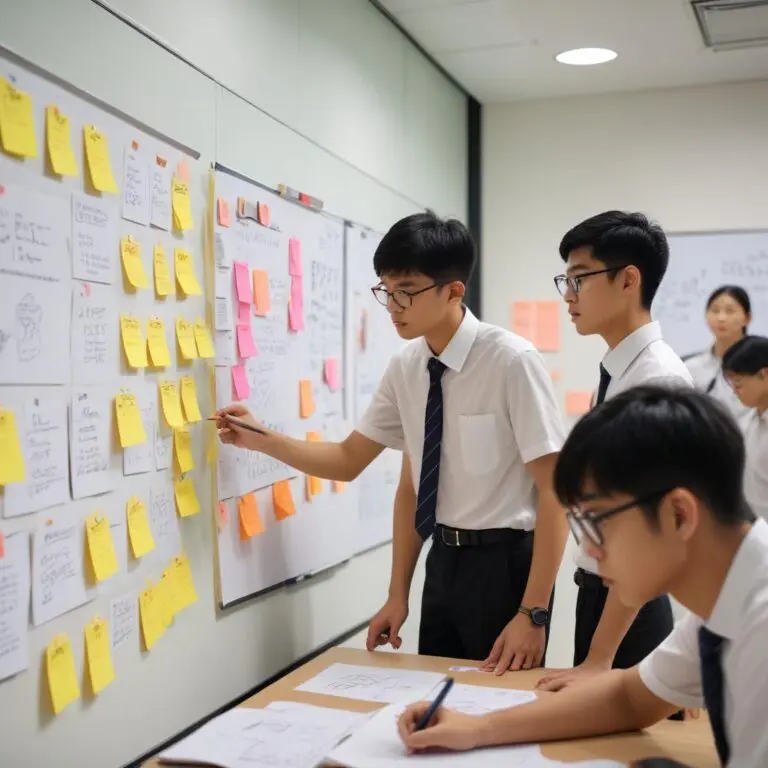





Singapore secondary students who struggle to solve complex problems are often not failing at solutions; they are failing at questions. Problem framing, the ability to define the right problem before attempting to answer it, is where the design thinking process delivers some of its most measurable learning outcomes. Through the Define phase of C-Academy’s EDIT Design Thinking® framework, students develop a skill that underpins not just project work, but lifelong critical thinking and futureproof skills.

1. Why Problem Framing Is the Most Underrated Skill in Secondary Education
Most secondary school assessments reward students for producing correct answers. Very few reward them for asking better questions. This creates a blind spot: students learn to solve the problem in front of them, but rarely pause to ask whether they have identified the right problem in the first place.
In C-Academy’s design thinking workshops with students from schools including Sembawang Secondary and Ngee Ann Secondary, facilitators consistently observe the same pattern at the start of a programme. When given a design challenge, say, improving student well-being on campus, most groups immediately jump to solutions. “Add more rest areas.” “Reduce homework.” They treat the brief as a fixed constraint rather than a starting point for investigation.
This is not a failure of intelligence. It is a failure of framing. Students have been trained, across years of schooling, to move quickly from problem to answer. Design thinking integration into the classroom interrupts that pattern and teaches them to slow down at the question stage.
Why this matters beyond the workshop: The World Economic Forum consistently lists complex problem-solving among the top skills employers will need in the coming decade. MOE’s own 21st Century Competencies framework identifies Adaptive and Inventive Thinking as a core competency, defined as the ability to “reframe problems” and “generate novel solutions.” Problem framing is not a soft skill. It is the entry point to developing real design thinking capabilities.
2. What Problem Framing Actually Means (And What It Is Not)
Problem framing is the process of defining which problem is worth solving, and for whom, before any solution is considered. It is distinct from problem-solving, which begins only after a frame has been established.
A useful way to understand the difference: problem-solving asks “How do we fix this?” Problem framing asks “What is the real issue here, and does fixing what we can see actually address it?”
In C-Academy’s workshops, the Define phase is structured around a specific output: the How Might We (HMW) statement. This is a single sentence that captures the problem space in a way that is specific enough to guide ideation, but open enough to allow creative solutions.
To help students craft meaningful HMW statements, C-Academy uses a structured template that guides them through three essential elements: the intended action (what they are trying to facilitate or change), the primary user (the specific person or group the solution is designed for), and the desired effect (the outcome or emotional shift they want to create for that person). This pedagogical scaffold ensures students do not simply restate the problem, they reframe it with empathy and precision.
A weak HMW statement sounds like: “How might we make the school canteen better?”
A strong HMW statement, shaped by this template, looks like: “How might we facilitate peer connection for lower secondary students who eat alone so that they can feel more comfortable, included, and less isolated during lunch?”
The difference is not just wording. The stronger version reflects genuine empathy data: it names a specific user group, describes an emotional need, and avoids locking in a solution. This level of specificity, achieved through the HMW template, is what the Define phase is designed to develop. It also sets the foundation for the next step: crafting a Value Proposition Statement that turns this problem frame into a clearly articulated solution direction.
What problem framing is not: It is not brainstorming. It is not the same as defining a project scope for a teacher. And it is not a writing exercise. Students who produce a well-framed HMW statement have already done significant analytical work, synthesising observations, identifying patterns in their empathy data, and making judgement calls about what matters most.
3. How the Define Phase of EDIT Design Thinking® Builds This Skill
The EDIT Design Thinking® methodology (Empathise, Define, Ideate, Test) is designed so that each phase builds on the last. By the time students reach Define, they have already conducted first-hand observation and empathy mapping in the Empathise phase. The Define phase then asks them to make sense of everything they have gathered.
C-Academy structures the Define phase across a dedicated session within its four-session Design Thinking Workshop. Students work in small groups, typically five to six, to review their empathy maps and identify recurring themes. During this stage, students first produce Negative Problem Statements, specific, evidence-backed summaries of user frustrations drawn directly from their empathy maps. For example, a student might write: “Buying my own materials is so expensive that I feel stressed because I don’t have the resources to do my project well.” There is no fixed template for these; students are encouraged to capture as many frustrations as they can identify, in their own words, before narrowing down.
After gathering their negative problem statements, the group selects the three problem areas most related to the design goal and crafts three HMW statements using the structured template. Facilitators guide this process with probing questions: “Who is this problem hardest for?” “What surprised you in your observations?” “If you could only fix one thing, what would have the biggest impact on the people you spoke to?”
This guided questioning is deliberate. Kimming Yap, Co-Founder and Managing Director of C-Academy, has observed in school deliveries that “the Define phase is where students first experience genuine cognitive discomfort, and that discomfort is exactly where the learning is. When a group realises their initial problem statement was too vague, and they have to go back to their empathy data to sharpen it, they are doing real analytical work.”
The output, a written HMW statement, serves as the anchor for every subsequent phase. Groups that rush through Define and produce a vague or solution-biased statement consistently struggle in Ideation. Groups that invest time here produce richer, more original ideas.
Practitioner insight from C-Academy’s school deliveries: In sessions with secondary students, groups of five consistently outperform larger groups during the Define phase. Smaller groups can hear every voice during synthesis, reducing the tendency for one strong personality to anchor the frame prematurely. This is a structural decision C-Academy builds into every workshop.
4. What C-Academy Facilitators See in the Classroom: Common Student Struggles and Breakthroughs
Across its work with students from schools including Methodist Girls’ School (Secondary), Hougang Secondary, and Northbrooks Secondary, C-Academy facilitators have documented consistent patterns in how secondary students approach problem framing.
The most common student mistakes:
- Framing the solution as the problem. Students write: “How might we build an app that tracks water usage?”, when the real problem has not yet been defined. This is a solution masquerading as a question; it bypasses the very empathy and user insight the previous phase was designed to produce.
- Framing too broadly. “How might we improve mental health in schools?” is too large to action. Students learn to narrow scope through follow-up questions about specific users and specific moments.
- Ignoring outlier data. During empathy synthesis, students tend to discard observations that do not fit their expected narrative. Facilitators actively surface these anomalies, as they often reveal the most interesting problem angles.
The breakthroughs:
The moment most facilitators describe as the turning point is when a student group returns to their empathy data after producing a weak HMW statement, and finds something they originally dismissed. In one session at Sembawang Secondary, a group working on sustainability habits realised mid-Define that the students they had interviewed were not unaware of environmental problems, they felt powerless to act on them. Reframing from “How might we increase environmental awareness?” to “How might we help students who care about sustainability take meaningful action within their school environment?” transformed the entire direction of their project.
That shift, from surface symptom to underlying need, is the signature skill of strong problem framing, and one that supports students in developing global awareness and civic literacy over time.
5. How Problem-Framing Skills Connect to MOE 21st Century Competencies
MOE’s 21st Century Competencies (21CC) framework identifies Adaptive and Inventive Thinking as a core domain. The framework describes this as the ability to imagine possibilities, make connections across disciplines, and reframe problems to find better solutions. Problem framing sits at the heart of this competency.
When students practise the Define phase of EDIT Design Thinking®, they are demonstrating several 21CC sub-skills simultaneously: synthesising information from multiple sources, making reasoned judgements under ambiguity, and communicating a clear problem position to peers and facilitators. These are also the same skills needed when engaging with multifaceted challenges, from social issues and healthcare services to questions of sustainable lifestyles and sustainable development goals.
For school HODs and VPs designing Applied Learning Programmes (ALP) or Values-In-Action (VIA) projects, the Define phase provides a structured, assessable moment where 21CC competency development can be observed and documented. The HMW statement is itself a visible artefact of thinking that can be assessed, compared across cohorts, and tracked over time. For educators aligning student engagement activities with clear learning objectives, the HMW statement offers a direct, manageable output that reflects meaningful cognitive work.
C-Academy’s pre/post competency surveys, conducted independently from the facilitating team, measure overall design thinking competence across cohorts. The average improvement across schools served is 37%. At Sembawang Secondary, scores moved from 13.5% to 69.5% , a 56% improvement in overall design thinking competence. These gains reflect not just ideation or prototyping, but the full capacity arc, including the ability to define problems well.
6. What School Leaders Can Do to Develop Problem-Framing Capacity Beyond One Workshop
A single design thinking workshop plants the seed, but sustained development requires deliberate design thinking integration into school culture. Here are practical approaches school leaders can implement:
Embed HMW questioning into existing project work. Before students begin any project, whether for a subject assignment, a CCA initiative, or a VIA programme, require them to write a How Might We statement using the structured template: intended action, primary user, and desired effect. This takes five minutes and shifts the cognitive starting point of every project.
Train teachers in facilitative questioning. The key skill is asking “Who is this really for, and what do they actually need?” rather than accepting the first problem definition students offer. This does not require a full design thinking training, even a one-hour briefing on the Define phase changes how teachers run project debrief discussions. Teaching processes that embed this kind of questioning consistently produce more reflective, user-centred student outputs.
Use HMW statements as a formative assessment tool. Compare the quality of HMW statements at the start and end of a programme. Stronger specificity, clearer user focus, and absence of embedded solutions are all assessable indicators of growth in problem-framing skill.
Design the environment for productive friction. Problem framing improves when students are required to defend their frame to peers and facilitators. Build in structured peer review moments where groups must explain why they chose their particular problem angle over alternatives. Exposure to diverse perspectives at this stage consistently produces stronger, more empathetic problem frames.
For schools looking to introduce or strengthen design education as a structured learning experience, C-Academy’s four-session Design Thinking Workshop is designed to develop all of these capacities, with the Define phase as its analytical centrepiece.
7. Connecting Problem Framing to the Value Proposition Design Process
Problem framing is not just a school activity; it is the analytical foundation of professional service design, service innovation, and innovation consulting. When students learn to define specific customer pains and customer gains through empathy mapping, they are using the same rigour found in the value proposition canvas, business model canvas, and broader market research practices.
Whether students are designing products and services, refining a customer journey, or developing a business strategy, the ability to synthesise customer insights into a clear customer profile is fundamental. This is the heart of Alexander Osterwalder’s innovation process, a discipline of design iteration where pain relievers and gain creators are mapped directly to customer jobs and customer requirements.
This process demands rigorous customer research. Students identify a clear customer segment and a defined target audience, conduct thorough customer interviews, and develop genuine customer understanding to build their value map. Without this, solutions fail to meet real customer expectations or address meaningful customer pain points, which is precisely why the HMW statement, with its emphasis on a specific user and a specific desired effect, is such a powerful pedagogical scaffold.
As students develop their problem-framing skills through the design thinking framework, they also build the design thinking capabilities needed to navigate professional contexts, from understanding market demand and business design to applying gain creators and pain relievers as design tools in product development. By the time students reach environments such as business incubators or innovation consulting firms, the habit of rigorous problem framing, grounded in real customer experience, verifiable user feedback, and sound innovation practices, will be one of their most transferable and valuable competencies.