




Singapore HODs choosing between an enrichment programme Singapore schools rely on and an ALP provider face a decision that shapes student development, budget allocation, and MOE reporting obligations for years ahead. The right enrichment programme singapore context is one that delivers a genuine learning experience — not just a scheduled activity. The two pathways are not interchangeable — and picking the wrong one for your school’s context creates friction that is difficult to undo mid-cycle.
1. Why the Enrichment Programme vs ALP Decision Matters for Singapore Schools
Most HODs approach this decision as a procurement question: which provider offers the best programme at the right price? In practice, it is a structural question first. An Applied Learning Programme sits within MOE’s formal curriculum architecture, carries specific reporting requirements, and is expected to demonstrate measurable learning outcomes tied to a subject discipline. An enrichment programme — whether a school programme, educational programme, or one of many enrichment programs available in Singapore — operates outside that structure. It can be scheduled more flexibly, adapted more readily, and evaluated on broader developmental outcomes rather than subject-specific competencies. Programme design matters enormously: the best enrichment programmes are built around clear student development goals, not just content delivery.
The stakes are real. Schools that engage an ALP provider Singapore without fully mapping the MOE requirements often find themselves mid-programme with a vendor who delivers excellent workshops but cannot produce the documentation, outcome data, or curriculum alignment evidence MOE expects. Conversely, schools that route a genuinely ALP-ready programme through enrichment funding miss the opportunity to embed it more deeply into the school’s learning architecture.
C-Academy has worked with students from schools including Sembawang Secondary School and Ngee Ann Secondary School across both school enrichment and ALP-aligned contexts. The consistent finding: schools that clarify the structural question before selecting a provider get significantly more from the engagement — because the provider can design the programme to fit the right framework from the start, rather than retrofitting it later.
What this means for HODs: Before you evaluate any provider, decide which pathway your school is actually pursuing. Everything else — scope, duration, outcomes, budget — follows from that.
2. What MOE Requires From an Applied Learning Programme Provider in Singapore
The Applied Learning Programme under MOE is designed to help students connect academic learning to real-world applications, typically anchored in a specific subject area (Science, Technology, Humanities, or Arts) — including STEAM education disciplines. Government agencies and community organisations often partner with schools to provide authentic contexts for ALP projects, exposing students to emerging technologies and real industry challenges. MOE’s expectations for an ALP provider Singapore include:
- Curriculum alignment. The programme must connect meaningfully to a subject discipline, not sit as a standalone activity. Providers need to demonstrate how their content maps to syllabus outcomes or 21st Century Competencies (21CC).
- Measurable student outcomes. Schools are expected to track and report on student learning. Providers should offer pre/post assessment tools, not just participant feedback forms.
- Sustained engagement. A single workshop does not constitute an ALP. MOE expects programmes that run across multiple sessions, allowing for iterative learning and skill development.
- Qualified facilitation. Facilitators should have relevant professional credentials, not just workshop delivery experience.
What MOE does not prescribe is the specific methodology a provider must use — which is where design thinking-based providers like C-Academy have genuine flexibility. C-Academy’s EDIT Design Thinking® methodology maps directly onto 21CC competencies including Adaptive and Inventive Thinking, Communication, and Collaboration — building critical thinking, problem solving, problem-solving skills, analytical thinking, and communication skills that translate into student achievement and academic excellence across subjects. These are the 21st century skills students need for career readiness and future careers in a complex, rapidly changing world — equipping them to be active contributors to society and the economy. This makes it a credible fit for schools building an ALP around applied problem-solving or innovation.
How do I choose an ALP provider for my secondary school? Start with MOE’s criteria above, then assess whether the provider can produce the documentation and outcome data your school needs for internal review and MOE reporting. A provider who cannot articulate their assessment methodology clearly is a risk.
3. What an Enrichment Class and Enrichment Classes in Singapore Should Deliver
An enrichment programme is not a lesser option — it is simply a different one. Whether delivered as a single enrichment class, a series of enrichment classes, or enrichment courses in a structured after school programme, the best enrichment classes in Singapore offer flexibility that ALP structures do not. For many schools, enrichment is precisely the right fit — especially when the goal is holistic education, co-curricular development, and age-appropriate activities rather than subject-specific curriculum alignment.
A quality enrichment programme — whether from an enrichment center, a school-based provider, or an external specialist — should deliver a comprehensive educational experience that builds both academic and personal capability:
- Clear learning outcomes that are communicated to students and teachers before the programme begins, not just described in a brochure
- Hands-on activities and hands-on experiments that go beyond passive instruction — students should be doing, not just listening
- Experienced instructors whose facilitator expertise is visible in the room: the ability to respond to student thinking in real time, not just follow a script
- Practical skills and transferable capabilities students can apply beyond the programme itself
- Character building outcomes — interpersonal skills, communication skills, and the confidence to present and defend ideas
Enrichment is the right fit when: your school wants to expose a broad cohort to enrichment activities and new skill sets without the reporting obligations of ALP; when you are piloting a methodology before committing to ALP integration; or when the programme goal is student enrichment and developmental (confidence, creativity, interpersonal skills, collaboration) rather than subject-specific. Academic enrichment, learning enrichment, and enrichment learning all fall within this space — and done well, they create enrichment opportunities that shape students for years beyond the programme itself, preparing them with practical skills and confidence for future careers.
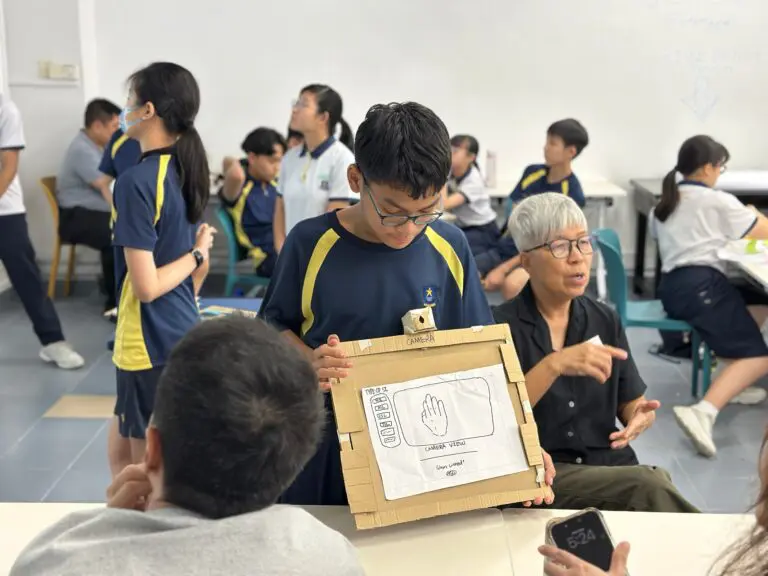
C-Academy’s Let Out Your Creativity design thinking workshop is structured as an enrichment programme — a full Design Thinking Workshop running across at least four sessions, covering Learning Journey, Empathise, Problem Definition, Ideation, Prototyping and Testing, and Final Pitch Presentation. Schools like Hougang Secondary have used this format to introduce design thinking to their student cohorts without the structural constraints of ALP, while still achieving measurable outcomes. C-Academy’s impact data shows an average 37% improvement in overall design thinking competence across cohorts — evidence that enrichment, done well, produces results that stand up to scrutiny.
What is the difference between an enrichment programme and an ALP in Singapore? The core difference is structural: ALP sits within MOE’s formal curriculum framework with subject-discipline alignment and reporting requirements; enrichment operates outside that framework with greater flexibility in scope, scheduling, and outcome focus.
4. The HOD’s Checklist: 10 Questions to Ask Before You Commit
Use this checklist before signing with any ALP provider Singapore or enrichment programme vendor.
On fit and structure:
- 1. Which pathway are we actually pursuing — ALP or enrichment — and does this provider have experience delivering in that context?
- 2. Can the provider map their programme to MOE’s 21CC framework or a specific subject discipline? Ask for the mapping document, not just a verbal assurance.
- 3. How many sessions does the programme run across, and what happens between sessions? A single-day workshop is not a programme.
On outcomes and evidence:
- 4. What does the provider measure, and how? Ask for sample pre/post assessment tools and a summary of outcome data from previous school engagements.
- 5. Can they share outcome data from comparable schools — similar student profile, similar programme scope?
- 6. Who conducts the assessment — the facilitating team, or an independent assessor? Independent assessment produces more credible data.
On delivery quality:
- 7. Who actually delivers the programme? Is it the same team who designed it, or freelancers? Core-team delivery matters for consistency.
- 8. What is the facilitator-to-student ratio, and how does the provider handle mixed-ability groups?
On logistics and accountability:
- 9. What documentation does the provider supply for MOE reporting or internal review?
- 10. What is the escalation process if the programme is not meeting expectations mid-delivery?
5. How Design Thinking Supports Applied Learning and Enrichment Pathways
Design thinking is one of the few methodologies that works credibly in both enrichment and ALP contexts — because it is inherently applied, iterative, and outcome-measurable. It fits naturally into an enrichment curriculum without requiring the structural overhead of ALP, while still delivering comprehensive learning and the kind of enrichment education that produces visible, measurable student achievement. The process itself — moving from empathy and scientific exploration of a real problem through to a tested prototype — is a model of real world application and interdisciplinary approach in action. Students tackle complex challenges, generate innovative solutions, and develop the lifelong learning mindset that both MOE and employers value. This is project based learning at its most applied: students do not study problems in the abstract, they work on them directly.
In an enrichment context, design thinking develops the 21CC competencies MOE identifies as priorities: students learn to empathise with real users, frame problems precisely, generate and test ideas, and present solutions. These are transferable skills with value across every subject and every future career path.
In an ALP context, design thinking can be anchored to a specific discipline — sustainability, community development, technology, or the arts — and structured to produce the curriculum alignment evidence MOE requires. C-Academy’s EDIT Design Thinking® methodology moves through four phases: Empathise, Define, Ideate, and Test. Each phase maps to observable student competencies that can be assessed pre and post programme.
Schools that have worked with C-Academy in an ALP-aligned context have used the EDIT Design Thinking® framework to connect student projects to real community or industry challenges — giving the programme the authentic learning and real world application MOE’s Applied Learning Programme framework is designed to foster. Students engage with applied subjects in a way that builds holistic understanding and civic engagement, preparing them for academic success and beyond.
6. Red Flags to Watch for When Evaluating Any Provider
- No outcome data. Any provider who cannot share pre/post assessment results from previous school engagements is either new to school delivery or not measuring what matters.
- One-day-only delivery. A single workshop, however well-designed, does not constitute a programme. Real skill development requires iteration across sessions.
- Freelancer-dependent delivery. If the person who pitches the programme is not the person who delivers it, quality consistency is at risk.
- Vague curriculum alignment. “We support 21CC” is not a curriculum map. Ask for the specific competencies addressed and how they are assessed.
- No escalation process. Providers who cannot articulate what happens if the programme underperforms mid-delivery are not set up for accountability.
C-Academy’s core team — including facilitators Kimming Yap and Yulia Saksen — delivers all programmes directly. Kimming serves as VP of the Design Business Chamber Singapore and holds advisory roles at NAFA and ITE; Yulia is a Registered Management Consultant with Enterprise Singapore and a WSQ ACLP Trainer. This is the level of practitioner credibility HODs should be looking for.
7. Making the Final Call: A Simple Decision Framework for HODs
| Question | If YES → | If NO → |
| Does your school have an active ALP to fill or build? | Evaluate ALP providers | Consider enrichment first |
| Can you commit to multi-session delivery across a term? | Either pathway works | Enrichment is more flexible |
| Do you need MOE-reportable outcome data? | ALP provider with assessment tools | Quality enrichment with outcome tracking |
| Are you piloting before committing to ALP? | Enrichment programme | — |
| Do you need subject-discipline curriculum alignment? | ALP provider | Enrichment programme |
The decision is not about which option is better — it is about which option fits your school’s current goals, reporting obligations, and student cohort. A well-run enrichment programme from a credible design thinking ALP provider in Singapore will outperform a poorly structured ALP every time.
If you are at the evaluation stage, the most useful next step is a direct conversation with potential providers — not to hear their pitch, but to ask the ten checklist questions above and see how specifically they can answer.