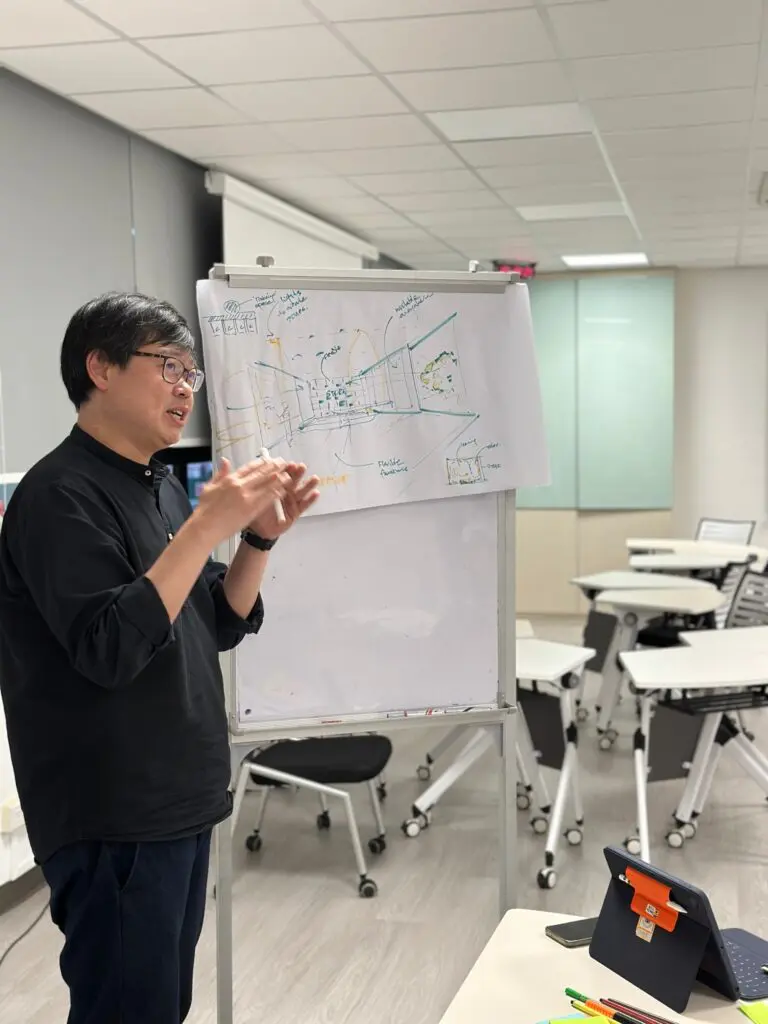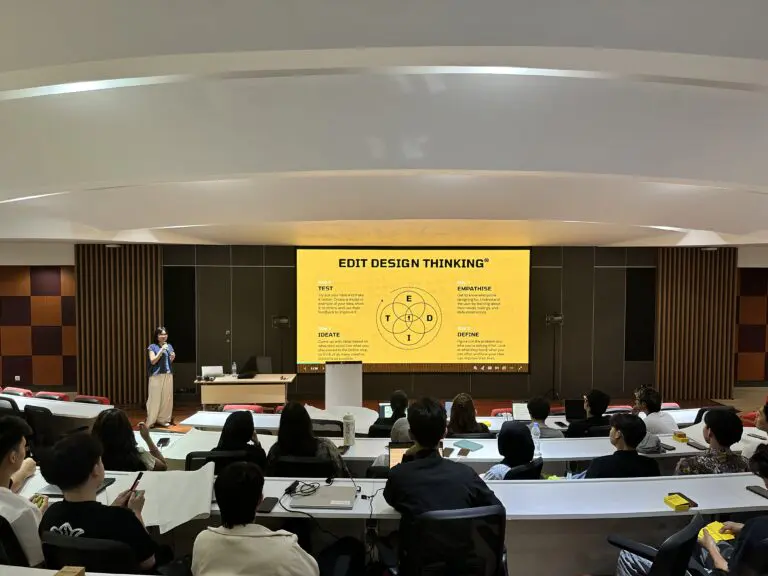





There is a version of design thinking that exists entirely in photographs. Students gathered around whiteboards, colourful sticky notes arranged in grids, arms crossed at the chest in the universal pose of “we are collaborating.” The photos look good in school newsletters. The learning, however, is not always obvious.
C-Academy runs design thinking programmes in Singapore secondary schools — and the most common question from parents, teachers, and students themselves is a version of the same thing: what do they actually learn? Not the activity. The outcome. The skill. The thing that changes how they think.
This article answers that question directly, drawing on C-Academy’s delivery experience across Singapore secondary schools and the pre- and post-programme assessment data collected from students at schools including Sembawang Secondary School and Methodist Girls’ School (Secondary). It is also a practical reference for HODs evaluating which design thinking skills and design thinking capabilities their school’s Applied Learning Programme should prioritise — and for parents and students curious about what a design thinking institute actually delivers beyond the brochure.
—
The Honest Answer: It Depends on the Programme
Not all design thinking programmes produce the same results. A one-day workshop and a six-session structured programme are not equivalent experiences, even if both involve sticky notes and empathy maps. The depth of learning is directly linked to whether the programme is structured to build competency progressively — session by session — or simply to expose students to the design thinking vocabulary.
C-Academy’s programmes are structured as six-stage journeys: Learning Journey, Empathise, Problem Definition, Ideation, Prototyping and Testing, and Final Pitch. Each stage has a specific competency target. Students do not move through activities — they build a skill, practice it on a real challenge, and carry it forward into the next stage. That structure is what produces measurable outcomes rather than memorable moments.
The Ministry of Education’s frameworks for secondary school enrichment — particularly the applied learning programme guidelines and the 21st Century Competencies framework — are built around exactly this kind of progressive skill development. A well-designed design thinking programme is one of the most direct ways to meet those objectives.
With that framing in place, here is what students actually learn.
—
1. How to Observe Without Assuming
The first and most difficult skill in design thinking is suspending what you already think you know about a problem in order to discover what is actually true.
Most secondary school students arrive with strong opinions about the challenges they are given. They have grown up inside those challenges — school life, peer dynamics, community issues — and have accumulated a set of explanations for why things are the way they are. Design thinking begins by treating those explanations as hypotheses, not facts.
In C-Academy’s Empathise stage, students conduct user research with real stakeholders. They observe behaviour, conduct interviews, and use empathy mapping to distinguish between what users say, think, do, and feel. The skill being built is not just research technique — it is the habit of checking assumptions before acting on them.
Kimming Yap, C-Academy’s Managing Director, describes this as one of the most transferable things a student can develop: “Once a student learns to separate what they assume from what they’ve actually observed, that habit shows up everywhere — in how they read a comprehension passage, how they approach a group project, how they navigate a disagreement with a friend.”
This is not a sticky note skill. It is a thinking habit — and it is the foundation everything else is built on.
—
2. How to Frame a Problem (Not Just Identify One)
There is a significant difference between noticing that something is wrong and being able to articulate what the real problem is.
Secondary school students are typically good at the former. Design thinking programmes develop the latter — specifically through the “How Might We” (HMW) method, which is taught during the Problem Definition stage. An HMW statement reframes an observation into an actionable design challenge: not “the school canteen is too crowded” but “How might we help students choose meal times that reduce peak congestion without feeling like a rule?”
The reframe matters because it changes what kinds of solutions are possible. A problem framed as a complaint produces solutions that are essentially complaints with a budget. A problem framed as a design challenge produces solutions that are genuinely useful.
In C-Academy’s programmes, students practise writing and revising HMW statements until they can reliably produce one that is specific enough to act on and open enough to invite creative solutions. This is a higher-order thinking skill — and one that maps directly to the Ministry of Education’s 21st Century Competencies framework under Critical and Inventive Thinking. It is also one of the design thinking capabilities that transfers most visibly to academic work: students who develop strong problem-framing skills write better essays, give better presentations, and navigate group conflict more constructively.
—
3. How to Generate Ideas (Not Just the First Idea)
The default mode for most students when asked to solve a problem is to go with the first idea that comes to mind, then defend it.
Design thinking interrupts this. The Ideation stage in C-Academy’s programmes uses structured tools — including Random Cards and Idea Dice — to push students past their first instincts. The goal is to generate volume and variety before evaluating. Students aim to produce at least 20 ideas before selecting a direction.
This is harder than it sounds. The resistance to generating “bad ideas” is strong in academic settings, where being right is valued over being generative. Part of what the Ideation stage teaches is that the best ideas rarely arrive first — they emerge from the combination and collision of earlier, rougher attempts.
The observable outcome: students who complete this stage are measurably more comfortable with divergent thinking. They generate more ideas, tolerate uncertainty longer, and select directions with more confidence — because they have actually compared options rather than defaulted to the first one. These design thinking skills directly support the kind of inventive, adaptive thinking that Singapore’s future workforce will need to navigate an economy shaped by technology, globalisation, and rapid change.
—
4. How to Build Something Before It Is Perfect
Prototyping is the stage that surprises students most. The instruction — build something that communicates your idea, using whatever is in front of you, in the next 20 minutes — feels wrong to students who have been trained to produce polished work.
The lesson is deliberate. In C-Academy’s Prototyping and Testing stage, students learn that a rough, testable prototype is more valuable than a polished untested one. They build, share with a real or simulated user, collect feedback, and revise. Then they build again.
What this develops is not craft. It is the willingness to make something visible before it is ready — and the confidence that making it visible is how it gets better. That disposition is one of the most consistent findings in C-Academy’s post-programme assessments: students who initially resist prototyping are often the ones who report the greatest shift in how they approach unresolved problems outside of school.
At Sembawang Secondary School, overall design thinking competence — measured across empathy, problem-framing, ideation, and prototyping — rose from 13.5% to 69.5% in a single programme cycle. That 56% improvement reflects real change across all four skill domains, not just exposure to new vocabulary.
—
5. How to Communicate a Solution, Not Just Describe It
The Final Pitch stage is not a presentation exercise. It is a test of whether students can do one specific thing: make another person care about the problem they have solved.
C-Academy teaches students to pitch using the Sweet Spot of Innovation framework — the intersection of user desirability, technical feasibility, and business viability. The pitch is not “here is what we made.” It is “here is the problem, here is who it affects, here is why our solution works, and here is why it is feasible.”
This is a communication skill that directly transfers to oral presentations, project work, and eventually job interviews and professional settings. Students who have completed a C-Academy pitch stage consistently report that the experience changed how they think about persuasion — that making a case for an idea requires evidence, empathy, and structure, not just confidence. For students who may later attend a design education summit, represent their school in competitions, or use an online learning platform for further design studies, this presentation competency is foundational. It also shapes how students engage with any student learning space — physical or digital — where ideas need to be communicated clearly to an audience.
—
What the Data Shows
Across five Singapore secondary schools, C-Academy’s pre- and post-programme assessments — built on DesignSingapore’s Learning by Design metrics — show an average 37% improvement in overall design thinking competence across the four core domains.
The improvements are most consistent in problem framing and ideation fluency. Empathy and prototyping show the widest variation — both are heavily influenced by the design challenge and the school context. Schools that invest time in the frame and scope session with C-Academy before delivery begins tend to produce stronger empathy and prototyping outcomes, because the challenge is more closely tied to something that aligns with student interest and the real issues students encounter in their daily lives.
The least visible outcome in the data — but among the most reported by teachers — is the shift in classroom posture. Students who have completed a design thinking programme are more likely to ask “why” before acting, more comfortable working with incomplete information, and more willing to revise their thinking when new evidence arrives. These are not captured in a competency rubric. But they are what teachers notice first.
—
Why This Matters for the Future Workforce
Design thinking capabilities are not supplementary skills — they are increasingly central to what Singapore employers, polytechnics, and institutes of higher learning look for in young graduates. The ability to understand a user’s real problem, reframe challenges constructively, generate novel solutions, and communicate them persuasively is not a niche creative skill. It is a general-purpose problem-solving method that applies across industries and disciplines.
The Ministry of Education’s emphasis on applied learning, future workforce readiness, and the development of inventive thinkers reflects this shift. Design education at the secondary level — when done well — plants the seeds for exactly the kind of adaptive, empathetic, solutions-oriented graduates that Singapore needs. C-Academy’s programmes are designed with this longer horizon in mind, not just the workshop hour.
—
The Sticky Notes Were Never the Point
Design thinking tools — empathy maps, HMW statements, Random Cards, prototypes — are scaffolds. They are temporary structures that help students practise a skill until the skill becomes habitual. The sticky notes are a means to an end.
What students actually leave a C-Academy design thinking programme with is a set of thinking habits: observe before assuming, frame before solving, generate before selecting, build before perfecting, communicate with evidence. These habits do not expire when the workshop ends. They show up in how students approach group projects, oral presentations, community challenges, and eventually careers.
That is what is worth measuring. And it is what C-Academy is built to deliver.