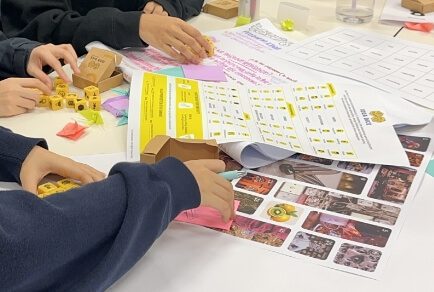










Secondary school students are growing up in a world where many of the problems they will face do not have one correct answer.
Issues such as artificial intelligence, sustainability, digital well-being, social inclusion and the future of work are complex. Students must learn how to understand different perspectives, navigate uncertainty, collaborate with others and turn ideas into practical action.
This is where design thinking for secondary schools in Singapore can make a meaningful difference.
Design thinking gives students a structured but flexible way to approach real-world challenges. Instead of immediately jumping to a solution, they learn to understand the people affected by a problem, question their assumptions, generate different possibilities, create prototypes and improve their ideas through feedback.
More importantly, students discover that creativity is not simply an artistic talent. It is a practical capability that can be developed through observation, empathy, experimentation and reflection.
What Is Design Thinking?
Design thinking is a human-centred approach to problem-solving.
It begins by understanding the experiences, behaviours and needs of the people affected by a challenge. Students then define the underlying problem, explore possible responses, build simple prototypes and test their ideas with others.
A typical design thinking process includes:
- Empathising with users and understanding their experiences
- Defining the real problem that needs to be addressed
- Ideating and generating multiple possible solutions
- Prototyping selected ideas in a simple, tangible form
- Testing the solutions and improving them through feedback
Unlike conventional exercises where students are given a fixed question and expected answer, a design thinking challenge is often open-ended.
For example, students may be asked:
- How might we make the school library more welcoming to different types of learners?
- How might we reduce food waste in the school canteen?
- How might we encourage healthier digital habits among teenagers?
- How might we help new students feel a stronger sense of belonging?
- How might we make learning spaces more inclusive and collaborative?
Students are not simply asked to discuss these issues. They investigate them, speak to relevant users, identify patterns and create possible solutions.
Why Design Thinking Matters in Secondary Education
The secondary school years are an important period of development.
Students are becoming more independent, forming stronger personal identities and encountering more complex academic and social situations. At the same time, they may still hesitate to share unconventional ideas, question assumptions or take creative risks.
A well-facilitated design thinking programme creates a safe structure for students to practise these behaviours.
It turns abstract issues into tangible challenges
Students may understand broad concepts such as sustainability, inclusion or cyber wellness, but struggle to see how they can personally contribute.
Design thinking helps them translate a large issue into a challenge they can observe and act on.
Instead of discussing sustainability only as a global topic, students might investigate why recycling bins in their school are being used incorrectly. They can observe behaviour, interview students and cleaners, identify barriers and test solutions such as clearer signs, redesigned bin placements or peer-led campaigns.
The issue becomes immediate, relevant and actionable.
It teaches students how to work with uncertainty
Many school assignments reward accuracy and correct answers. Real-world problems are different.
Students may begin with incomplete information. Their first idea may not work. Feedback may reveal that they misunderstood the problem.
Through design thinking, students learn that uncertainty does not mean failure. It means there is more to discover.
This can help students become more adaptable and willing to revise their thinking rather than becoming attached to their first answer.
It gives students a stronger sense of ownership
Young people are more likely to engage with a project when they understand why it matters and feel that their voices are taken seriously.
Design thinking allows students to investigate issues connected to their own school, community or daily lives. They become active contributors rather than passive recipients of information.
Even when a prototype is not implemented immediately, students can see how their observations, choices and ideas contributed to a meaningful outcome.
It makes collaboration purposeful
Group work does not automatically develop collaboration.
In some projects, one confident student makes most of the decisions while others complete assigned tasks. Design thinking requires a more deliberate form of teamwork.
Students must listen to interview findings, compare observations, build on one another’s ideas, negotiate priorities and make decisions together. Different strengths become useful at different stages of the process.
A quieter student may notice an important user behaviour. A visual thinker may help communicate the idea. A practical team member may identify implementation challenges. A confident speaker may present the final proposal.
How Design Thinking Supports Singapore’s Education Priorities
Design thinking is especially relevant to Singapore schools because it can support broader learning goals without becoming another examinable subject.
Developing Emerging 21st Century Competencies
Singapore’s Ministry of Education identifies three groups of Emerging 21st Century Competencies:
- Critical, Adaptive and Inventive Thinking
- Communication, Collaboration and Information Skills
- Civic, Global and Cross-Cultural Literacy
These competencies are intended to help students thrive in increasingly digitalised, interconnected and rapidly changing environments.
Design thinking gives students opportunities to practise these competencies within one connected learning experience.
They apply critical thinking when identifying the causes of a problem. They use inventive thinking when generating possibilities. They practise communication and collaboration during interviews, group discussions, prototype development and presentations.
When challenges involve communities or people with different needs, students also learn to consider perspectives beyond their own.
Supporting the Applied Learning Programme
The Applied Learning Programme helps secondary school students connect academic knowledge and skills with real-world contexts. MOE describes it as non-examinable learning that emphasises the practical application of knowledge and thinking skills in authentic settings.
Design thinking can provide a useful problem-solving approach within an ALP because it connects investigation, creativity, experimentation and practical application.
In a February 2026 parliamentary response, MOE specifically identified design thinking as one of the approaches schools may use within the ALP. It noted that students can develop collaboration, critical and inventive thinking, civic literacy and interpersonal skills while defining problems and generating solutions. MOE also reported that about one-third of schools had participated in externally partnered design challenges.
This does not mean every design thinking workshop automatically fulfils an ALP objective. The challenge, activities and outcomes must still be designed around the school’s intended learning goals.
Extending CCE and Values in Action
Design thinking can also complement Character and Citizenship Education and Values in Action by helping students move from discussing an issue to designing a response.
CCE develops values and social-emotional competencies through areas such as identity, relationships, choices, cyber wellness, mental health and National Education. It is delivered not only through dedicated lessons but also through student development experiences and school-based initiatives.
For instance, students exploring inclusion can interview peers about moments when they felt excluded. Students examining cyber wellness can investigate the pressures behind excessive screen use or harmful online behaviour.
They can then design interventions based on actual needs rather than creating a generic awareness poster.
Design thinking should not replace the reflection, service and values-based components of CCE or VIA. It can strengthen them by giving students a practical process for turning empathy into action.
Six Skills Students Build Through Design Thinking
1. Empathy
Empathy is more than feeling sorry for another person. It requires students to listen carefully, recognise different perspectives and understand why people behave in certain ways.
During a design thinking project, students may conduct interviews, observe a space or map a user’s experience. They learn to separate their assumptions from what people actually say and do.
This helps them design solutions that are relevant to real needs.
2. Problem framing
Students often want to solve the first problem they notice.
Design thinking encourages them to investigate more deeply.
A complaint that “students do not use the reading corner” may initially appear to be a furniture problem. Research may reveal that students find the area too exposed, too noisy or associated only with compulsory reading.
By reframing the problem, students can develop more appropriate solutions.
3. Creative confidence
Some students believe they are not creative because they cannot draw well or immediately produce original ideas.
Structured ideation activities show them that creativity can be practised.
Prompts, random stimuli, visual tools and rapid idea-generation exercises help students move beyond their first response. The aim is initially to produce possibilities without judging every idea too early.
Students then learn how to compare, combine and strengthen those ideas.
4. Collaboration
Design thinking makes thinking visible.
Students place observations, insights and ideas where the team can review them. This reduces reliance on one dominant voice and allows the group to build on shared information.
They also learn that disagreement can be productive when it is focused on improving the solution rather than winning an argument.
5. Communication
Students communicate throughout the entire process.
They ask interview questions, explain observations, present ideas visually, gather feedback and pitch their final proposal.
They must adapt their message to different audiences, from classmates and teachers to school leaders or external partners.
6. Resilience through iteration
A prototype is not expected to be perfect.
Its purpose is to help students learn what works, what is confusing and what needs to change. This lowers the fear associated with making mistakes.
Students experience feedback as part of development rather than as a final judgement of their ability.
What a Secondary School Design Thinking Programme Can Look Like
A strong programme should involve more than a presentation about design thinking terminology.
Students need time to apply the process to a meaningful challenge.
Stage 1: Introduce the challenge
The programme begins with a focused challenge connected to the students’ experiences or the school’s priorities.
A good challenge is broad enough to allow creativity but specific enough to guide research.
“Improve the school” is too vague.
“How might we make shared learning spaces more supportive of both focused study and group collaboration?” gives students a clearer context, users and purpose.
Stage 2: Build real-world understanding
Students explore the setting in which the challenge exists.
This may involve:
- Observing behaviour in a school or community space
- Conducting interviews
- Going on a learning journey
- Speaking to subject-matter experts
- Reviewing existing systems or initiatives
- Documenting points of difficulty or frustration
External partners can make this stage particularly meaningful by exposing students to experiences beyond the classroom.
Stage 3: Empathise with users
Students organise their research using tools such as empathy maps, interview summaries, user profiles or experience journeys.
They look for recurring needs, motivations and tensions.
The facilitator helps students move beyond superficial findings. For example, “students want more seats” is an observation. The deeper insight may be that students need informal spaces where they can connect without feeling that they are disturbing others.
Stage 4: Define the problem
Teams decide which user and need they want to address.
They may create a “How might we” question to guide the next stage.
A useful question is not so narrow that it already suggests one solution, and not so broad that students do not know where to begin.
Stage 5: Generate and select ideas
Students use divergent thinking to generate many possibilities before evaluating them.
They can then group related ideas and assess them using criteria such as:
- Relevance to the user
- Potential impact
- Feasibility
- Originality
- Available time and resources
- Alignment with the challenge
The strongest concept may combine elements from several earlier ideas.
Stage 6: Prototype
Students turn an idea into something that others can understand and respond to.
A prototype does not need to be expensive or technically advanced. It might be:
- A paper interface
- A cardboard model
- A storyboard
- A role-play
- A service journey
- A campaign mock-up
- A redesigned floor plan
- A simple digital screen
- A pilot activity
The prototype should be detailed enough to test an important assumption.
Stage 7: Test and improve
Students share the prototype with intended users and gather feedback.
Rather than asking only, “Do you like it?”, they observe how people interact with the concept and ask what is useful, unclear or missing.
Teams then decide what to retain, revise or remove.
Stage 8: Present and reflect
At the end of the programme, students explain both their solution and the process that led to it.
A final showcase can include teachers, school leaders, peers, parents or external partners.
Reflection should cover what students learnt about the users, how their thinking changed, what they would improve and how the idea could be taken forward.
Design Thinking Challenge Themes for Secondary Schools
Reimagining learning spaces
Students can investigate how classrooms, libraries, study areas and shared spaces support different learning needs.
Possible challenges include improving concentration, encouraging collaboration, increasing accessibility or creating a stronger sense of belonging.
Sustainability
Students can explore waste, energy consumption, food practices, recycling behaviour, biodiversity or the use of school resources.
The strongest projects go beyond environmental awareness and examine why current behaviours continue.
Cyber wellness
A design thinking workshop can help students explore digital habits from a user-centred perspective.
Students might investigate online comparison, excessive device use, misinformation, cyberbullying or the pressure to remain constantly connected.
MOE’s Cyber Wellness curriculum emphasises balanced technology use, positive online identities, respectful online relationships and responsible digital citizenship.
School and community well-being
Students can design ideas that strengthen peer support, inclusion, mental well-being or connections between different groups.
They might focus on students entering Secondary One, classmates who feel isolated or people who face barriers when using a particular space or service.
Culture and heritage
Students can investigate how local stories, traditions and community memories might be communicated to younger audiences.
Outputs could include interactive experiences, exhibitions, campaigns, installations or digital storytelling concepts.
Human futures and artificial intelligence
Students can examine how AI may affect learning, relationships, creativity and future careers.
Instead of treating technology as automatically positive or negative, they learn to identify human needs and consider how innovation can be used responsibly.
Choosing the Right Programme Format
The right format depends on what the school wants students to experience and produce.
Half-day introduction
A half-day design thinking workshop is suitable for exposure, leadership programmes, camps or post-examination enrichment.
Students can experience a compressed version of the process through a small challenge, rapid ideation and simple prototyping.
The limitation is that there is less time for user research and iteration.
One-day design sprint
A full-day programme allows students to complete an end-to-end challenge with greater depth.
It can work well as an introduction to an ALP, project-based learning experience or student innovation initiative.
Multi-session learning journey
A multi-session programme provides more time for research, learning journeys, external partnerships, prototype development and testing.
Students can revisit their assumptions between sessions and create more developed proposals.
This format is more appropriate when the school expects sustained competency development or wants students to address a real school or community challenge.
Educator development
Schools that want to sustain design thinking beyond one student workshop can include teacher facilitation or train-the-trainer sessions.
Educators can learn how to frame challenges, facilitate discussions, manage ideation, guide prototype testing and adapt tools for their own subjects.
How Should Schools Assess Design Thinking?
A design thinking programme should not be evaluated only by how attractive the final prototypes look.
The learning process is equally important.
Schools can assess students using criteria such as:
- Quality of observation and research
- Ability to understand different user perspectives
- Clarity of the problem definition
- Range and relevance of ideas
- Evidence used when selecting a concept
- Willingness to respond to feedback
- Team participation and collaboration
- Ability to explain decisions
- Quality of reflection
- Potential for implementation or further testing
Pre- and post-programme reflections can also help schools understand changes in students’ confidence, empathy, collaboration and problem-solving awareness.
What to Look for in a Design Thinking Workshop Provider
Not every creative activity is a complete design thinking programme.
When evaluating providers, schools should consider whether the programme includes:
A real and relevant challenge
The project should connect with students’ lives, school priorities or an authentic external context.
Age-appropriate scaffolding
Lower-secondary students may need more structured prompts and examples. Older students may be ready for greater research independence and more ambiguous challenges.
Experienced facilitation
Facilitators should be able to guide inquiry without deciding the solution for students.
They must also know how to encourage quieter participants, manage dominant voices and help teams move beyond superficial ideas.
Practical tools and materials
Worksheets and creative tools should clarify the thinking process rather than become activities completed for their own sake.
Opportunities for feedback
Prototyping without testing limits the learning. Students should receive feedback from peers, teachers, relevant users or external partners whenever possible.
Clear learning outcomes
The provider should explain what students will understand, practise and produce by the end of the engagement.
A continuation pathway
Schools should know what can happen after the final presentation. This might include a pilot, further testing, teacher follow-up materials or a student implementation team.
How C-Academy Brings Design Thinking into Secondary Schools
C-Academy delivers practitioner-led design thinking programmes for schools using the EDIT Design Thinking® methodology.
EDIT guides students through four connected stages:
- Empathise: Understand users through observation, interaction and research
- Define: Identify patterns and frame the core problem
- Ideate: Generate, develop and prototype possible solutions
- Test: Gather feedback, refine ideas and improve the original point of view
Programmes can be customised according to the school’s student profile, learning objectives, cohort size, schedule and chosen theme.
Depending on the project, students may work on challenges related to community, culture, cyber wellness, sustainability, learning environments, artificial intelligence or immersive experiences.
C-Academy’s programmes are led by practising consultants and supported by a network of community, industry and educational partners. Students are introduced not only to design thinking tools but also to the realities of solving problems beyond the classroom.
Across its 2024–2025 programmes involving more than 300 students from five Singapore secondary schools, C-Academy reported an average competency improvement of 37 percentage points. Empathy scores increased from 44% to 78% based on pre- and post-programme competency rubrics.
Individual projects have included:
- Reimagining student-centred classrooms
- Transforming a school library into a more inclusive community hub
- Designing ideas for a cleaner and greener campus
- Exploring conservation through a learning journey
- Developing solutions around school well-being and shared spaces
These projects demonstrate that design thinking is not limited to product design. It can be used to improve services, behaviours, environments, experiences and relationships.
Frequently Asked Questions
Which secondary school levels are suitable for design thinking?
Design thinking can be adapted for students from Secondary One to Secondary Five.
Younger students usually benefit from shorter challenges, more visible examples and guided research tools. Upper-secondary students can manage more complex stakeholders, independent research and implementation planning.
Do students need an art or design background?
No. Design thinking is a problem-solving process, not an art class.
Students may sketch or create visual prototypes, but they are assessed on how well they understand the challenge, respond to users and develop their ideas—not on drawing ability.
How long should a design thinking programme be?
A half-day workshop can provide an introduction, while a one-day sprint allows students to complete a simplified process.
For deeper learning, a multi-session programme gives students more time to conduct research, test prototypes and respond to feedback.
Can design thinking be conducted for a large cohort?
Yes, but large-cohort programmes require careful planning.
Students should work in smaller teams with clear activity instructions, suitable facilitator support, shared materials and structured checkpoints. The programme may also be delivered across multiple classes or days.
What do students produce at the end?
Depending on the challenge, students may produce physical models, service concepts, storyboards, campaign ideas, redesigned spaces, digital mock-ups, role-plays or implementation proposals.
They should also be able to explain the user need, research findings, decisions and feedback behind their concept.
Can design thinking support ALP, CCE or VIA?
Yes, when the challenge and learning outcomes are intentionally aligned.
Design thinking can support authentic problem-solving within ALP, help students develop empathy and civic awareness within CCE-related themes, and strengthen the investigation and solution-development stages of VIA projects.
It should be customised to complement the school’s existing programme rather than treated as a standalone activity with no connection to wider learning.
How can schools continue the learning after the workshop?
Schools can select promising ideas for further testing, appoint student implementation teams, integrate selected tools into subject lessons or train educators to facilitate future challenges.
The greatest long-term value comes when students encounter the design thinking mindset repeatedly rather than only once.
Preparing Students to Create Meaningful Change
The purpose of design thinking is not to turn every secondary school student into a professional designer.
It is to help students become more observant, empathetic, resourceful and confident when facing unfamiliar problems.
They learn to ask better questions before proposing answers. They discover that meaningful ideas begin with understanding people. They experience how feedback can improve rather than diminish their work.
Most importantly, students realise that they do not need to wait until adulthood to contribute.
With the right process, guidance and opportunities, they can begin designing positive change within their schools and communities today.
C-Academy works with secondary schools in Singapore to create customised design thinking workshops and multi-session learning journeys based on each school’s priorities, students and intended outcomes.
Share your school’s objectives with C-Academy to request a tailored programme proposal.