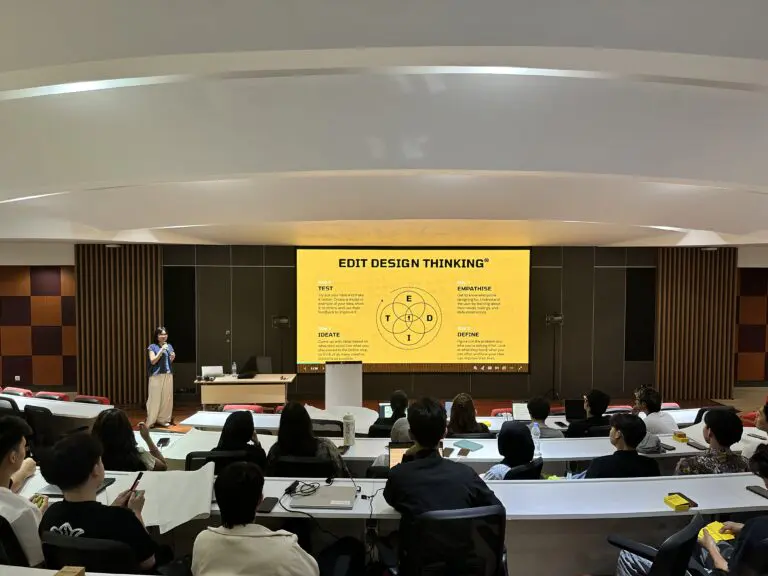





Singapore secondary schools exploring design thinking programmes often encounter a crowded market of frameworks adapted from corporate innovation labs, business schools, and Silicon Valley product teams. Most were never designed with a 14-year-old student, a 70-minute lesson block, or an MOE school calendar in mind. EDIT Design Thinking® is C-Academy’s proprietary methodology, built specifically for Singapore secondary schools and grounded in seven years of direct delivery across secondary school programmes. This article unpacks how the methodology works, what makes it structurally different from generic frameworks, and what real outcomes schools have seen when it is applied well.
1. Why Design Thinking Needs to Be Built for the School Context
The dominant design thinking models in circulation — Stanford d.school’s 5-stage process, IDEO’s human-centred design framework, and the Double Diamond developed by the UK Design Council — were each created for adult practitioners working in professional or higher education settings. They are well-established, widely used, and genuinely effective in the contexts for which they were designed. The point is not that these frameworks are flawed; it is simply that adapting them to a secondary school environment requires considerable effort, and the fit is rarely seamless.
When applied to secondary school settings, some structural mismatches tend to emerge. These frameworks often assume participants have prior experience with ambiguous, open-ended problem spaces — including what practitioners call wicked problems, challenges that resist simple, linear solutions. Secondary school students, particularly at Sec 1 and Sec 2 level, are accustomed to problems with defined correct answers. Moving them into a fully open empathy-to-prototype journey without careful scaffolding produces confusion rather than creative confidence.
Most frameworks were also designed for immersive sprint formats — three days, a full week, a semester-long elective. Singapore secondary schools operate within tightly structured timetables. Applied Learning Programme (ALP) slots, form teacher guidance periods, and enrichment cohort hours must be planned around national examinations, SYF commitments, and school-wide event calendars. A framework that cannot function within a 4-session minimum structure, spaced across a term, is not a practical option for most HODs.
There is also a subtler challenge: many frameworks conflate the ideation phase with the creative output phase, skipping the critical work of problem definition. Students end up generating ideas for the wrong problem, then losing confidence when their solutions feel disconnected from reality. The facilitator challenge in a school setting is not unlocking creativity; it is building the rigour to frame a meaningful problem before ideation begins.
This is precisely the context in which EDIT Design Thinking® was developed — not as a critique of other models, but as a methodology purpose-built for Singapore secondary school students, their timetables, and their learning needs. What is the design thinking process and how is it used in Singapore schools? At its most useful, it is a structured innovation process for solving real human problems — not a creativity exercise. The distinction matters enormously for how it is facilitated with students. Understanding why design thinking works in a school context begins with recognising that its value lies in the rigour of its structure, not simply in the openness of its brief.
2. What EDIT Design Thinking® Is — and How It Differs From Other Models
C-Academy’s EDIT Design Thinking® methodology moves through four phases: Empathise → Define → Ideate → Test. The acronym is deliberate — each letter maps to a phase, and the sequence is non-negotiable. Unlike some frameworks that present their stages as iterative loops students can enter at any point, EDIT Design Thinking® is intentionally linear in its early stages, for a specific pedagogical reason: students who have not done deep empathy work cannot define a meaningful problem, and students who have not defined a meaningful problem produce unfocused ideas.
What are the phases of design thinking in the EDIT approach? They are Empathise, Define, Ideate, and Test — four stages of design thinking that build directly on one another, each producing a defined output that feeds into the next. As a human-centered design approach, EDIT Design Thinking® places genuine understanding of user needs at the start of every programme, before any solution thinking begins.
What makes EDIT Design Thinking® distinctively suited to Singapore secondary schools is this combination of structural clarity and pedagogical intentionality. The four-phase sequence is designed to mirror how students actually build understanding: from observation to insight, from insight to problem framing, and from problem framing to solution generation. Each phase has a defined output that feeds directly into the next, which means students always know what they are working towards and why.
The pedagogical reasoning behind the linear structure is grounded in C-Academy’s seven years of school delivery. Students in early secondary are not yet practised at holding ambiguity across multiple open phases simultaneously. By making the sequence clear and each phase’s purpose explicit, EDIT Design Thinking® reduces cognitive overload and allows students to focus their energy on the thinking required at each step — rather than on navigating an unfamiliar process.
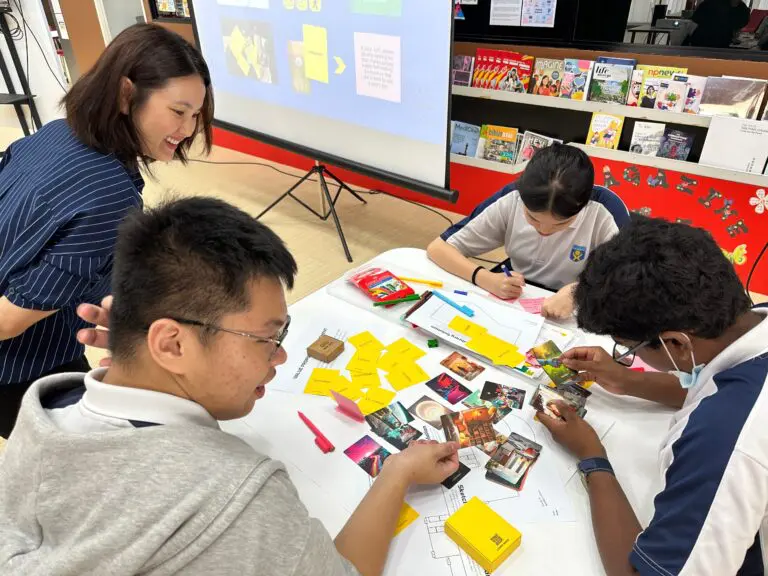
A concrete example illustrates this well. In a programme delivered at Ngee Ann Secondary School, students were working on a sustainability challenge related to food waste in their community. During the Empathise phase, they interviewed canteen vendors and observed lunchtime behaviour. The Define phase then required them to synthesise these observations into a precise “How Might We” statement — a step that, without the EDIT Design Thinking® scaffolding, students consistently attempted to skip in favour of jumping to solutions. With the structured problem-framing tools C-Academy provides, the cohort produced HMW statements specific enough to generate genuinely actionable ideas in the Ideate phase. The linear structure was not a constraint; it was what made the creative work possible.
One notable design decision: EDIT Design Thinking® integrates prototyping within the Test phase rather than treating it as a standalone stage. This is not a simplification — it reflects a deliberate choice to keep students focused on the purpose of building (to test an assumption) rather than the craft of building. In C-Academy’s delivery experience, when prototyping is elevated to its own stage, students invest disproportionate effort in aesthetic finish at the expense of learning.
3. How Each Phase of EDIT Design Thinking® Works in a Real School Programme
Understanding the design thinking process on paper is different from seeing how each phase functions under real school conditions. Here is what each phase involves in C-Academy’s facilitated programmes.
Empathise
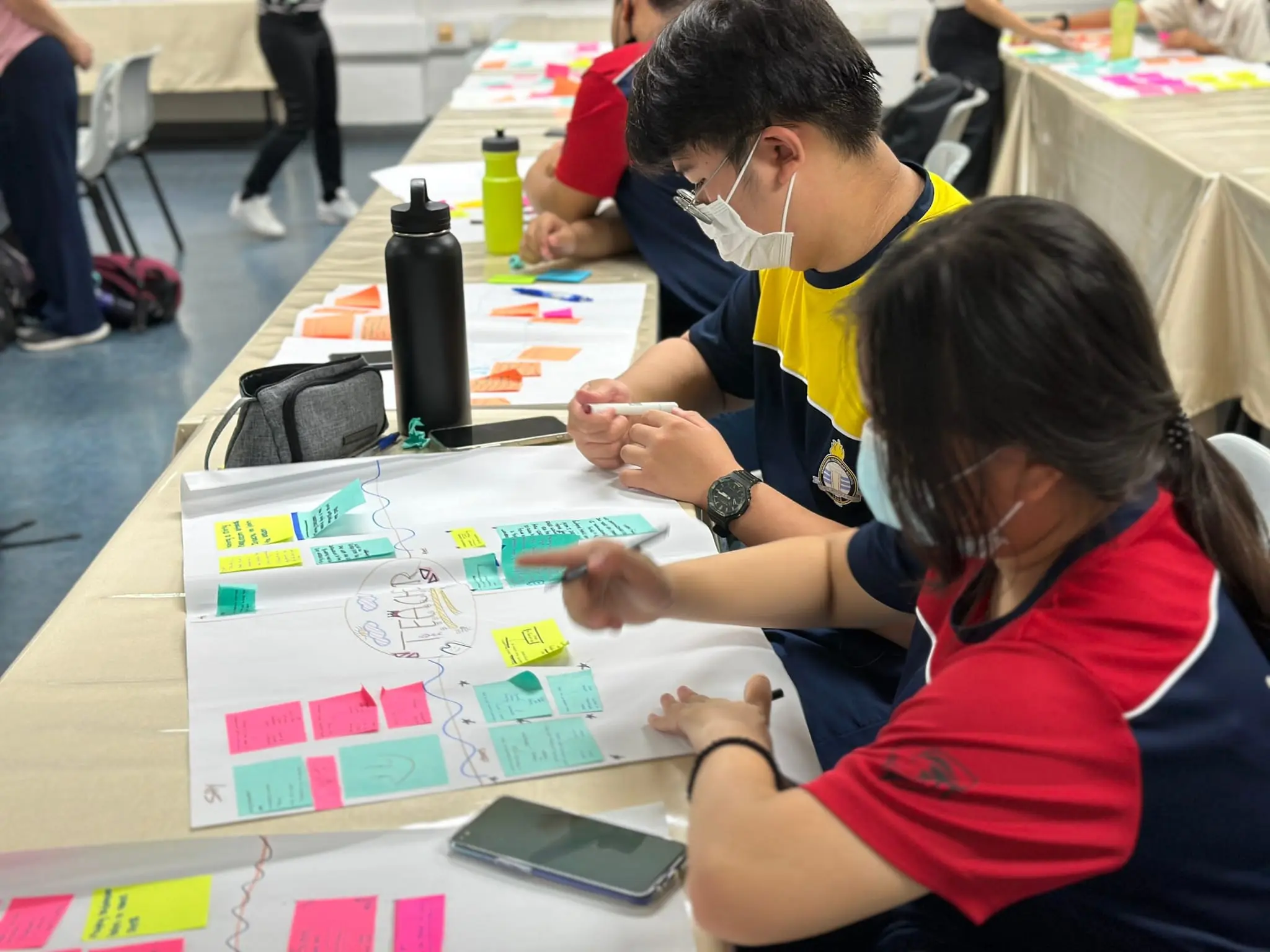
At Methodist Girls’ School (Secondary), students were tasked with reimagining the classroom experience. Even though they were designing as users themselves, the empathy phase pushed them to step outside their own perspective — interviewing both fellow students and teachers to uncover needs and frustrations they had never considered from another point of view. Journey mapping is used to help students trace how a user moves through a specific experience, making it easier to identify moments where friction or unmet user needs arise. C-Academy facilitators guide students through active listening techniques and observation frameworks, with the goal of returning from field engagement with raw insight rather than assumed problems.
Define
The Define phase is where most non-specialist facilitators lose students. Translating messy empathy data — scattered observations, contradictory user statements, emotional responses — into a precise, actionable “How Might We” (HMW) statement is genuinely difficult. At Northbrook Secondary, students brought their empathy maps into the Define phase and worked through the messy process of identifying the real problem beneath what they had observed. Rather than jumping to solutions, they used guided problem-framing to surface negative problem statements and turn them into precise How Might We questions — the foundation everything else builds on. Students learn to distinguish between symptoms (what they observed) and root causes (why it is happening), and to write an HMW statement narrow enough to act on but open enough to generate multiple solutions.
Ideate
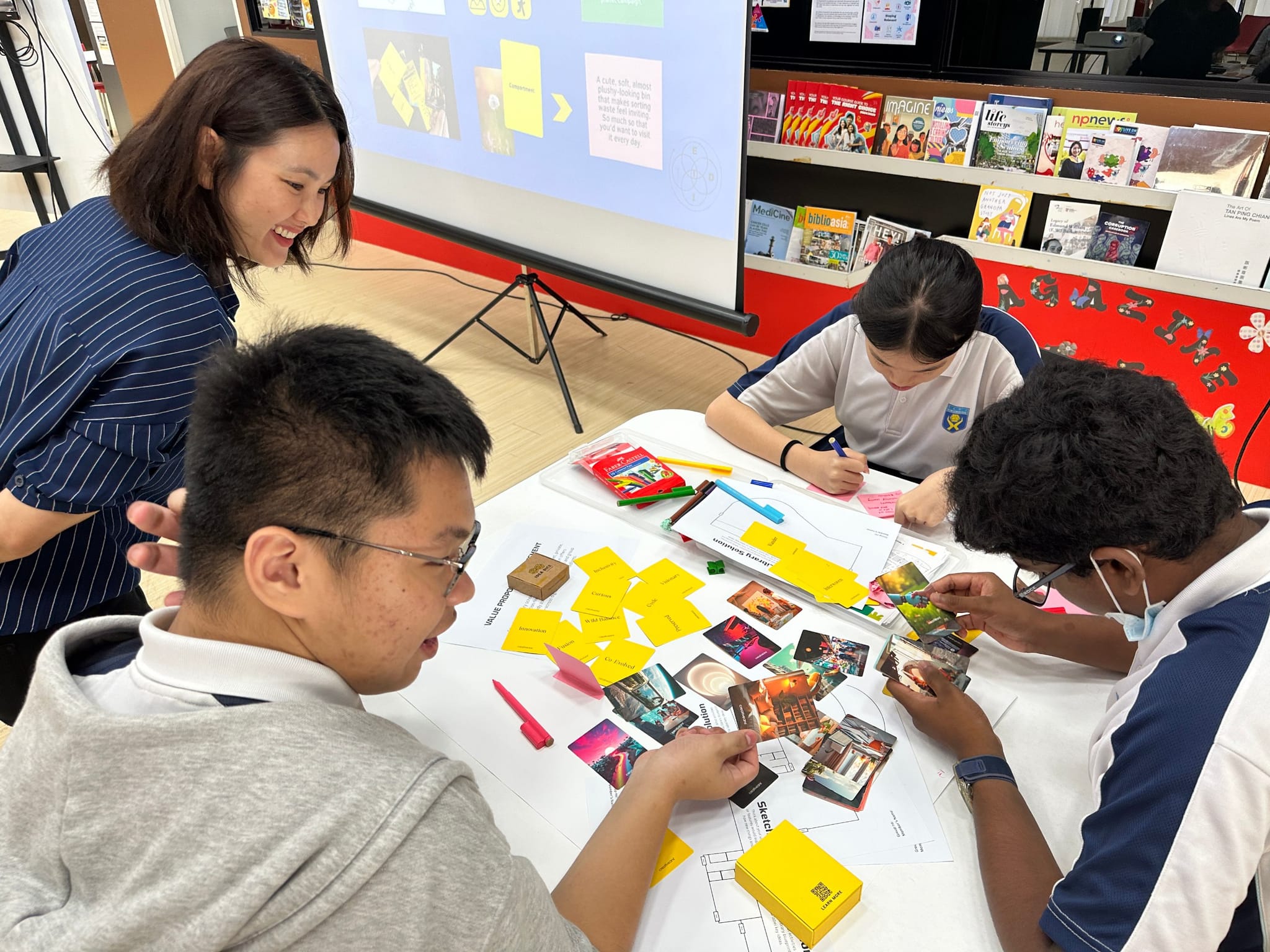
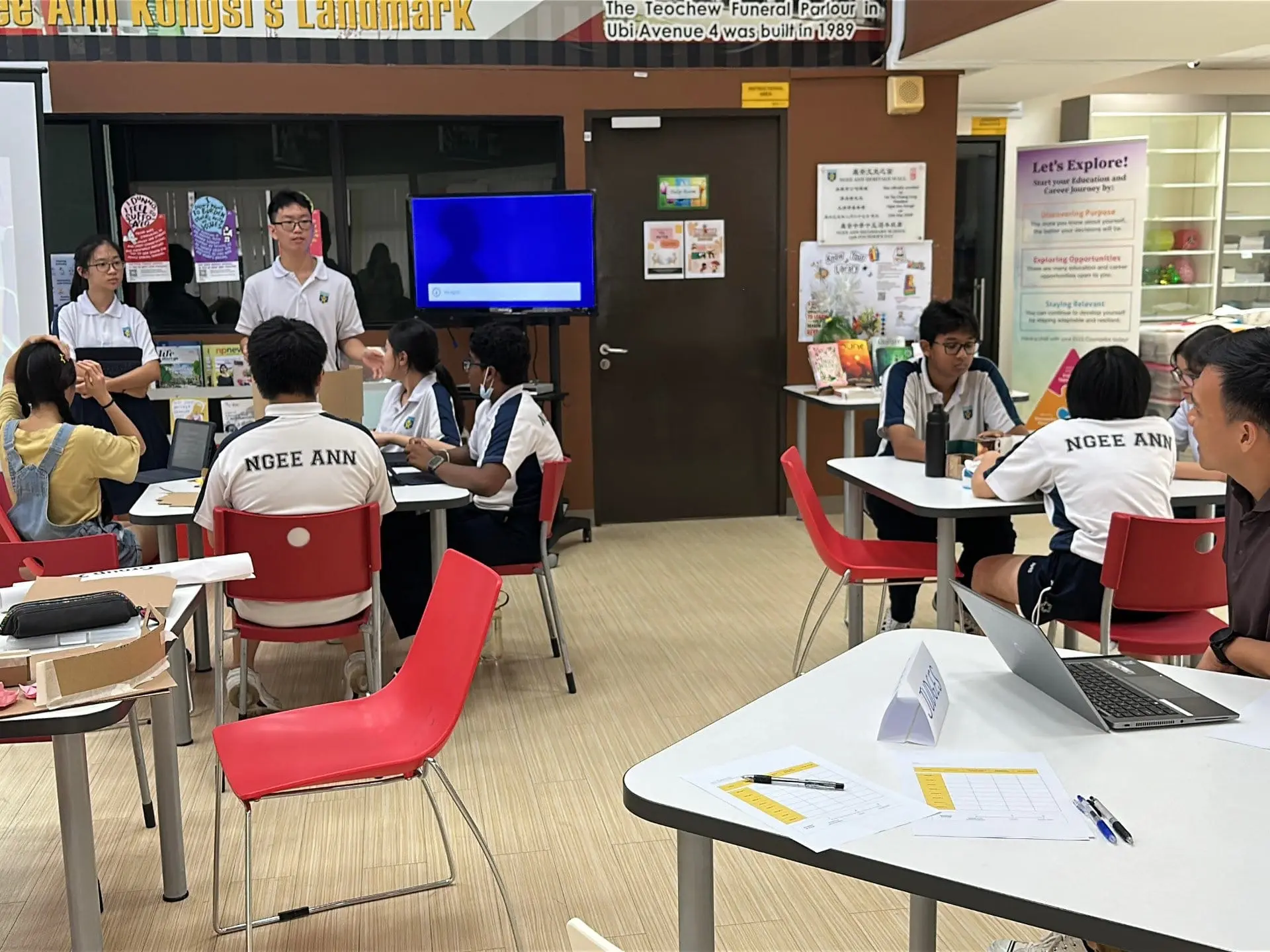
With a defined HMW statement, ideation becomes focused rather than scattered. The Ideate phase explicitly develops both divergent thinking — generating a wide range of possibilities without immediate judgement — and convergent thinking, the disciplined process of evaluating and narrowing those possibilities towards the most promising directions. Together, these two modes of creative problem solving are what separate structured design thinking from open brainstorming. At Ngee Ann Secondary, students used C-Academy’s Random Cards and Idea Dice to move through rapid idea generation, then applied the Sweet Spot of Innovation framework to filter for ideas that were desirable, feasible, and viable — all within a single workshop session. In half-day sprint observations, C-Academy facilitators have found that groups of five generate more implementable ideas than groups of eight, because accountability for contributing is more evenly distributed. Groups larger than six tend to develop a passive audience within the team.
Test
The Test phase in EDIT Design Thinking® encompasses both rapid prototype and test cycles alongside structured feedback collection. Students build a low-fidelity prototype — not a finished product — and return it to their target users for reaction. The goal is not validation but learning: does this solution address the actual problem we defined? At Sembawang Secondary, student teams built surprisingly sophisticated low-fidelity prototypes — not polished products, but tangible, testable models that they presented and stress-tested during the workshop. The quality of thinking embedded in those prototypes consistently surprised teachers who expected rough sketches. Feedback is documented, and students iterate their HMW statement or solution based on what they discover. In longer programmes, multiple test cycles occur within this phase.
4. What a 4-Session EDIT Design Thinking® Workshop Looks Like in Practice
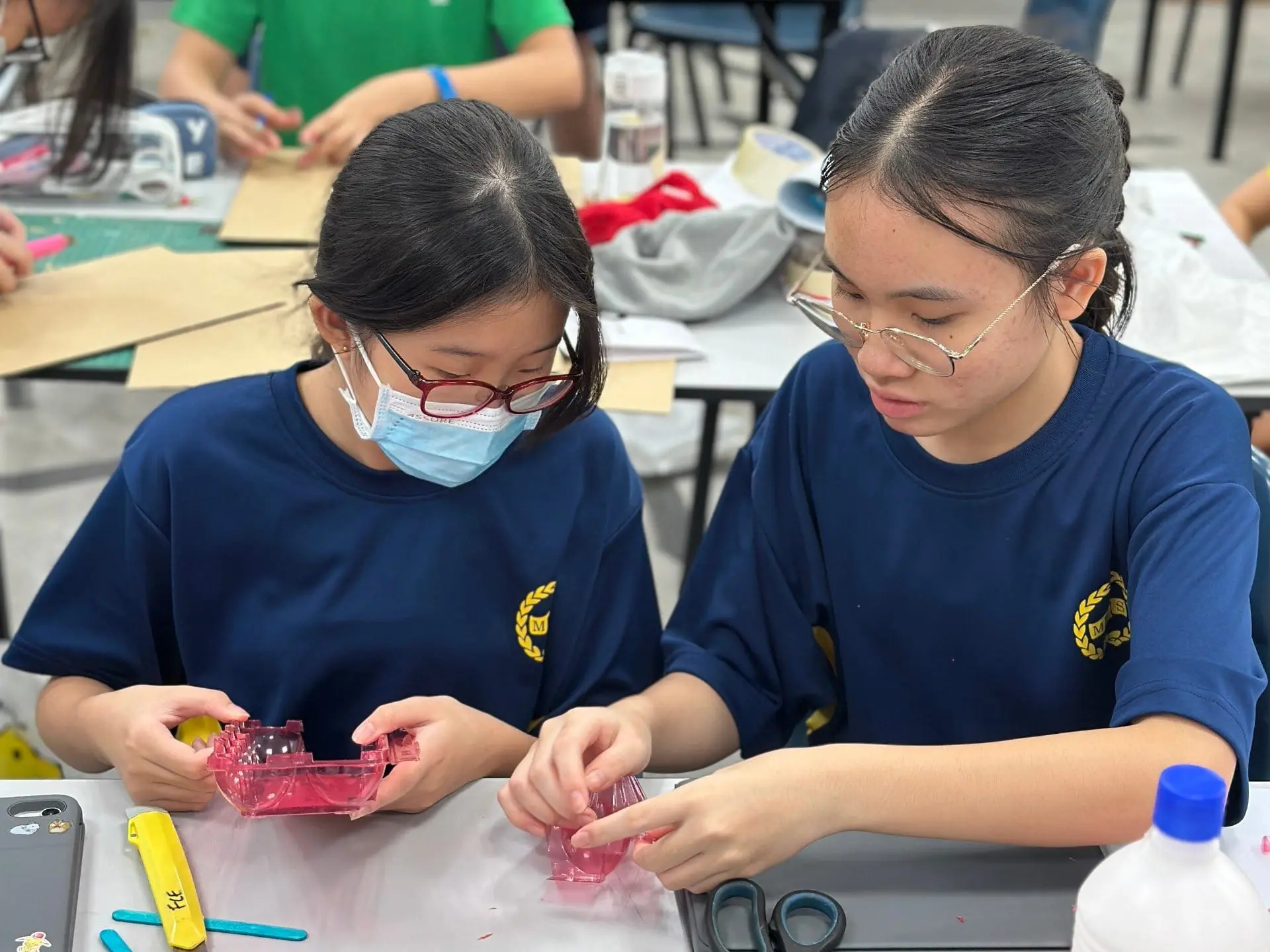
C-Academy’s design thinking workshops for secondary schools run across a minimum of four sessions. This structure is not arbitrary — it reflects both the depth required to move through EDIT Design Thinking® meaningfully and the practical realities of secondary school timetabling. Here is a typical session breakdown:
- Session 1, Learning Journey: Students engage with the real-world context of their design challenge through a structured field or community experience. This grounds the empathy work in lived observation rather than assumption.
- Session 2, Introduction to EDIT Design Thinking®, Empathise, and Problem Definition: Facilitators introduce the EDIT Design Thinking® framework, then guide students through their empathy data to produce a refined HMW statement.
- Session 3, Ideation, Prototyping, and Testing: Students move through ideation using C-Academy tools, build low-fidelity prototypes, and conduct a first round of user testing.
- Session 4, Final Presentation: Teams present their refined solutions, empathy maps, and value propositions to an audience — often including school leadership, partner organisations, or community stakeholders.
What is the difference between design thinking and project-based learning? Both involve students working on real challenges over multiple sessions, but the distinction is in the orientation. Project-based learning typically begins with a defined output and works backwards. EDIT Design Thinking® begins with an undefined problem and works forward through human insight — the output is discovered, not prescribed. This makes it more cognitively demanding but also more transferable to novel situations students will encounter beyond school.
The Challenge Sprint — C-Academy’s condensed design sprint format — follows the same EDIT Design Thinking® sequence within a compressed timeframe, making it suitable for post-exam windows or enrichment days where a full four-session programme is not feasible. Even in this shorter format, the phase structure and facilitation model remain intact.
5. How EDIT Design Thinking® Supports MOE’s 21st Century Competencies
MOE’s 21st Century Competencies (21CC) framework identifies Adaptive and Inventive Thinking, Communication, Collaboration, and Civic Literacy as core outcomes for Singapore students. How does design thinking support 21st century competencies in MOE schools? The alignment with EDIT Design Thinking® is direct and structural, not incidental.
Adaptive and Inventive Thinking is developed through the Ideate and Test phases — students are explicitly trained to generate multiple solutions, stress-test assumptions, and revise their thinking based on evidence rather than defending their initial idea. This is design thinking for innovation in practice: students learn not just to have ideas, but to develop and pressure-test them in response to real user feedback.
Communication is embedded across the Define and Test phases. Writing a precise HMW statement is a communication exercise. Presenting a value proposition to a community stakeholder at Session 4 requires students to translate complex thinking into clear, persuasive language for a non-specialist audience.
Collaboration is structural. EDIT Design Thinking® is always delivered in teams. The facilitation model — with facilitators intervening to redistribute participation rather than accepting dominant voices — directly addresses the collaboration skills MOE identifies as essential.
Civic Literacy and Cross-Cultural Skills are engaged when programme themes connect students to community stakeholders outside their immediate peer group. The applications of design thinking extend across C-Academy’s sustainability, community, and culture-themed programmes, which involve engagement with elderly residents, environmental groups, and heritage organisations — including partners such as the Jane Goodall Institute Singapore and Pek Sin Choon.
6. Design Thinking Outcomes: What Schools Have Seen With the EDIT Approach
C-Academy measures programme impact through a pre- and post-competency assessment conducted with students before and after each design thinking workshop. The assessment evaluates four dimensions: empathy, problem-framing, ideation, and prototyping. Assessors are external to the facilitating team to ensure independence.
Across cohorts, C-Academy has recorded an average improvement of 37 percentage points in design thinking competence.
At Sembawang Secondary School, one of C-Academy’s Applied Learning Programme partner schools, the improvement was particularly marked: overall design thinking competence moved from 13.5% to 69.5% — a gain of 56% across the cohort. Facilitator observations from that programme noted that the most significant shift occurred in the Define phase: students who had initially struggled to distinguish between a symptom and a root cause were, by Session 3, writing HMW statements with a level of precision that surprised their form teachers.
These are not participation metrics or satisfaction scores. They reflect measurable changes in how students approach problem solving — the transferable skill that C-Academy’s co-founders Kimming Yap and Yulia Saksen have consistently identified as the core purpose of design thinking education in Singapore schools.
7. Why EDIT Design Thinking® Is the Right Fit for Your School
EDIT Design Thinking® has been designed with the realities of Singapore secondary school life in mind — the timetabling constraints, the range of student readiness, and the pressure on HODs and VPs to demonstrate measurable outcomes. Across seven years of delivery, certain school contexts have emerged as particularly well suited to the methodology.
Schools running or planning an Applied Learning Programme with a real-world problem focus will find EDIT Design Thinking® a natural fit. The four-phase structure maps directly onto ALP objectives, and the pre- and post-competency assessment provides the kind of documented evidence that supports ALP reporting and review.
Post-exam enrichment windows are another strong context. The Challenge Sprint format — a condensed design sprint experience built on the EDIT Design Thinking® sequence — is specifically designed for shorter time windows, giving students a meaningful, output-oriented programme during periods that can otherwise feel unfocused.
Schools working to develop 21CC competencies systematically across a cohort will benefit from the assessment infrastructure built into every EDIT Design Thinking® programme. Measurable gains in empathy, problem-framing, ideation, and prototyping give schools concrete data to report against MOE’s competency framework.
Mixed-ability cohorts are well served by the structured facilitation model. Because EDIT Design Thinking® does not reward prior academic achievement — it rewards observation, listening, and iterative thinking — students who struggle in traditional academic settings often emerge as strong contributors, particularly in the Empathise and Ideate phases. The methodology develops creative problem solving skills that sit outside conventional academic assessment, which means students who are rarely recognised in a classroom context find genuine opportunities to lead.
Schools that want to move beyond one-off creativity sessions towards programmes with tangible student outputs and genuine community connection will find the full four-session structure particularly rewarding. The Session 4 presentation to real stakeholders — school leadership, community partners, or external organisations — gives students an authentic audience and a genuine sense of purpose.
The minimum commitment for a full EDIT Design Thinking® programme is four sessions. Schools that have attempted to compress the methodology into fewer sessions consistently report weaker student outcomes — particularly in the Define phase, where insufficient time leads students to skip problem-framing and jump directly to solutions.
If your school is exploring an Applied Learning Programme partnership or a structured design thinking enrichment programme, C-Academy’s team — led by facilitators with active professional design practice, not only educational backgrounds — can advise on formats suited to your school’s calendar, cohort size, and ALP objectives. Reach out through the C-Academy contact page to start the conversation.