




In a design thinking workshop, play creates the psychological safety and momentum teams need to explore boldly—unlocking more original ideas, stronger collaboration, and faster learning through experimentation.
1. Why Play Matters in Design Thinking
1.1 The serious science of play
Play may look spontaneous, but it’s actually a complex cognitive process. Neuroscientists have found that play activates areas of the brain associated with creative thinking, emotional regulation, and problem-solving. It encourages the kind of lateral, divergent thinking essential for innovation. When participants engage in playful exercises during a design thinking workshop Singapore, they enter a state of psychological safety. This “safe space” reduces fear of judgment, allowing them to share bold ideas freely. Play helps people unlearn rigidity and rediscover curiosity—qualities that drive human-centric innovation.
1.2 The link between play and design thinking frameworks
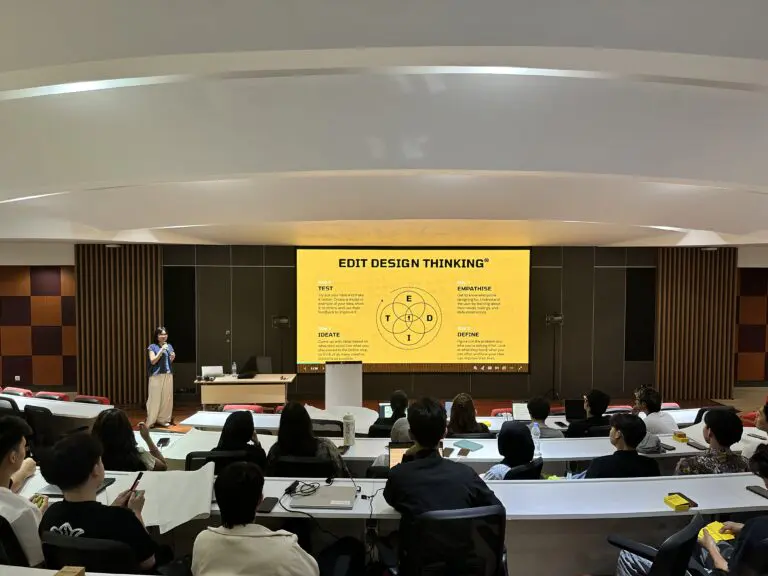
Design thinking is built upon exploration and empathy. The EDIT Design Thinking® framework—Empathise, Define, Ideate, Test—demands openness, imagination, and iteration. This framework represents the foundation of design thinking fundamentals, enabling participants to empathise with users and co-create solutions that truly address needs. Play complements this perfectly. It fuels empathy (by inviting participants to role-play users), enhances ideation (through experimentation), and supports testing (by reframing prototypes as playful experiments instead of final products). When play is integrated into a design thinking course, it transforms learning from theoretical to experiential—helping both professionals and students internalise the mindset of innovation.
2. Understanding the Psychology of Creative Thinking and Play
Children learn by touching, building, imagining, and failing forward—all through play. But somewhere along the way, adults begin to fear being “wrong.” C-Academy’s facilitators see this pattern often in corporate and educational settings. Adults hesitate to experiment because they’ve internalised perfectionism. The good news? Play reverses that conditioning. It reactivates creative confidence—the belief that everyone can generate ideas worth exploring. This shift in mindset is essential for effective design thinking practice, where teams must experiment without fear.
Empathy lies at the heart of every design thinking process. When participants play—whether through storytelling, improvisation, or tactile tools—they access emotion and imagination more easily. Through play, participants can embody user experiences, act out scenarios, and gain insight into people’s needs. This builds not only better solutions but stronger human connections.
By turning abstract personas into playful characters, teams learn to design with, not for, their users—an essential trait of human-centric innovation.
3. Introducing Idea Dice: C-Academy’s Tool for Structured Creativity in Design Thinking Workshops
3.1 What is Idea Dice?
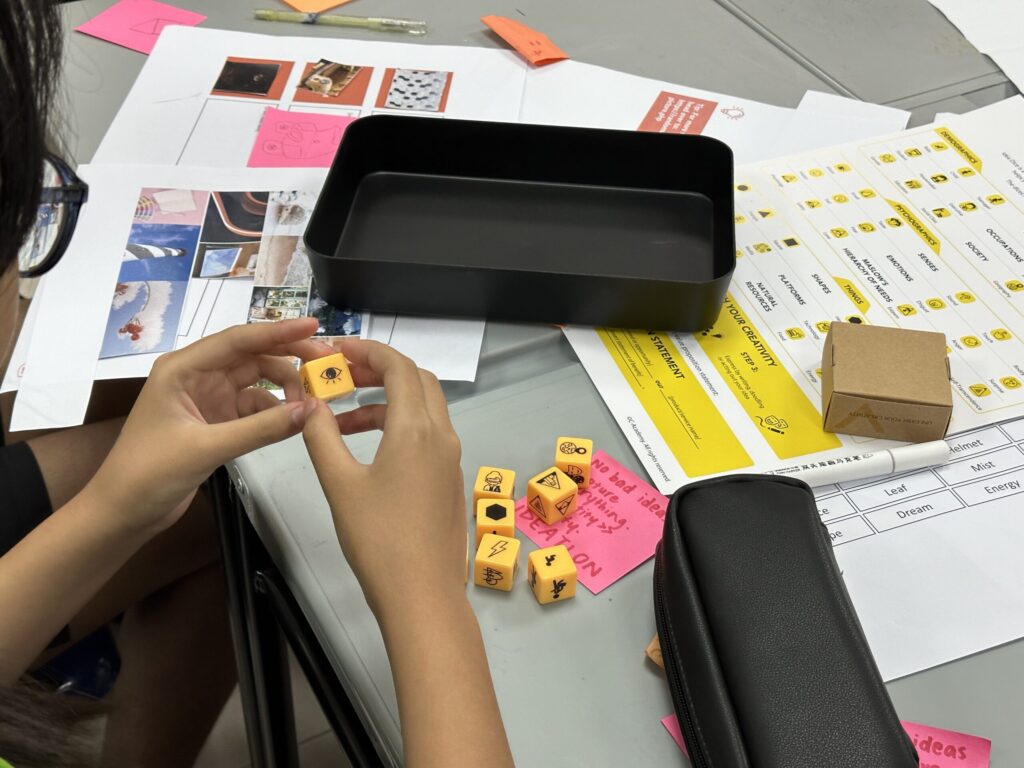
Idea Dice is a creative thinking toolkit developed by C-Academy to support teams and learners in the Ideate phase of the design thinking framework. It consists of nine physical dice, each printed with visual symbols that act as triggers for association and storytelling. When rolled, the dice present random combinations of images, objects, and concepts. Participants are encouraged to connect these elements to the challenge at hand—stimulating unexpected associations that spark fresh ideas. Each set of Idea Dice is compact, tactile, and versatile, designed to support both individual brainstorming and group collaboration during any innovation workshop.
3.2 How Idea Dice complements the design thinking process
The tool maps directly to the EDIT Design Thinking® framework:
- Empathise: Use the dice to explore user emotions through metaphors or scenarios.
- Define: Identify patterns or themes inspired by recurring dice symbols.
- Ideate: Generate novel solutions by combining different dice prompts.
- Test: Use dice to explore potential reactions, obstacles, or alternative viewpoints.
This structure gives teams a playful yet practical way to sustain momentum through each stage of the design thinking process, ensuring that ideation remains lively, collaborative, and human-centred.
4. Why Tangible Tools Work Better Than Screens in a Design Thinking Course
4.1 The science of hands-on learning
In today’s digital world, many teams rely on online brainstorming apps. But tangible tools like Idea Dice engage different parts of the brain—especially the motor cortex and sensory memory. Research shows that physical interaction increases attention and retention, while randomness disrupts habitual thought patterns. This multisensory engagement helps participants enter “flow”—a mental state where creativity feels natural. In a design thinking workshop, such embodied learning results in deeper collaboration and more imaginative solutions.
4.2 Physicality and presence in innovation workshops
During an innovation workshop, rolling dice together creates a shared rhythm that unites the group. People lean in, laugh, and co-create ideas in real time. The tactile nature of Idea Dice levels the playing field—introverts and extroverts alike participate equally. It shifts focus from “who speaks loudest” to “what idea emerges.” That social play dynamic is a crucial ingredient for productive design thinking implementation.
5. Breaking Through Creative Blocks: Turning Play into Breakthrough Solutions
Creative blocks happen when people fixate on what’s practical instead of what’s possible. Traditional brainstorming often results in predictable ideas because participants unconsciously limit themselves. Idea Dice breaks this cycle by introducing randomness. When someone rolls a symbol they don’t expect—say, a leaf, an eye, or a bridge—they must reinterpret it in context. This forces lateral thinking: “How does this connect to our user’s challenge?” Suddenly, new perspectives emerge.
Gamification—the use of play elements in serious contexts—makes creative exercises feel less intimidating. When facilitators incorporate Idea Dice into a design thinking workshop Singapore, teams compete playfully to create the most unusual yet meaningful ideas. The reward isn’t a prize—it’s pride in originality and the satisfaction of arriving at genuine breakthrough solutions. Through this, participants learn a vital truth: innovation thrives on curiosity, not certainty.
6. How Idea Dice Strengthens Team Collaboration Through the Design Thinking Process
6.1 Building creative trust
Trust is essential for creativity. In group settings, people often censor themselves to avoid embarrassment. Playful tools reduce that pressure. Rolling dice together creates a sense of equality—everyone starts from the same randomness, no hierarchy. This playful interaction mirrors the user experience design principle of co-creation: the best ideas emerge when everyone feels safe contributing.
6.2 Fostering diversity of thought
Each participant interprets the same dice differently, depending on their experience.
In a mixed team—teachers, students, executives, or engineers—this diversity becomes an advantage. It leads to design thinking practice that’s richer, more inclusive, and more innovative.
7. Integrating Idea Dice into Design Thinking Certification and Training Programmes
For schools and universities running a design thinking course, Idea Dice offers an easy way to make creativity tangible. Teachers can use it to facilitate the Ideate phase, teach lateral thinking, or evaluate how students connect ideas. Because each roll is unpredictable, no two sessions are the same—making every class a live exploration of creativity and design thinking fundamentals.
In professional settings, Idea Dice also plays a role in design thinking certification and executive education. Participants demonstrate mastery not by memorising theory but by showing how they apply frameworks to novel challenges. Using Idea Dice during assessments helps trainers evaluate adaptability and ideation fluency—core indicators of innovation capability.
8. Real-World Applications: Idea Dice in Design Thinking Training for Boardrooms and Classrooms
In corporate settings, an innovation workshop supported by Idea Dice helps teams overcome tunnel vision. For example, a marketing department might use it to reimagine customer journeys; a logistics team might use it to rethink service efficiency. Rolling the dice together reminds professionals that creative thinking is everyone’s responsibility, not just “the design team’s.” C-Academy facilitators often integrate Idea Dice into design thinking training sessions, where participants learn to connect business objectives with human insights through playful exploration.
In schools, Idea Dice transforms the classroom into a playground for ideas. Students use it to brainstorm social projects, design inventions, or empathise with community challenges. This playful method helps them understand design thinking fundamentals—observation, empathy, ideation, and prototyping—without feeling like they’re in a traditional lesson.
9. Why Play Boosts Human-Centred Innovation
9.1 The emotional connection
Human-centred innovation is not just about efficiency; it’s about empathy and meaning. Play brings emotion back into problem-solving. When participants laugh, imagine, and build together, they reconnect with the joy of creation—the emotional core of the design thinking framework.
9.2 Sustaining curiosity beyond the session
After a workshop, many participants continue using Idea Dice informally—in meetings, classrooms, or brainstorming sessions. The tool becomes a portable reminder that innovation begins with asking “what if?”. By maintaining this playful habit, organisations sustain creative energy long after the workshop ends. This continuity represents successful design thinking implementation: not a one-off event, but an evolving culture of exploration.
10. The C-Academy Approach: Turning Play into Practice Through Design Thinking Implementation
C-Academy’s philosophy is simple: creativity thrives within structure. That’s why tools like Idea Dice work so well—they offer just enough randomness to inspire, but within a clear design thinking process that channels energy toward meaningful outcomes. From corporate leaders to schoolteachers, everyone benefits from rediscovering creative play. C-Academy’s design thinking training and design thinking courses help facilitators integrate gamified creativity into classrooms and boardrooms alike. Play becomes a structured, repeatable way to build empathy, collaboration, and innovation.
Embedding play into the design thinking framework is not about adding fun for its own sake—it’s about unlocking new ways of seeing and connecting. When organisations and schools make playful exploration part of their design thinking culture, they empower teams to experiment fearlessly and collaborate more deeply.
As workplaces and schools adopt hybrid models, C-Academy’s design thinking online programmes allow participants to experience playful learning anywhere. Virtual Idea Dice sessions bring teams together across geographies, demonstrating that creativity knows no borders. The fusion of digital learning with tactile play marks a new era in design thinking workshops—one that’s accessible, inclusive, and joyfully human.
11. Key Takeaways: What Every Design Thinking Workshop Can Learn from Play
- Play enhances creative confidence by reducing fear of failure.
- Idea Dice structures creativity while keeping it spontaneous.
- Tangible tools increase engagement by stimulating multiple senses.
- Gamification fosters teamwork and psychological safety.
- Play sustains innovation by transforming creativity into culture.
- Within the design thinking course ecosystem, play strengthens empathy, imagination, and innovation.
Conclusion: Reimagining Design Thinking Courses Through Play
Innovation doesn’t begin with strategy—it begins with imagination. By bringing play back into professional and educational spaces, C-Academy helps individuals rediscover the power of curiosity. Tools like Idea Dice bridge logic and intuition, transforming brainstorming into an act of joyful exploration. Whether you’re designing a new product, a lesson plan, or a policy, the message is the same: creativity flourishes when people feel free to play.