









Of the eight design thinking workshops for secondary schools that C-Academy offers, the Community theme consistently produces the most personally meaningful student experiences. It is also the one that generates the most significant gains in empathy — the competency that underpins everything else in the design thinking process.
This article explains what actually happens in a community-themed design thinking workshop, what students gain from it, and why it connects so effectively to the broader student development goals Singapore secondary schools are working towards.
What a Community-Themed Design Thinking Workshop Actually Looks Like
A community-themed design thinking workshop is not a charity project or a service-learning visit with a design twist. It is a structured, facilitated process in which students use C-Academy’s EDIT Design Thinking® methodology — the design thinking framework at the core of all C-Academy’s workshop programmes — to identify and attempt to solve a real problem faced by a specific community.
The community is not abstract. Students are not asked to “design something for elderly people in general.” They are brought into contact with real individuals — residents of a specific neighbourhood, users of a community centre, members of a particular social group — and asked to understand their lives well enough to frame a design challenge worth solving.
This specificity is what separates a community-themed design thinking workshop from a generic enrichment activity. The users are real. The problem is real. The empathy has to be real too. It is one of the most genuinely experiential learning formats available to Singapore secondary schools, because the design thinking journey moves through authentic contact with the world rather than simulated classroom scenarios.
C-Academy’s standard delivery structure across a community-themed programme follows four sessions:
- Session 1, Learning Journey: Students visit a real-world community site — a community centre, a social service organisation, a public space used by the community — to ground their understanding before any frameworks are introduced. This is not a presentation. Students observe, conduct early user research, and begin forming a picture of the community and its challenges.
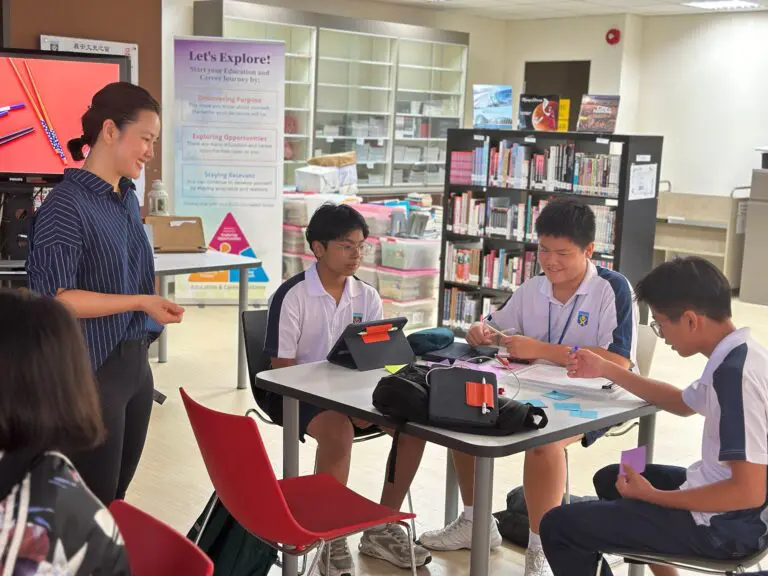
- Session 2, Empathise and Define: Students conduct structured empathy interviews with community members, build empathy mapping outputs, and work towards a How Might We statement — a specific, user-grounded problem definition that becomes the focus of everything that follows.
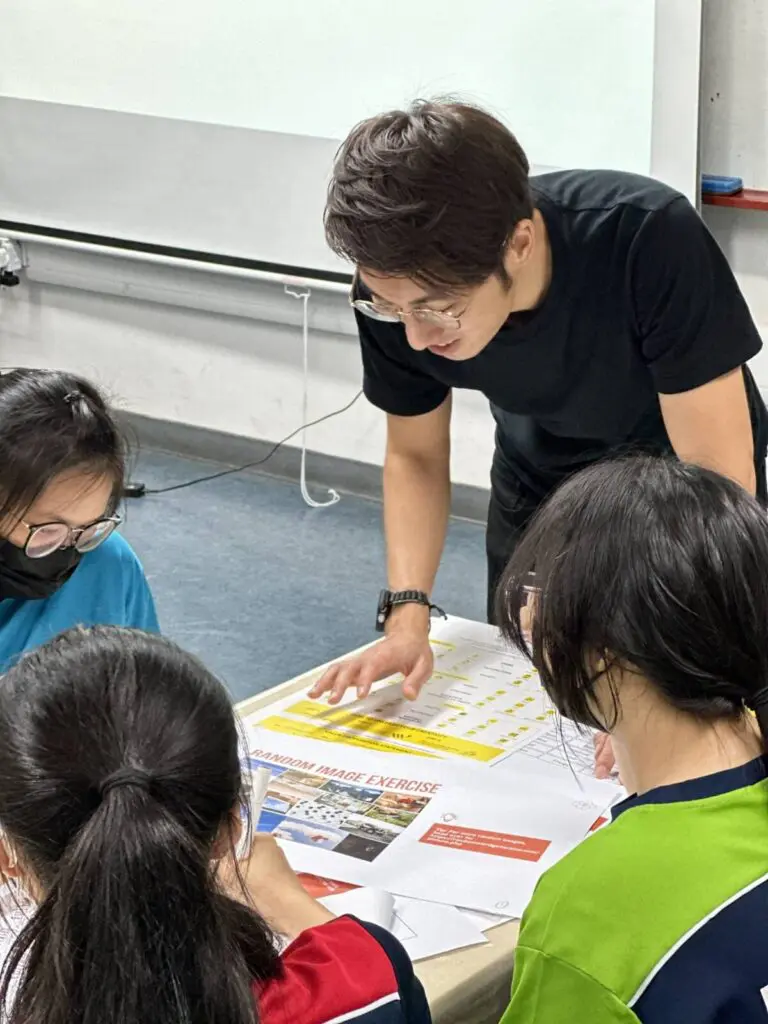
- Session 3, Ideation, Prototyping, and Testing: In what functions as a compressed design sprint, students use design thinking tools including Random Cards and Idea Dice to accelerate creative ideation. They generate design solutions, select the most promising, build a rapid prototype through design thinking prototyping, and gather user feedback by testing with real community users.
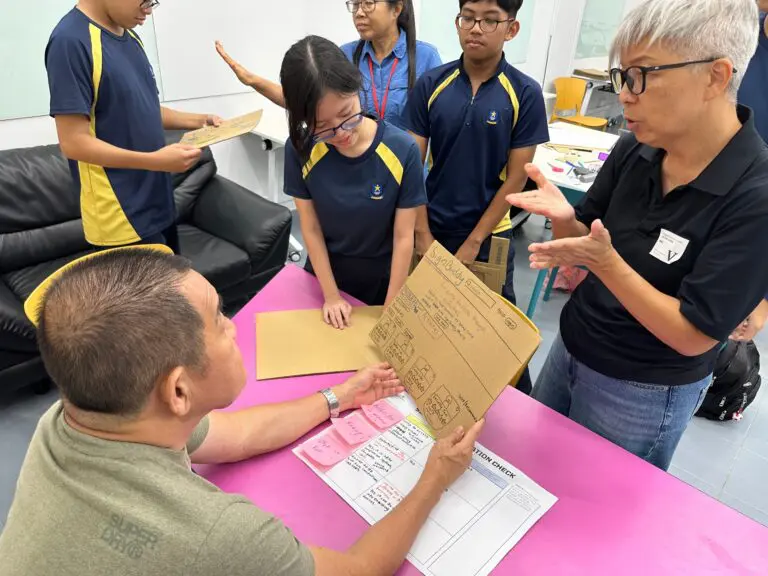
- Session 4, Pitch Presentation: Student teams present their value proposition and prototype to an audience that may include school leaders, community partners, and peers — evaluated against C-Academy’s Sweet Spot of Innovation framework, which assesses user desirability, technical feasibility, and business or social viability.
The Skills Students Build — and Why They Last
Empathy That Goes Beyond the Classroom
Every design thinking approach develops empathy. The Community theme develops it at a depth that other themes rarely match, because the users are genuinely different from the students themselves.
When a Secondary 3 student from a middle-income background spends time in empathy interviews with an elderly resident who lives alone in a one-room HDB flat, something shifts. Not just in their understanding of that person’s life — in their understanding of what it means to design for someone whose experience differs from their own. That shift is what C-Academy measures in its pre- and post-programme competency surveys, and it is consistently strongest in the Community theme.
Empathy at this level is not a soft skill. It is the foundation of effective problem-solving, creative thinking, and community collaboration — three of the design thinking skills Singapore’s education system most needs to develop in students heading towards a future of work that will be defined by complexity, interdependence, and change. It is also central to what C-Academy calls design mindsets — the habits of mind that distinguish students who have genuinely internalised the design thinking methodology from those who have simply followed a process.
Problem Framing in Ambiguous, Real-World Contexts
Community challenges are messy real world problems. They do not arrive pre-packaged with a clear problem statement. Students have to observe carefully, ask the right questions, synthesise what they hear from user research, and arrive at a problem frame that is both specific enough to be actionable and broad enough to admit creative solutions.
This is harder than it sounds. Most students arrive at a community-themed workshop expecting to hear a problem and then solve it. What they discover is that problem definition is itself a creative and analytical act — often the most important one in the entire design thinking journey.
The design brief that students develop at the end of Session 2 — anchored in a How Might We statement — is a direct measure of this capability. Strong design briefs are specific, user-centred, and generative. They open up the ideation phase rather than closing it down. Weak ones are too broad, too solution-specific, or disconnected from what students actually observed in their user research. The gap between the two is where the learning happens.
Systems thinking also emerges naturally in the Community theme. When students investigate a community challenge, they begin to see how social, environmental, and behavioural factors intersect — how a problem that appears simple on the surface is often embedded in a web of causes and conditions. This capacity for systems thinking is one of the most transferable outcomes of a community-themed innovation programme.
Collaboration Skills Under Real Pressure
Community-themed design thinking workshops are inherently collaborative. Student teams of four to five work on a shared design challenge, with real community members as their users and a real pitch at the end. The social dynamic is productive in ways that individual tasks and classroom discussions rarely replicate.
But the community collaboration is also genuinely demanding. Student teams have to negotiate competing interpretations of what they observed, resolve disagreements about which problem to focus on, and make collective decisions under time pressure. These are not simulated versions of real collaboration challenges. They are the real thing — which is why the design thinking skills students develop in a community-themed workshop transfer more readily to other contexts than skills practised in lower-stakes settings.
This kind of structured teamwork under pressure is also a core element of student leadership development. Students who take on facilitation roles within their teams — managing the design brief process, guiding the ideation, leading the pitch — often emerge from community-themed programmes with a noticeably stronger sense of themselves as design ambassadors: people who can navigate uncertainty, lead creative processes, and advocate for the needs of others.
Civic Literacy and Social Impact
Community-themed design thinking workshops develop civic literacy in a way that is difficult to achieve through design thinking curriculum alone. When students spend time with community members, listen to their experiences, and design solutions that improve their lives, they develop a concrete understanding of social impact — not as an abstract value, but as a practice with real implications and real constraints.
This connects directly to MOE’s Character and Citizenship Education (CCE) framework, which emphasises civic literacy, global awareness, and cross-cultural skills as core student development outcomes. A well-run community-themed workshop is one of the most effective elements of a design thinking curriculum that brings these outcomes to life in a way students can feel and remember. It builds the design thinking mindsets — empathy, curiosity, openness to user feedback — that make civic engagement meaningful rather than performative.
Creative Confidence and Student Creativity
One of the less-discussed outcomes of the Community theme is what happens to student creativity when the stakes are real. In a lower-stakes classroom setting, students often self-censor — afraid to suggest ideas that might seem odd or impractical. In a community-themed design thinking workshop, the presence of real users changes the dynamic.
When students know they will be testing their prototype with real community members and presenting to real stakeholders, creative confidence rises. They are not performing creativity for a teacher. They are solving a real problem for real people. That shift in orientation — from performance to purpose — is what maker education at its best looks like, and it is what drives the innovation challenge outcomes that community-themed programmes consistently produce.
What the Data Shows
C-Academy uses a pre- and post-programme competency survey based on DesignSingapore’s Learning by Design framework to measure change across four dimensions of the design thinking framework: empathy, problem framing, ideation, and prototyping.
Across all school programmes, C-Academy has recorded an average improvement of 37% in overall design thinking competence. At Sembawang Secondary School, students recorded an improvement of 56% — from 13.5% to 69.5% in overall design thinking competence — in a single programme cycle.
The Community theme consistently produces the strongest empathy gains across all eight workshop programmes. Students who arrive at a community-themed programme with low baseline empathy scores — students who struggle to identify user needs beyond their own experience — show the steepest improvement curves. This is because the Community theme forces genuine contact with unfamiliar lives, which is the single most effective driver of empathy development in the 21st century competencies framework.
For HODs who want enrichment to produce measurable student development outcomes rather than just positive student feedback, the Community theme’s data profile is one of its strongest arguments.
How It Connects to School Priorities
Values in Action and Service Learning
Schools with established VIA programmes or service-learning frameworks find that the Community theme integrates naturally with their existing design thinking curriculum. The Learning Journey session can be linked to existing community partnerships. The empathy interviews can be conducted with community contacts the school already has. The final presentation can be shared with community partners as a genuine social impact contribution rather than a closed classroom exercise.
This integration matters because it prevents the design thinking workshop from feeling like a standalone event disconnected from the rest of the school year. When students can see a direct line between the community-themed workshop and their VIA commitments or service-learning projects, the learning deepens and the development outcomes are more durable.
Applied Learning Programme (ALP) Alignment
Community-themed design thinking workshops align well with ALP objectives that emphasise real world problems, iterative testing, and applied design thinking skills. Schools that have designed their ALP around community engagement or social innovation find that C-Academy’s Community theme provides the structured design thinking methodology their ALP needs without displacing the community context they have already established. The design thinking approach, with its emphasis on user research, design brief development, design thinking prototyping, and user feedback cycles, maps directly onto ALP learning outcomes.
Post-Exam Enrichment
The post-exam window is one of the best times to run a community-themed design thinking workshop. Students are not under academic pressure, which means they arrive more open to the kind of genuine experiential learning and community collaboration the Community theme requires. The cognitive load of exams is gone. What remains is curiosity — and the Community theme is designed to channel it into design thinking mindsets and creative confidence that students carry forward.
What Students Say
The feedback C-Academy receives from community-themed programmes is qualitatively different from feedback on other workshop programmes. Students do not just say the workshop was interesting or that they learned useful design thinking skills. They say it changed how they think about people.
“I realised I had a lot of assumptions about the elderly. After the interviews, I understood that their problems were not what I expected at all.” — Secondary 3 student, community-themed programme
“It was the first time I had to listen properly — not to answer, but just to understand. That was harder than I thought.” — Secondary 4 student, community-themed programme
These reflections are not incidental. They are the outcome that makes community-themed design thinking workshops one of the most educationally significant workshop programmes available to Singapore secondary schools. The design thinking skills are real, the empathy is real, and the social impact on how students understand their place in society is real.
For HODs looking for an innovation programme — or any enrichment programme — that produces outcomes students carry with them beyond the classroom, the Community theme is where C-Academy consistently sees the deepest and most lasting results. It develops the full range of 21st century competencies: systems thinking, creative confidence, student leadership development, and the design thinking mindsets that prepare students not just for the next academic stage, but for a future in which the ability to understand and respond to human needs is the most valuable skill of all.