



Singapore secondary schools running design thinking programmes consistently report stronger student engagement and skill retention compared to traditional instruction, not because the content is more entertaining, but because the methodology asks students to do, not just listen.
At C-Academy, we have delivered Design Thinking Workshops to secondary school cohorts across Singapore since 2017, working with schools including Sembawang Secondary, Hougang Secondary, Ngee Ann Secondary, and Methodist Girls’ School (Secondary). What we observe on the ground confirms what educators increasingly recognise: passive learning has significant limits when the goal is developing 21st-century competencies and genuine character development in students.
This article explains why design thinking for secondary school students in Singapore is structurally better suited to how adolescents learn, what our delivery experience tells us, and how HODs and curriculum planners can evaluate whether their current approach is achieving what it promises.
WHO RUNS THIS PROGRAMME
C-Academy runs EDIT Design Thinking® workshops and programmes for Singapore secondary schools, aligned to MOE’s 21st Century Competencies, ALP and VIA.
1. Why Passive Instruction Falls Short for 21CC Development
MOE’s 21st Century Competencies (21CC) framework identifies Adaptive and Inventive Thinking, Communication, and Collaboration as core competencies for Singapore students. These are not knowledge-based outcomes, they are practice-based ones. You cannot develop them by reading about them or watching a presentation.
Traditional instruction works well for knowledge transfer. A teacher explaining the structure of a persuasive essay, a chemistry equation, or a historical timeline is efficient and appropriate for that goal. But when the desired outcome is a student who can identify a real-world problem, reframe it creatively, generate solutions, and communicate them persuasively to an audience, a lecture is the wrong tool.
Design thinking provides the structure that makes active learning rigorous. Without a methodology, active learning risks becoming unstructured noise. Students need guardrails, especially at the secondary level, where unstructured group work often defaults to the loudest voice dominating or the quietest students disengaging entirely.
C-Academy’s EDIT Design Thinking® methodology — Empathise, Define, Ideate, Test — gives secondary school students a clear, repeatable process for tackling real-world problems. Each phase has a specific goal, deliverable, and set of tools. Students know what they are trying to achieve at every step, which reduces anxiety and increases participation.
2. Character Development Through the Design Thinking Process
One of the most consistent outcomes we observe in C-Academy-facilitated Design Thinking Workshops is character development — a shift in how students carry themselves, engage with others, and approach problems they have not seen before.
This is not incidental. It is built into the methodology.
The Empathise phase is the most direct driver. For many students, this is the first time they are formally asked to set aside their own assumptions and focus entirely on understanding someone else’s experience, whether that is a classmate, a community member, or a user of a product they are designing. A well-facilitated Empathise phase uses structured interviews, observation tasks, and empathy mapping to make perspective-taking concrete and achievable.
The Define phase builds analytical rigour. Students synthesise their findings into a How Might We (HMW) statement — a question that frames the problem from the user’s perspective without prescribing a solution. This develops exactly the kind of careful, evidence-based thinking that character education programmes often talk about but rarely operationalise.
By the time students reach Ideate, they have a real-world problem worth solving and a genuine understanding of who they are solving it for. The quality of ideas generated at this stage is consistently higher than in workshops that jump straight to brainstorming without the earlier phases.
Our Impact Report data reflects this: across C-Academy-facilitated programmes, students show an average improvement of 37% in design thinking competence, measured through pre and post student surveys across empathy, problem-framing, ideation, and prototyping. At Sembawang Secondary School, for example, design thinking competence rose by 56%, from 13.5% to 69.5%.
3. Learning Through Making: Why Prototyping Matters for Secondary Students
One of the most distinctive features of design thinking is that students learn through making. Rather than reading about problem-solving or watching a demonstration, they build something — a low-fidelity prototype that represents their proposed solution — and then test it with real users.
This learning through making approach is particularly effective for secondary school students in Singapore for two reasons.
First, it externalises thinking. When students build a physical or paper prototype, their ideas become visible and discussable. Peers and facilitators can engage with the concept directly, which produces much richer feedback than a verbal description or a slide presentation.
Second, it creates a cycle of iteration. Students test their prototype, receive feedback, identify what is not working, and refine their design. This iterative cycle mirrors how professionals in design, engineering, and business actually work. For students, it builds resilience and the understanding that a first idea is a starting point, not a final answer.
4. Design Thinking and Sustainable Lifestyles: A Natural Fit
Design thinking for secondary school students in Singapore connects particularly well with sustainability themes. When students are asked to identify a real-world problem in their community and design a solution, they frequently choose challenges related to sustainable lifestyles — food waste, energy use, environmental impact of everyday choices.
This is not by accident. The Empathise phase naturally surfaces what people around students actually care about. And for many Sec 2 and Sec 3 cohorts in Singapore, sustainability is a live and genuine concern.
C-Academy’s Design Thinking Workshops under the Sustainability theme are specifically designed to channel this into structured problem-solving. Students investigate how behaviours around sustainable lifestyles form, what barriers exist to change, and how design can remove those barriers rather than just encourage willpower.
The result is both a stronger learning experience and a more meaningful output — students leave not just with a prototype, but with a deeper understanding of why sustainable behaviour change is difficult and what it actually takes to shift it.
5. Students as Co-Constructors of Knowledge
A key principle underlying design thinking education is that students are not passive recipients of information — they are co-constructors of knowledge. This phrase, widely used in progressive education frameworks, means that students generate understanding through their own inquiry and experience, not through transmission from a teacher.
In a well-facilitated Design Thinking Workshop, this is what actually happens. Students generate their own research questions during Empathise, synthesise their own insights during Define, and develop their own solutions during Ideate and Test. The facilitator’s role is to create the conditions for this, not to provide the answers.
This has a measurable effect on retention. When students have constructed an understanding themselves — through interviewing, mapping, building, and testing — they remember it because it is theirs. The empathy map they drew, the prototype they tested, the feedback they received: these are personal learning events, not curriculum content.
For HODs evaluating design thinking providers, the co-constructors of knowledge framework is a useful lens. Ask the provider: what percentage of each session is student-led? What does the facilitator do when a group gets stuck? How are student insights captured and built upon across sessions? The answers reveal whether the methodology is genuinely applied or just marketed.
6. The Structural Advantages of Design Thinking for Schools
Here is a comparison that HODs often find useful when evaluating approaches:
| Traditional Lecture | Unstructured Group Work | Design Thinking Workshop (EDIT Design Thinking®) | |
|---|---|---|---|
| Engagement model | Passive reception | Active but unguided | Active, structured, iterative |
| 21CC alignment | Low (knowledge transfer only) | Moderate (inconsistent) | High (all core 21CCs practised per session) |
| Character development | Incidental | Variable | Explicit, built into methodology |
| Student output | Notes, test answers | Variable, often incomplete | Empathy maps, HMW statements, prototypes, presentations |
| Teacher’s role | Content delivery | Crowd management | Facilitator and coach |
| Real-world connection | Low | Variable | High (every project is grounded in real context) |
The structured nature of design thinking is particularly important for mixed-ability cohorts. Because each phase has a clear process and tools, students who might disengage in open-ended tasks have a defined entry point. Students who are ready for more challenge can go deeper at the same phase without the whole group slowing down.
7. What a Design Thinking Workshop for Secondary School Students Looks Like in Practice
A typical C-Academy Design Thinking Workshop for Singapore secondary schools runs across at least 4 sessions. The activities for each session are flexible depending on the overall timeline, but a standard 4-session programme covers:
Session 1, Learning Journey: Students are introduced to real-world challenges through an immersive experience. This session grounds the programme in authentic context before any formal methodology is introduced.
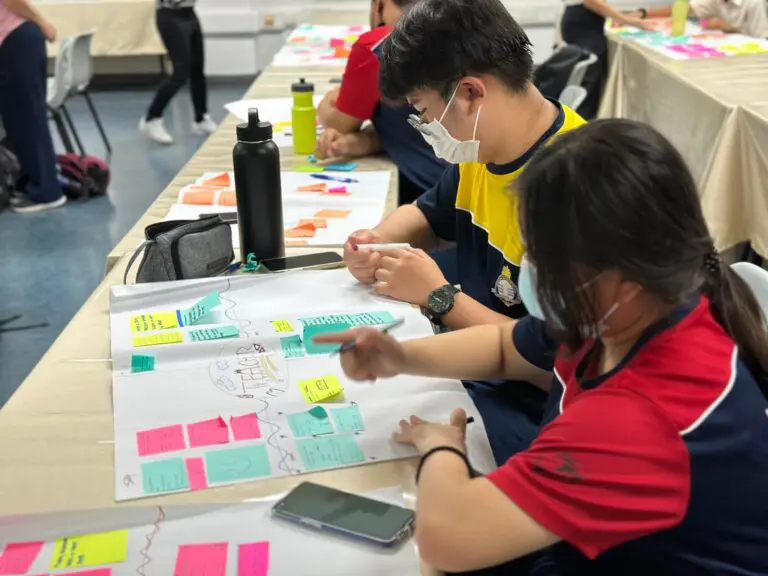
Session 2, Introduction to Design Thinking, Empathise, and Problem Definition: Students learn the EDIT Design Thinking® framework and immediately apply it. They conduct structured interviews with real users or community stakeholders, document their findings on empathy maps, and synthesise their insights into a How Might We (HMW) statement.
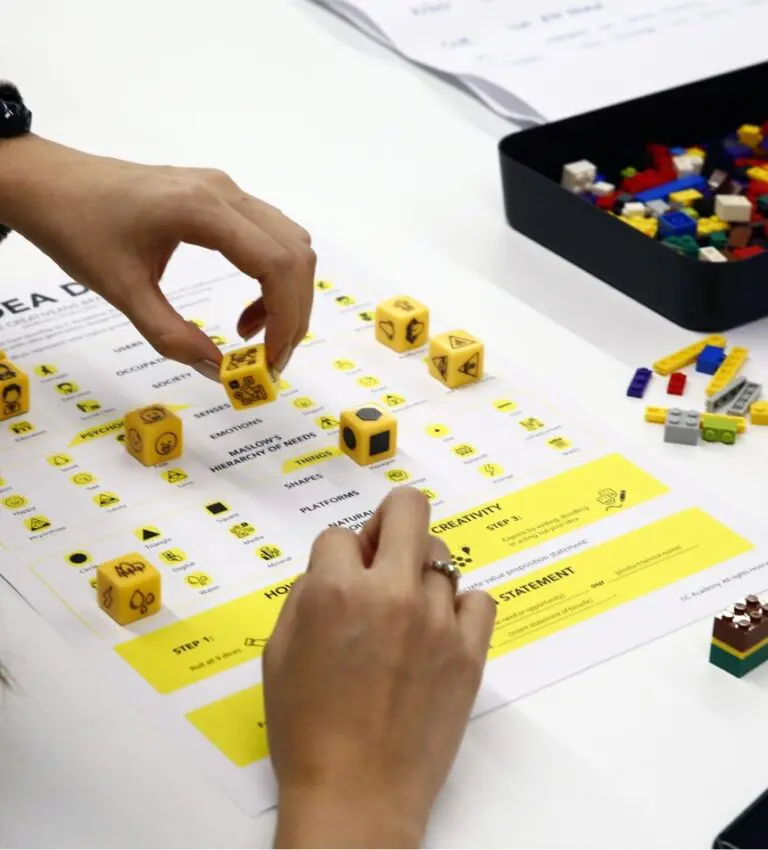
Session 3, Ideation, Prototyping, and Testing: Using C-Academy’s Random Cards and Idea Dice tools, students generate a wide range of ideas, evaluate and select their best concept, build a low-fidelity prototype, and test it with real users or peers.
Session 4, Final Presentation: Students present their solution to a panel, communicating the real-world problem they identified, the empathy insights that shaped it, and the solution they developed.
By the end of 4 sessions, each student has practised empathy, problem framing, creative ideation, prototyping, and communication — with every step grounded in a real-world challenge that matters to someone.
8. Bringing Design Thinking to Your School
C-Academy works with Singapore secondary schools to design programmes directly aligned with your ALP requirements, cohort needs, and school calendar. Our core team delivers every session — we do not outsource facilitation to freelancers — which means the quality and approach are consistent across every school we work with.
If you are planning your next ALP cycle or looking to introduce design thinking for secondary school students in Singapore, we are happy to share what we have learned across more than a decade of delivery.