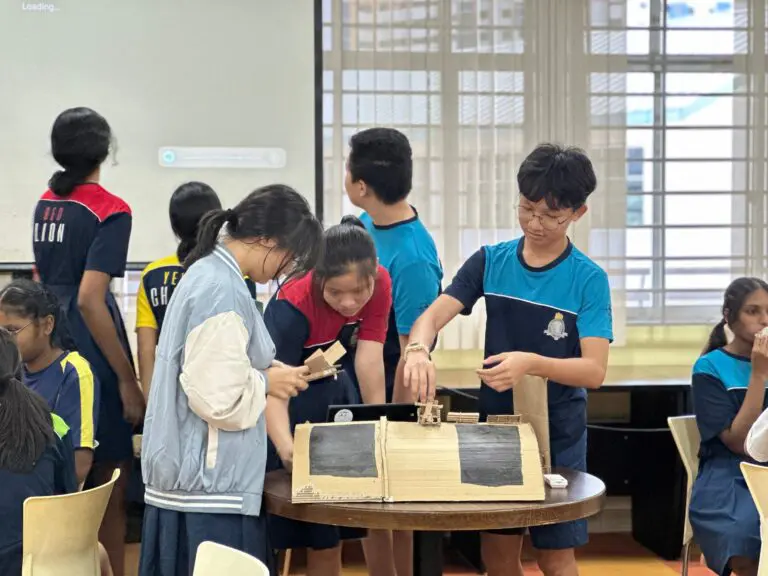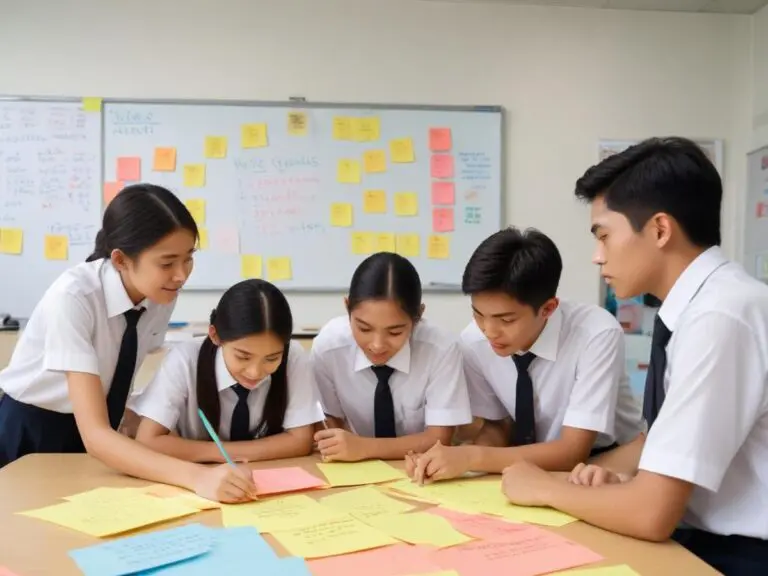





Most secondary school students, when asked to “just brainstorm”, produce a short list of safe, familiar ideas — then stop. Divergent thinking does not switch on by instruction. In C-Academy’s EDIT Design Thinking® workshops, structured ideation tools like Random Cards and Idea Dice consistently unlock creative output that open-ended brainstorming sessions rarely produce, particularly with teenage learners who are accustomed to searching for the “correct” answer.
Understanding what is design thinking — and why it works — starts with recognising that creativity is not a talent distributed unevenly across students. It is a capacity that emerges when the right design thinking tools and conditions are in place. At its core, design thinking is a human-centered design methodology — one that puts the needs, behaviours, and experiences of real users at the centre of every stage of the design process. This is the core insight behind C-Academy’s hands-on approach to ideation in schools.
1. Why Divergent Thinking Is Hard to Teach — and Harder to Sustain
Divergent thinking — the ability to generate many possible solutions to complex problems — sits at the heart of MOE’s 21st Century Competencies framework, specifically under Adaptive and Inventive Thinking. A design thinking overview of most secondary school curricula reveals the same pattern: students spend the majority of their learning time in convergent mode — reading, selecting the best answer, refining a single response. The thinking process is almost entirely linear.
The shift to divergent thinking is genuinely difficult, and not because students lack creativity. In C-Academy’s experience working across Singapore secondary schools, the most common sticking point is what facilitators call “evaluation paralysis” — students self-censor ideas before they are even voiced, asking internally, Is this good enough? Is this too weird?
The second challenge is sustaining divergent thinking beyond the first two or three minutes. Even when students begin well, ideation energy tends to drop sharply once the obvious ideas are exhausted. Without a mechanism to push past that wall, groups default to refining what they already have rather than generating genuinely new directions.
This is precisely why ideation tools matter. They are not gimmicks. They are structured prompts that disrupt familiar thinking patterns and give students a cognitive direction to move in without the pressure of producing something “right.” The non-linear process of design thinking — particularly in the ideation phase — requires tools specifically designed to support it.
2. What Makes a Good Ideation Tool for Secondary School Students
Not every ideation tool works equally well across age groups and contexts. A good ideation tool for secondary school students needs to meet several conditions simultaneously.
Low barrier to entry. Students should be able to pick it up and use it within minutes, without lengthy instruction. Complexity in the tool creates cognitive load that competes with the creative task itself.
Built-in randomness. The tool should introduce an element of surprise that students cannot anticipate. This is the core mechanism that breaks evaluation paralysis — when a random prompt appears, students cannot pre-judge it because they did not see it coming.
Constraint without prescription. The best ideation techniques for students narrow the creative space just enough to give direction, without telling students what to think. They prompt how to think. This is a principles of design thinking in action: constraints are generative, not limiting.
Group compatibility. Secondary school students work in groups. A tool that rewards individual output over group riffing tends to produce parallel ideas rather than genuinely collaborative ones.
C-Academy’s Random Cards and Idea Dice were developed with all four of these criteria in mind. Both tools emerged from real workshop delivery experience, not from theoretical design — which is why they behave differently in practice from generic brainstorming tools or off-the-shelf design thinking resources.
3. How Random Cards Work in a Design Thinking Workshop
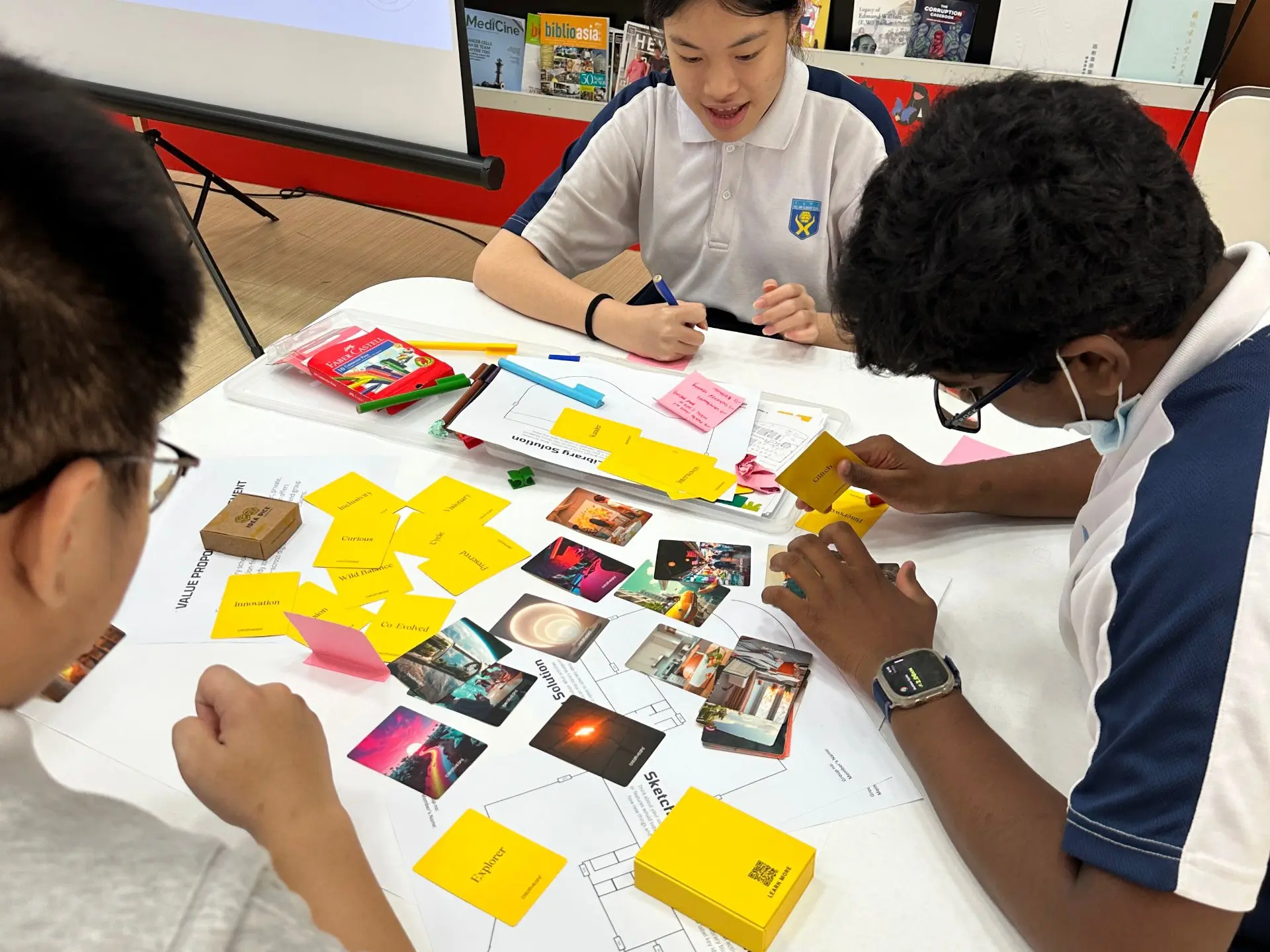
Random Cards are a set of prompt cards used during the Ideation phase of the EDIT Design Thinking® framework. Each card presents an unexpected stimulus — a concept, a material, a scenario, a constraint, or an object — that students must connect to their design challenge.
The mechanism is deceptively simple: a student draws a card at random and the group must ask, How does this connect to the problem we are trying to solve? The card does not provide an answer. It provides a direction of association that the group would almost certainly not have arrived at through a standard design process.
In practice, C-Academy facilitators have observed a consistent pattern across workshops: the first reaction to a Random Card is almost always resistance — “That has nothing to do with our problem.” The facilitator’s role at this point is not to explain the connection but to hold the space and ask the group to sit with the discomfort. Within roughly 60 to 90 seconds, someone in the group almost always finds a thread. That moment of unexpected connection is frequently where the strongest ideas in the session originate.
This reflects a broader truth about the design thinking process: problem identification and idea generation are not separate steps in a solution-based approach. They are deeply intertwined. When students connect a random stimulus to a design challenge, they are often reframing the problem at the same time as generating a solution direction — which is precisely what a well-designed design thinking framework is built to encourage.
4. How Idea Dice Unlock a Different Kind of Creative Thinking
Where Random Cards operate through associative thinking, Idea Dice operate through combinatorial thinking. Each die presents a different dimension of a problem — function, user, context, constraint, material, or scale — and students roll multiple dice simultaneously to generate a prompt matrix.
The result is a combination of variables that students must respond to together. This is cognitively distinct from the associative leap required by Random Cards. Combinatorial thinking is especially effective for students who are more systematic in how they approach complex problems — it gives structure to creativity rather than asking them to make a lateral leap.
In C-Academy workshops, Idea Dice tend to perform particularly well in the later stages of ideation, once the group has already generated an initial set of ideas and needs to push into less obvious territory. The dice introduce specificity that forces students to think about how an idea would actually work, not just what it is.
This mirrors the iterative process at the heart of any strong design thinking model: ideas are not finished at first generation. They are developed, combined, and pressure-tested through repeated cycles of divergent and convergent thinking. Idea Dice support the divergent half of that cycle with a structure that students can return to whenever generative energy stalls.
C-Academy facilitators have observed that Idea Dice are especially useful for groups that have reached an early consensus too quickly. Rolling the dice introduces a new variable that destabilises the comfortable agreement and reopens the creative space — without the facilitator having to directly challenge the group’s direction.
5. What Facilitators Observe When Students Use Structured Ideation Tools
The shift in group dynamics when students use structured ideation tools — compared to open brainstorming sessions — is measurable in behavioural terms. C-Academy facilitators consistently observe the following across school workshops.
Participation becomes more equitable. In open brainstorming, dominant voices tend to set the creative direction early, and quieter students defer. When a card or die introduces a shared random stimulus, every group member starts from the same point. The stimulus is neutral — it belongs to no one — which lowers the social risk of contributing.
Idea volume increases, particularly after the first five minutes. Open brainstorming typically peaks quickly and then stalls. Random Cards and Idea Dice create natural re-entry points — each new card or roll resets the generative energy. This is the hands-on approach to ideation that distinguishes C-Academy’s methodology from lecture-based design thinking certificate programmes or theory-only instruction.
Cross-disciplinary connections emerge more frequently. Students who would not describe themselves as “creative” — particularly those with strong analytical tendencies — often respond very productively to the combinatorial logic of Idea Dice. The structure makes the creative task feel tractable. This connects directly to user research and human needs identification: when students are prompted to think across dimensions, they naturally consider the perspective of different users.
Design thinking skills develop visibly within a single session. Facilitators with experience across multiple cohorts report that the design thinking phases in which structured ideation tools are used produce measurably stronger prototyping output than sessions where ideation is left to open brainstorming alone.
Across cohorts, C-Academy’s pre/post competency assessments show a 37% average improvement in overall design thinking competence, with ideation scores contributing consistently to that figure. Schools with shorter workshop timelines that compress or remove the structured ideation phase tend to see lower gains in the problem-solving and prototyping stages that follow.
6. Fitting Ideation Tools Into the EDIT Design Thinking® Framework
Random Cards and Idea Dice are not standalone activities. Within the EDIT Design Thinking® framework — Empathise, Define, Ideate, Test — they belong specifically to the Ideate phase, and their effectiveness depends on the quality of the work done in the phases before.
A design thinking framework examples approach shows this clearly: students who have built genuine empathy through the Empathise phase and articulated a sharp How Might We statement in the Define phase bring a real, felt problem to the ideation table. The tools then have meaningful material to work with. When the preceding phases have been rushed or treated as procedural boxes to tick, ideation tools produce more generic output — students are connecting random prompts to a vague problem rather than a specific human need.
This is also where C-Academy’s approach differs from the five stages of design thinking as commonly described in the design thinking framework is often taught in workshops or online design thinking courses. The Hasso Plattner Institute model and IDEO’s design thinking model both emphasise empathy and problem definition as prerequisites for effective ideation. C-Academy’s EDIT Design Thinking® framework applies the same principle, but with ideation tools specifically calibrated for the user testing and usability testing requirements of the secondary school context.
This sequencing is a deliberate feature of C-Academy’s workshop design. In a standard four-session Design Thinking Workshop, structured ideation using Random Cards and Idea Dice typically occupies the first portion of Session 3, following the How Might We articulation at the close of Session 2. Facilitators calibrate the number of cards drawn or dice rolled based on group energy and idea quality, rather than running a fixed time block.
7. How Teachers and HODs Can Introduce Ideation Tools in School
Teachers and HODs exploring how to build a user-centric approach to creativity in their classrooms often ask the same question: where do structured ideation tools fit within existing subject frameworks? The answer is more flexible than most expect.
Design thinking skills — particularly divergent thinking, problem identification, and the ability to consider human needs — are transferable across subjects. Service design and product development contexts in upper secondary levels offer natural entry points. Even in subjects without an explicit design thinking framework, the principles of design thinking apply whenever students need to generate multiple approaches to a complex problem rather than converge on a single answer.
For teachers and HODs exploring how to introduce structured ideation into school settings, C-Academy’s practitioners suggest starting with three practical steps:
Step 1: Begin with a clear problem statement. Ideation tools work best when students have something specific to ideate against. A vague challenge produces vague output regardless of the tool used. A strong problem statement is the foundation of any solution-based approach.
Step 2: Run a short warm-up. Before introducing Random Cards or Idea Dice, spend five minutes on a low-stakes association exercise. This shifts students from convergent to divergent mode before the tool is introduced and helps establish the thinking process as exploratory rather than evaluative.
Step 3: Hold the discomfort. The most important facilitator behaviour is resisting the urge to explain or rescue when students declare a card “irrelevant.” The connection almost always comes — and breakthrough innovation in student thinking is more likely when the group finds it themselves.
C-Academy’s EDIT Design Thinking® methodology supports schools in building this facilitation capacity through structured programmes. HODs interested in embedding design thinking ideation practices across subjects can explore how the Applied Learning Programme framework supports cross-disciplinary creative problem solving. As the design thinking market in Singapore’s education sector continues to grow, schools that build genuine facilitation capacity — rather than relying on one-off workshops — are best positioned to develop students with lasting design thinking skills.