





Most secondary students can brainstorm ideas. Fewer can explain why those ideas matter to someone else. That gap between generating a concept and communicating its relevance is precisely where the value proposition lives. When design thinking is taught well, the value proposition is not a bolt-on business lesson. It emerges naturally from the empathy and ideation work students have already done.
This article is written for educators and workshop facilitators in Singapore who want to integrate value proposition thinking into their design thinking programmes in a way that feels coherent, purposeful, and age-appropriate.
1. What Is a Value Proposition and Why Does It Belong in Design Thinking?
A value proposition is a clear statement of the benefit a solution delivers to a specific person, and why that benefit matters more than the alternatives. In business contexts, it anchors product strategy. In education contexts, it teaches students to think from someone else’s perspective before declaring their solution worthwhile.
This is precisely the disposition design thinking cultivates. When students move through customer interviews and problem framing, they are gathering the raw material a value proposition is built from. Keeping value proposition design separate from the broader design process, treating it as a business studies concept dropped into an innovation workshop, wastes that material and confuses students about what they were doing in the first place.
At C-Academy’s design thinking workshops for secondary schools in Singapore, facilitators introduce the phrase “value proposition” only after students have completed their empathy maps. This sequencing is deliberate: the words of their interviewees become the evidence base for the proposition, not the other way around.
The practical benefit for facilitators is consistency. Students who understand that a value proposition simply answers “who benefits, how, and why it matters” find the concept accessible rather than intimidating.
2. How Design Thinking Sets Up the Value Proposition (Stage by Stage)
Each stage of the design thinking process builds a layer of the value proposition. Making this visible to students accelerates their customer understanding considerably.
Empathise surfaces the user’s real frustrations, motivations, and workarounds through structured customer research. This becomes the customer insights that ground the proposition in evidence. Students document customer pains — the frustrations their interviewees live with — and customer gains, the outcomes their users actually want. Without this groundwork, students default to assumptions rather than real customer experience.
Define compresses that evidence into a point-of-view statement: “Secondary three students who travel by public bus struggle to manage revision time between school and tuition.” That sentence already contains two of the three components of a strong value proposition: the target audience and the problem.
Ideate generates candidate solutions. At this stage, facilitators can prompt students to ask: “Which of these ideas most directly addresses the pain we identified?” That question is a soft introduction to value proposition thinking before any formal framework is introduced. Students begin to distinguish between pain relievers (features that remove or reduce specific frustrations) and gain creators (features that produce outcomes users actively want) — a distinction drawn from Alexander Osterwalder’s original value proposition design framework and adapted here for secondary school use.
Prototype and Test validate whether the proposition holds. If users do not respond to the solution as expected, the proposition needs design iteration. This mirrors the innovation process in real product development, where products and services are refined through multiple cycles of user feedback.
At C-Academy, facilitators use a visible progression wall in the workshop room. Each stage’s output is physically connected to the next with arrows, so students can trace exactly how their empathy interview informed their eventual proposition. This visual scaffolding reduces the cognitive load of integrating multiple frameworks simultaneously.
3. C-Academy’s Value Proposition Statement: A Student-First Alternative to the Value Proposition Canvas
The value proposition canvas, associated with Alexander Osterwalder’s business model canvas methodology, is a standard design tool in professional innovation consulting and service design. It covers customer jobs, customer pains, customer gains, pain relievers, gain creators, and products and services — a rigorous framework built for business strategy and market research contexts. Adapting it directly for fourteen-year-olds without modification tends to produce confusion rather than customer understanding.
C-Academy’s approach is different. Rather than translating an external framework, C-Academy developed its own Value Proposition Statement (VPS): a purpose-built design tool that achieves the same analytical outcome while remaining fully accessible to secondary school students. The VPS is C-Academy’s own student-first equivalent of the value proposition canvas — one of the design tools in the EDIT Design Thinking® programme that is grounded in the same logic of customer experience and customer insights, but expressed in language students can immediately apply.
The VPS formula follows directly from the “How Might We” statement students have already written:
For (who is the persona), who (what they need or what is the opportunity), our product/service is a (category) so that (how does it benefit them or others?).
For example: “For Ryan, who is often misread as ‘not listening’ and feels frustrated because others aren’t aware of his hearing needs, our product is a wearable aid that helps others recognise his hearing needs and communicate more clearly, so that he feels respected and confident.”
This structure directly addresses the customer profile — the specific target audience, their customer pain points, and their customer expectations — while framing the solution in terms of benefit rather than features. Students who have completed their empathy mapping and defined their “How Might We” find the VPS a natural next step: the persona is already named, the customer pains are already documented, and the opportunity is already framed. The VPS asks them to complete the sentence, not start over.
The result is a value proposition design process that is both rigorous and student-friendly. Students practise the same innovation process used in service design and service innovation contexts — customer research, customer requirements, customer understanding — without needing to navigate a complex canvas before they have the conceptual foundation to use it well.
4. What Does a Student-Friendly Value Proposition Look Like?
A student-friendly value proposition retains the logic of professional value proposition design while simplifying the language. A reliable three-sentence structure works well at secondary level:
1. “We help [specific user] who [specific problem or situation]…”
2. “…by [what the solution does]…”
3. “…so that [the meaningful outcome for the user].”
For example: “We help secondary students who lose track of revision deadlines by creating a shared timetable system linked to their school calendar, so that they feel less overwhelmed in the weeks before exams.”
This structure forces specificity. Vague propositions fail the fill-in-the-blank test immediately. “We help students do better in school” tells you nothing about the customer segment, the mechanism, or the outcome.
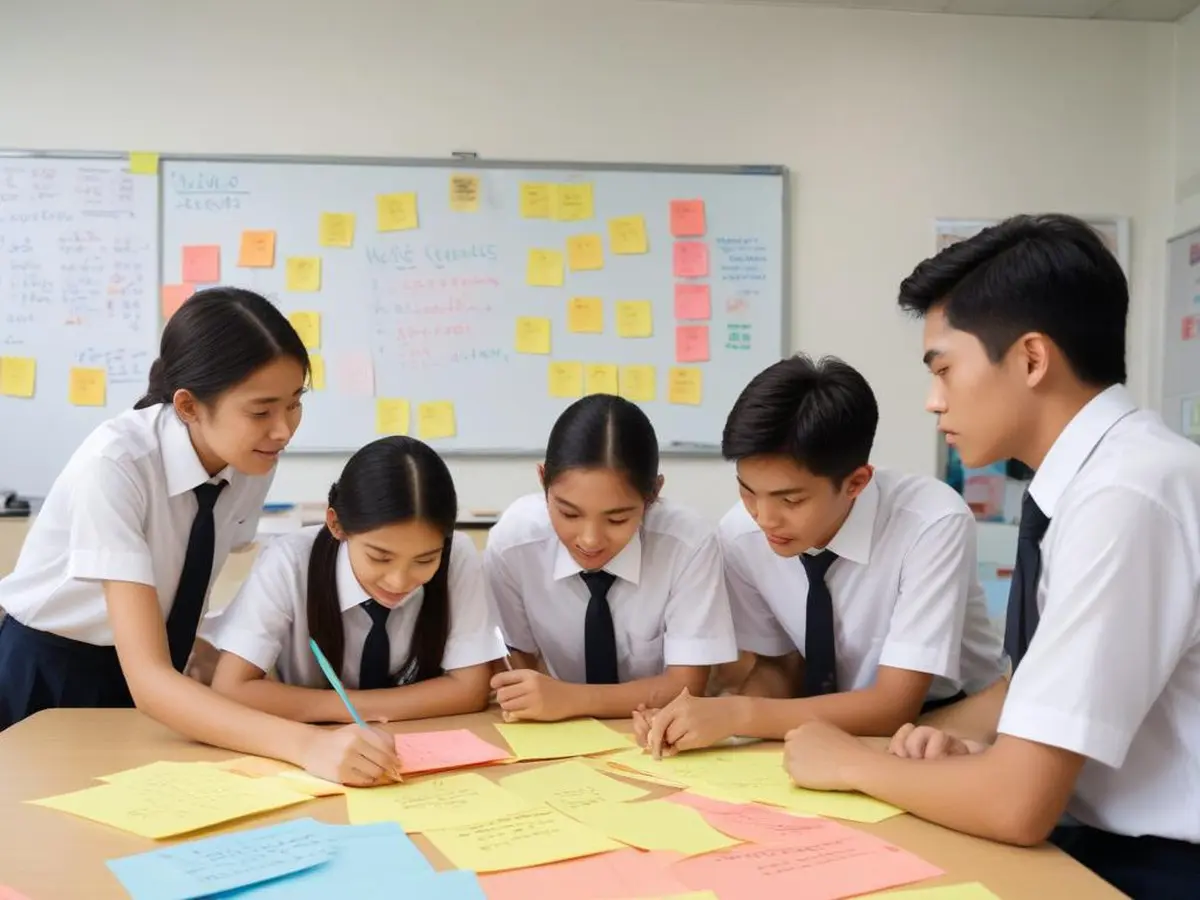
C-Academy uses laminated sentence-starter cards during workshops. Students write their proposition on a sticky note, attach it to the card, and display it alongside their prototype. Facilitators then conduct a gallery walk where peers identify which part of the proposition is clearest and which needs sharpening. This peer critique is often more effective than direct facilitator feedback at this age group.
5. Classroom Activity: Building the Value Proposition Statement with Secondary Students
Once students are comfortable with the VPS formula, a structured Value Proposition Statement exercise can be introduced as a consolidation tool. The activity below is designed for a 45–60 minute session and connects the VPS directly to earlier design thinking work.
Materials: A3 printed VPS templates, coloured markers, sticky notes, empathy maps from earlier in the process.
Step 1: Revisit the customer profile (10 minutes). Students identify the three most significant customer pain points and the two most important gains their user wants. These are written on sticky notes in the user’s own words where possible.
Step 2: Map the value map to the customer profile (15 minutes). Each feature of the prototype is matched to a specific customer pain or gain. Features that cannot be matched are flagged for discussion. This is where students begin to think like service designers: every element of a solution should address a real customer expectation or customer requirement.
Step 3: Draft the proposition statement (10 minutes). Using the three-sentence structure, students write their first draft. Facilitators circulate and ask: “Who exactly is this for?” and “How does your user feel after using this?”
Step 4: Peer review (10 minutes). Pairs exchange their Value Proposition Statements and mark any section where the customer segment is unclear, the problem is vague, or the outcome is generic.
Step 5: Refine and present (10–15 minutes). Students revise based on peer feedback and present their proposition to the group in under 60 seconds.
C-Academy adapted this structure for a Secondary 3 Applied Learning Programme cohort, with students building propositions for solutions targeting elderly residents in their community. The peer review step produced the most significant improvements, particularly in clarifying the specific customer segment and the human-level outcome.
6. How to Teach Students to Test and Refine Their Value Proposition
A proposition is a hypothesis, not a conclusion. Teaching students to treat it this way is one of the most transferable skills in the entire design thinking and innovation process.
The simplest test is a return to the customer journey. Students go back to their original interviewees — or a representative user from the same customer segment — and read their proposition aloud. They ask: “Does this sound like something that would matter to you? What would change how useful this is?”
Responses are sorted into three categories: confirms the proposition, challenges a specific component, or surfaces a customer requirement that was missed. Students revise accordingly. This process is a condensed version of the customer research cycle used in professional service design and business incubator programmes.
C-Academy facilitators note that students often resist revising propositions they feel emotionally attached to. The reframe that works: “The goal is not to be right the first time. The goal is to build something that actually helps someone.” Repositioning design iteration as evidence of good practice shifts the dynamic quickly and builds the kind of creative confidence that transfers well beyond the workshop.
7. Common Mistakes Students Make and How Facilitators Can Help
Proposing for themselves rather than their user. Students describe what they would find useful, not what their interviewee expressed. Facilitators redirect by asking: “Where in your empathy mapping notes did you find evidence for this?” This anchors the discussion in customer insights rather than personal preference.
Being too broad about the customer segment. “Everyone who uses their phone” is not a target audience. Narrowing to a specific context, “Year 3 students preparing for end-of-year exams”, makes the proposition testable and the market demand concrete.
Conflating the solution with the outcome. Students say “our app helps students revise” when the outcome they mean is “students feel more confident going into exams.” The distinction matters because outcomes are what users actually care about, and it reflects the difference between a product feature and a customer gain.
Skipping the empathy base. When propositions are written without grounding in the customer journey, they tend to describe solutions rather than benefits. Facilitators can catch this early by asking students to point to the specific empathy map data that supports each part of their proposition.
At C-Academy, facilitators use a “so what?” ladder during feedback rounds. Students state their proposition, and the facilitator asks “so what?” repeatedly until the student arrives at the human-level outcome. It is a productive exercise that consistently produces stronger propositions and sharpens students’ understanding of business design thinking at a level appropriate to their age.
8. Connecting Value Proposition Work to MOE 21st Century Competencies and Innovation Practices
Singapore’s Ministry of Education 21st Century Competencies framework emphasises civic literacy, critical and inventive thinking, and communication. Value proposition work, grounded in customer understanding and user feedback, addresses all three in a single integrated activity.
Students must think critically about evidence from customer interviews. They must communicate a clear argument in constrained language. And by designing products and services for a specific community member — an elderly neighbour, a classmate with learning differences, a hawker stall owner — they practise the civic orientation the framework calls for.
These are also the innovation practices that underpin real-world service design and business strategy. The customer journey, market demand analysis, and market research skills students develop during this exercise are not simplifications of professional tools: they are the same analytical habits applied at an appropriate scale. A Secondary 3 student who can articulate customer pains, identify gain creators, and draft a value proposition has covered the same conceptual ground as a junior product designer in a business incubator environment.
C-Academy’s Applied Learning Programme partnerships with secondary schools in Singapore are structured around this alignment. Workshop outcomes are mapped explicitly to competency indicators, which helps teachers justify curriculum time and helps students connect workshop learning to their broader school experience.
When value proposition thinking is positioned not as a business lesson but as a communication discipline grounded in empathy and customer experience, it belongs naturally in any secondary school design thinking programme. Students who complete this process carry forward a customer-first habit of mind that serves them well in academic, civic, and professional life.