



Every term, Singapore secondary school HODs face the same question: what enrichment programme should we put our students through this year? The options are familiar — communication skills workshops, technology literacy sessions, coding robotics days, character building retreats, and a growing range of enrichment classes in Singapore from providers like Mindchamps and others targeting students across all levels. Most of these are competent, age-appropriate activities that give students a good day out and some exposure to a new domain.
But if you are looking for something that does more than that — something that builds practical skills students can actually use, develops logical thinking and analytical thinking habits, and produces measurable student outcomes you can report on — a design thinking workshop is worth a closer look. Not because conventional enrichment is without value, but because design thinking workshops are structured differently, assessed differently, and produce a different kind of growth.
This guide is for HODs in Singapore secondary schools who want to understand that difference clearly — and make an informed decision about which format actually fits their school’s goals.

WHO RUNS THIS PROGRAMME
C-Academy runs EDIT Design Thinking® workshops and programmes for Singapore secondary schools, aligned to MOE’s 21st Century Competencies, ALP and VIA.
1. What Conventional Enrichment Classes in Singapore Typically Look Like
Enrichment classes in Singapore encompass a diverse range of programmes, despite the common perception that they are mainly enrichment classes for preschoolers. At the younger end, they focus on early childhood development — fine motor skills, scientific exploration, hands-on experiments, visual-spatial abilities, and age-appropriate activities designed to stimulate curiosity in formative years. At the secondary level, conventional enrichment classes shift toward communication skills, interpersonal skills, fun learning experiences, and exposure to domains like coding robotics or engineering principles.
What Most Enrichment Classes Deliver Well
The best conventional enrichment programmes — whether from established providers or school-organised — do several things well. They expose students to new domains, create educational experiences that feel different from regular classroom lessons, and introduce students to skills and ideas they might not encounter in the standard syllabus. For primary students transitioning to secondary school, enrichment can play an important role in broadening horizons and building confidence.
Many providers position their offerings as comprehensive learning experiences — covering everything from mathematical foundation and fun learning to technology literacy and 21st-century education. Experienced instructors design these classes to be engaging, accessible, and age-appropriate. There is real value in that — and many Singapore secondary schools include conventional enrichment as a regular part of their school calendar.
Where Conventional Enrichment Class Often Falls Short
The gap appears when schools look for deeper, measurable learning outcomes. Most conventional enrichment classes in Singapore — even well-designed ones — are not built around formative assessment or pre/post competency measurement. Students leave with a broader awareness and a positive experience, but schools have limited evidence of what specifically changed as a result. For HODs who need to justify programme spend to school leadership or align activities to MOE’s applied learning programme (ALP) objectives, this is a real limitation.
The learning, however enjoyable, tends to be incidental rather than intentional. Students may develop interpersonal skills or communication skills from the experience — but that growth is a by-product, not a designed outcome.
2. What a Design Thinking Workshop Offers Instead
A design thinking workshop is structured around a defined design thinking methodology — a sequential process that moves students through clearly differentiated stages, each with distinct skills, outputs, and formative assessment checkpoints. It is not an enrichment class with a design thinking label. It is a fundamentally different learning format.
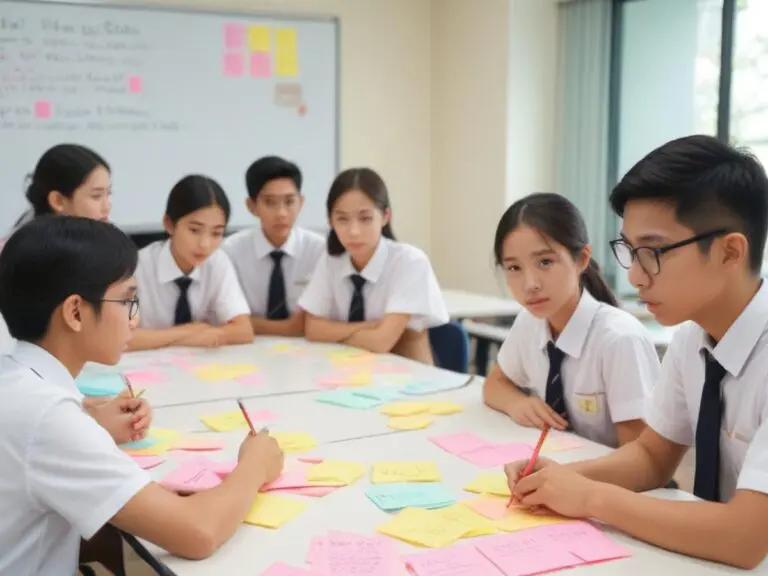
In C-Academy’s EDIT Design Thinking® workshops, students work through a real design challenge from beginning to end. They conduct empathy interviews, develop user personas, frame a problem using problem framing — a How Might We (HMW) statement, generate ideas through structured ideation, build low-fidelity prototypes, conduct user testing, and present their solutions in a Final Pitch. The process develops analytical thinking, creative problem solving, problem solving skills, communication skills, design thinking skills, and innovation process skills — all within a single, coherent programme.
The key difference from conventional enrichment is intentionality. Every stage in the design thinking process is designed to build on the last. Student outcomes are measured. Teachers receive a Post Workshop Report showing cohort-level competency growth across five domains. At Sembawang Secondary School, this structured approach contributed to a 56% improvement in design thinking competence — from 13.5% to 69.5% — as measured in C-Academy’s pre/post student assessment.
That kind of result does not come from a single enrichment session. It is what design thinking education, when properly structured, is designed to produce.
3. Comparing the Two Formats Directly
For HODs making a planning decision, the following comparison covers the most practically relevant distinctions.
Structure: A conventional enrichment programme typically runs as a series of activities or experiences — engaging and well-organised, but not built around a defined skill progression. A design thinking workshop follows a sequential design thinking process where every stage feeds the next, and students produce a tangible output — a prototype and a pitch — that demonstrates applied learning.
Assessment: Most enrichment classes do not include formative assessment or measurable student outcomes. A design thinking workshop includes pre/post competency measurement, which allows schools to document learning for ALP reporting, school innovation programme requirements, and 21st century competencies (21CC) framework alignment.
Depth of skill development: Conventional enrichment builds broad awareness. A design thinking workshop builds specific, transferable skills — including design thinking skills, communication skills, logical thinking, creative problem solving, and innovation process thinking — through a hands-on, student-centred learning experience.
Duration: Enrichment classes are often half-day or full-day experiences. C-Academy’s EDIT Design Thinking® workshops are typically structured as a one-to-two day intensive or a multi-session programme — giving students enough time to work through the full design sprint format and genuinely iterate on their ideas.
Curriculum alignment: Design thinking workshops can be aligned directly to CCE curriculum outcomes, ALP objectives, and MOE’s 21CC framework. This makes them documentable, justifiable, and reportable — supporting 21st century competencies (21CC) development — in ways that most enrichment classes are not.
4. Why Design Thinking Is a Stronger Investment for Secondary School Students
Conventional enrichment fills an important role — especially for primary students working on foundational skills or for activities designed around fun learning and broad exposure. But for secondary school students preparing for future careers in a complex, interdisciplinary world, the calculus is different.
Secondary students benefit most from programmes that develop practical skills they can transfer across contexts — not just knowledge of a domain, but the ability to work through real-world problems with rigour and creativity. Design thinking workshops are explicitly designed around this. Students learn to frame a problem before jumping to solutions. They develop a human-centered approach to challenges. They practise iterating on ideas based on real user feedback rather than assumptions. These are skills with direct relevance to future careers, further education, and any context where students need to work collaboratively on complex problems.
The design thinking process also develops technology literacy and scientific exploration instincts — students approach problems by gathering evidence, testing assumptions, and refining solutions. This mirrors the critical thinking habits that distinguish strong learners across all subjects, not just design.
C-Academy has delivered this process across Singapore secondary schools including Methodist Girls’ School (Secondary), Ngee Ann Secondary, Northbrooks Secondary, and Sembawang Secondary. Lead facilitator Yulia Saksen and the C-Academy practitioner team work with students across a wide range of academic profiles — and the structured approach consistently produces growth that a single enrichment day cannot replicate.
5. How C-Academy’s EDIT Design Thinking® Workshop Is Structured
C-Academy’s EDIT Design Thinking® workshop for secondary schools translates design thinking methodology into a classroom-compatible, facilitated educational experience — one that delivers the hands-on, experiential engagement of enrichment alongside the structured learning rigour of a formal programme.
The EDIT Design Thinking® Process
The EDIT framework covers five stages: Empathise (empathy interviews, user research, journey mapping), Define (problem statement, How Might We framing, user personas), Ideate (structured ideation using physical design tools), Test (rapid prototyping, user testing, iteration), and Pitch (presenting solutions to a real audience). Each stage builds on the previous one, creating a coherent design thinking process with visible student outputs at every step.
Assessment, Reporting, and Teacher Professional Development
Every C-Academy workshop includes pre and post student competency assessment across five domains: Empathy, Experimentation, Collaboration, Creative Confidence, and Design and Design Thinking Understanding. Schools receive a Post Workshop Report summarising cohort-level student outcomes — supporting ALP documentation, school innovation programme reporting, and teacher professional development planning.
This is what makes the EDIT Design Thinking® workshop a comprehensive learning investment rather than a conventional enrichment class: it produces evidence of learning, not just memories of it.
6. Can a Design Thinking Workshop Also Work as an Enrichment Programme?
Yes — and this is where the distinction becomes most practically useful. A well-designed design thinking workshop can absolutely occupy the enrichment slot on your school calendar. Students experience it as engaging, hands-on, and different from regular lessons. It creates the kind of memorable educational experience that conventional enrichment programmes aim for — but with the added depth of structured skill development and measurable student outcomes.
Many schools book C-Academy’s workshop as part of their enrichment calendar precisely because it does both. The experience is genuinely enjoyable — there is real fun learning in the process of building prototypes and pitching ideas. But underneath that engagement is a coherent methodology, formative assessment, and a programme structure that produces growth you can measure and report.
The conventional enrichment model — a day of well-organised, age-appropriate activities — is not wrong. But for schools that want more from their enrichment investment, a design thinking workshop offers a better alternative to what is typically the standard format of enrichment classes in Singapore.
7. Questions HODs Should Ask Before Booking Either
Whether you are considering enrichment classes in Singapore or a design thinking workshop, the following questions will help clarify which format fits your school’s goals.
What student outcomes do you need to demonstrate? If you need to report measurable competency growth to school leadership or MOE, a design thinking workshop is the appropriate format. If the goal is broad exposure and a positive learning experience, conventional enrichment may suffice.
How does this connect to your curriculum? A design thinking workshop aligned to your CCE curriculum, ALP objectives, or 21CC framework delivers more than one that runs as a standalone event. Enrichment classes rarely provide this level of curriculum alignment.
Who are the facilitators? Experienced instructors with both design thinking and secondary school facilitation backgrounds produce very different outcomes from generalist trainers. Ask about facilitator credentials before booking.
What happens after? Schools that plan for follow-up consistently report stronger long-term impact from design thinking programmes. Is teacher professional development part of the scope? Will teachers be equipped to reinforce design thinking language in their classrooms?
For Singapore secondary schools ready to move beyond the conventional enrichment model, C-Academy’s EDIT Design Thinking® workshop offers a clear, facilitated, and measurable pathway — from the first empathy interview to the Final Pitch.