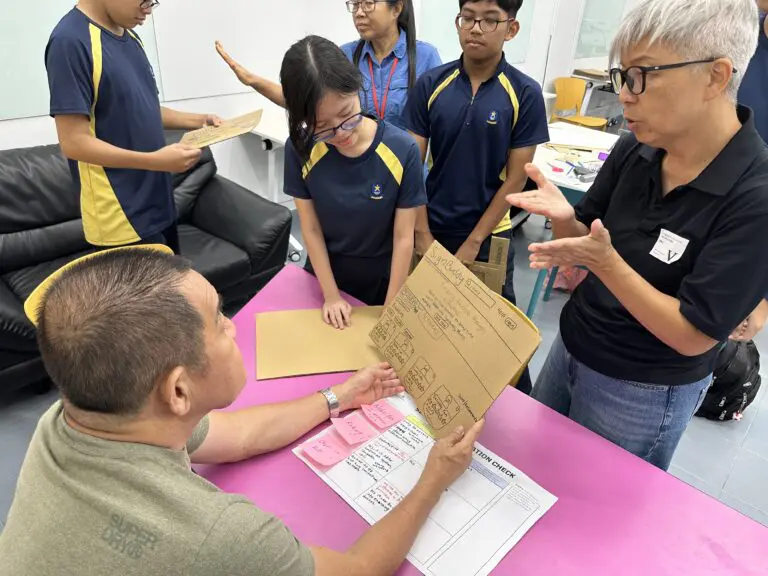




If you’ve researched design thinking programmes for your school, you’ve likely encountered several frameworks claiming to teach creative problem-solving. What separates C-Academy’s EDIT Design Thinking® from the rest isn’t just branding — it’s a structural and pedagogical approach built specifically for how secondary school students actually learn, behave, and grow in the Singapore education context.
WHO RUNS THIS PROGRAMME
C-Academy runs EDIT Design Thinking® workshops and programmes for Singapore secondary schools, aligned to MOE’s 21st Century Competencies, ALP and VIA.
1. What Most Design Thinking Frameworks Have in Common
The most widely referenced design thinking frameworks in education come from IDEO and Stanford’s d.school, typically presenting the design thinking process as five stages: Empathise, Define, Ideate, Prototype, and Test. The British Design Council’s Double Diamond is another widely used design thinking model, splitting the design process into Discover, Define, Develop, and Deliver.
Both design thinking models share a common logic: move from understanding a problem to generating and testing solutions. This linear-to-iterative design process has proven effective in corporate innovation labs and university design courses.
What most standard design thinking frameworks have in common, then, is that they were designed for adults with prior critical thinking experience, access to domain knowledge, and the motivational autonomy to drive their own process. They assume a learner who can self-direct. In a corporate context, that assumption holds. In a Secondary 3 classroom midway through Term 2, it often doesn’t.
This isn’t a criticism of those frameworks — they serve their intended contexts well. It’s simply an observation that applying a corporate or university design thinking approach directly to school students, without pedagogical adaptation, frequently produces surface-level outcomes: students who can name the phases but cannot navigate them independently, and facilitators who fill the gaps with instruction rather than facilitation.
2. Where the Standard Design Thinking Process Falls Short in a School Setting
Which design thinking framework is best for education? The honest answer is that most standard design thinking frameworks need significant scaffolding before they work reliably with secondary school students.
The most common failure points C-Academy’s facilitators observe when students encounter unmediated standard design thinking frameworks include:
These are not hypothetical concerns. Kimming Yap, C-Academy’s Managing Director, has observed these patterns across deliveries at schools including Sembawang Secondary and Northbrooks Secondary, where initial facilitation sessions revealed that students who had previously encountered design thinking through classroom-based modules struggled most — not because they lacked ability, but because they had been taught about the process rather than guided through it.
3. The Four Phases of EDIT Design Thinking® — and What Makes Each One Different
EDIT Design Thinking® stands for Empathise → Define → Ideate → Test. At first glance, this looks similar to the d.school model. The difference lies in what happens within each phase — and how those phases are scaffolded for a school delivery context. Understanding what makes EDIT Design Thinking® distinct starts with understanding what standard design thinking frameworks were never built to do.
Empathise
In standard design thinking frameworks, empathy work is often self-directed: go observe, go interview, come back with insights. In C-Academy’s approach, the Empathise phase is anchored to a Learning Journey — a structured site visit or interaction with a partner organisation (such as Pek Sin Choon, SADeaf, or the Jane Goodall Institute Singapore). Students observe real people in real contexts, guided by facilitated observation protocols that prevent surface-level conclusions. This grounds empathy in lived experience, not classroom roleplay — and it is where the design thinking principles of human-centred design become tangible rather than theoretical.
Define
The Define phase in EDIT Design Thinking® uses a deliberate scaffolding sequence: observations → empathy map → insight statement → HMW question. Each step is explicitly taught and practised before students move to the next. This prevents the common failure mode of students writing HMW statements that are either too broad (“How might we make the world better?”) or too solution-prescriptive (“How might we build an app?”).
Ideate
C-Academy uses two proprietary ideation tools — Random Cards and Idea Dice — to accelerate divergent thinking. These tools impose productive constraints that force students to combine unexpected concepts, breaking the default pattern of anchoring to the first idea. This is a structural difference from standard design thinking frameworks, which typically suggest brainstorming techniques without providing tangible tools calibrated for student use.
Test
The Test phase in EDIT Design Thinking® includes a Sweet Spot of Innovation evaluation: students assess their prototype against three intersecting criteria — desirability, viability, and feasibility — before presenting. This teaches students to think like designers and communicators simultaneously, a skill directly relevant to MOE’s applied learning outcomes.
4. How EDIT Design Thinking® Aligns With MOE’s 21st Century Competencies
How does the design thinking process align with Singapore’s MOE curriculum? MOE’s 21st Century Competencies (21CC) framework identifies Adaptive and Inventive Thinking, Communication, and Collaboration as core competencies for student development.
EDIT Design Thinking® maps directly onto these:
| EDIT Phase | 21CC Competency | How It’s Developed |
|—|—|—|
| Empathise | Communication | Active listening, perspective-taking, interview skills |
| Define | Adaptive Thinking | Synthesising ambiguous information into a clear problem frame |
| Ideate | Inventive Thinking | Divergent ideation using Random Cards and Idea Dice |
| Test | Collaboration | User feedback integration, team iteration, pitch presentation |
This alignment is not incidental. C-Academy designed EDIT Design Thinking® with the awareness that Singapore schools need programmes that can demonstrate competency development in terms educators, HODs, and school leaders recognise and report on. At Sembawang Secondary School, students who completed C-Academy’s full Design Thinking Workshop showed an overall increase in design thinking competence from 13.5% to 69.5% — a 56% improvement — measured via pre- and post-workshop assessments of their ability to apply design thinking skills.
5. A Practical Framework for Schools: Choosing the Right Design Thinking Approach
When evaluating design thinking frameworks for your school, the key questions are not about which model is most prestigious — they’re about what the design thinking approach does for your students in the time available.
A practical checklist for HODs and ALP coordinators:
EDIT Design Thinking® is designed to meet all four criteria. It was built by practitioners who have delivered it to students from Ngee Ann Secondary, Methodist Girls’ School (Secondary), Pei Hwa Secondary, and Hougang Secondary — not developed in a university lab and then adapted for schools.
6. Seeing EDIT Design Thinking® in Practice: Design Thinking Framework Examples From C-Academy School Deliveries
The difference between design thinking frameworks that read well on paper and one that works in a school setting shows up most clearly in the Define phase.
In a delivery at Northbrooks Secondary, C-Academy facilitator Mavis Chew observed that students initially wrote HMW statements that were either too broad or already embedded a solution. Rather than correcting the statements directly, the EDIT Design Thinking® scaffolding process guided students back to their empathy maps — asking them to identify the gap between what their user said, did, thought, and felt. Within a single session, the quality of problem framing shifted markedly. Students moved from “How might we make elderly people less lonely?” to nuanced, insight-driven questions about specific behaviours and unmet needs.
This is what human-centred design looks like in practice — not as a design thinking approach described in a slide deck, but as a lived design process that students navigate with real stakes. This outcome — the ability to frame a problem meaningfully before jumping to solutions — is precisely what standard design thinking frameworks struggle to produce when applied without pedagogical scaffolding. It is also, not coincidentally, the competency that most directly reflects MOE’s emphasis on adaptive and inventive thinking as a graduate outcome.
For Singapore schools looking for a design thinking programme that goes beyond surface exposure and produces measurable, reportable growth in student competencies, the structural differences of EDIT Design Thinking® are worth understanding in detail.
To learn more about how C-Academy delivers EDIT Design Thinking® in Singapore secondary schools, visit the about us page or explore the full range of design thinking workshops.
—