





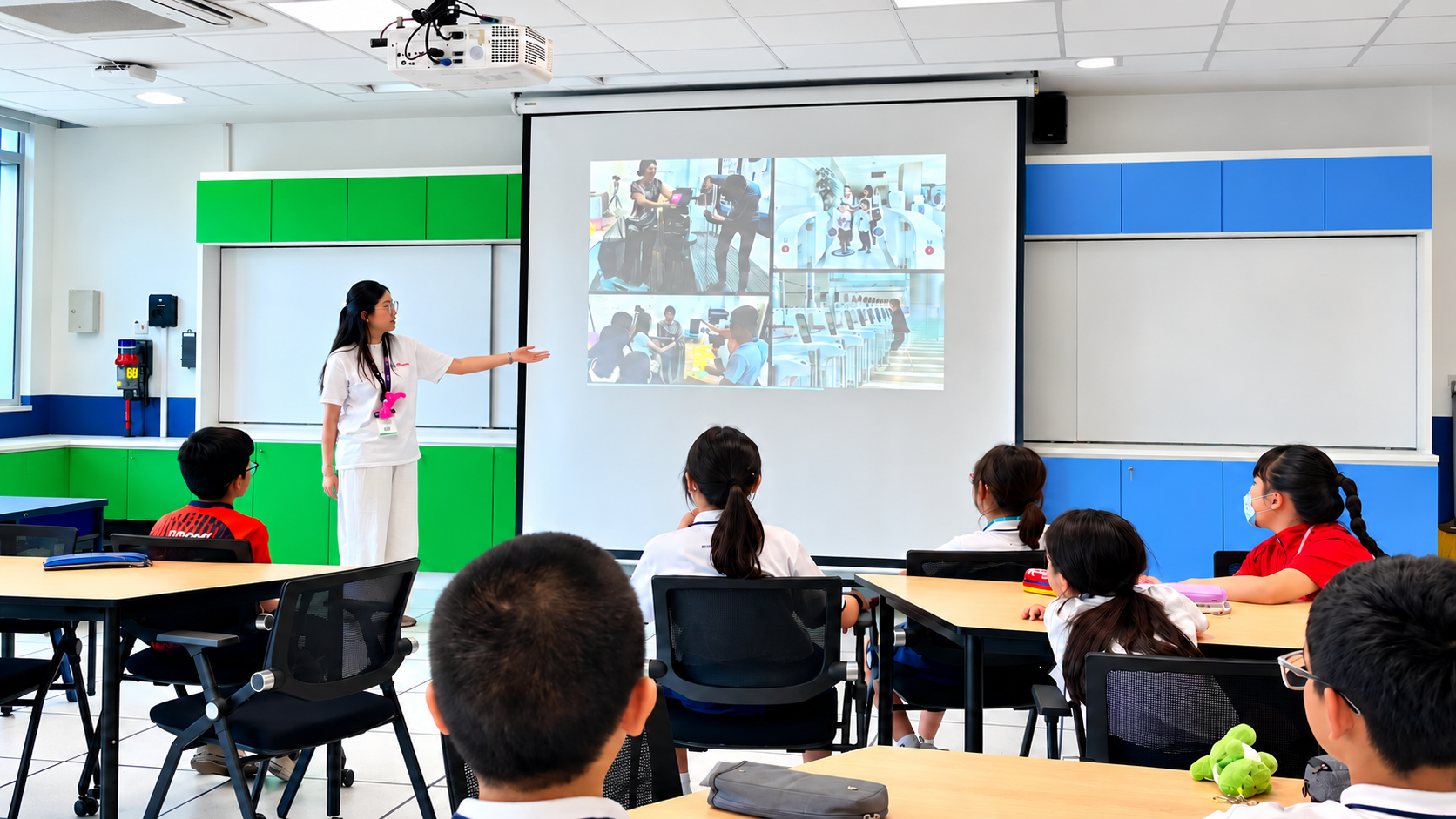
What a design thinking workshop looks like for primary students
Every workshop follows the same four stages of EDIT Design Thinking®, scaled to the age of the class.

Empathise
Students find out what a real person needs, by observing and asking questions.
Define
They turn what they found into one clear “How might we” question.
Ideate
They generate ideas with our Random Cards, for lateral thinking, and Idea Dice, for structured ideation.
Test
They build a simple prototype, show it to others and improve it from the feedback.
Design thinking at every primary level

Design Thinking for Primary 1 and 2
Students explore simple challenges through observation, discussion and hands-on making. Activities can use visual prompts and guided questions to help younger learners share and develop their ideas.

Design Thinking Workshops for Primary 3 and 4
Students learn to understand a problem, generate ideas and build simple prototypes. Through group activities, they practise sharing their ideas and responding to feedback from others.

Design Thinking Programme for Primary 5 and 6
Students work in teams to explore real-world challenges, understand people’s needs and develop possible solutions. They build and test prototypes, then use feedback to improve their ideas.
Design thinking workshop formats for primary schools
Where it fits in your school's programmes
Our design thinking workshops can support your school’s ALP, VIA, post-PSLE and post-exam activities, with challenges suited to your students’ level and the time available.

Design thinking for your primary school's ALP
Primary schools run their own Applied Learning Programme (ALP). Design thinking gives students a structured way to apply what they learn to a real problem, which is what an ALP is for. We customise the challenge to your ALP theme, your students’ level and the time available.

Design thinking for VIA projects
VIA runs in every primary and secondary school. The Empathise stage starts from a real community need, so a VIA project begins with a clear purpose.

Post-PSLE design thinking programme for Primary 6
After the PSLE, primary schools run post-PSLE activities for Primary 6 students in Term 4. A design thinking sprint or a short series of workshops fits this period.

Post-exam days for every level
Some schools set aside activity days for every level after the year-end examinations. A single workshop fits one day.
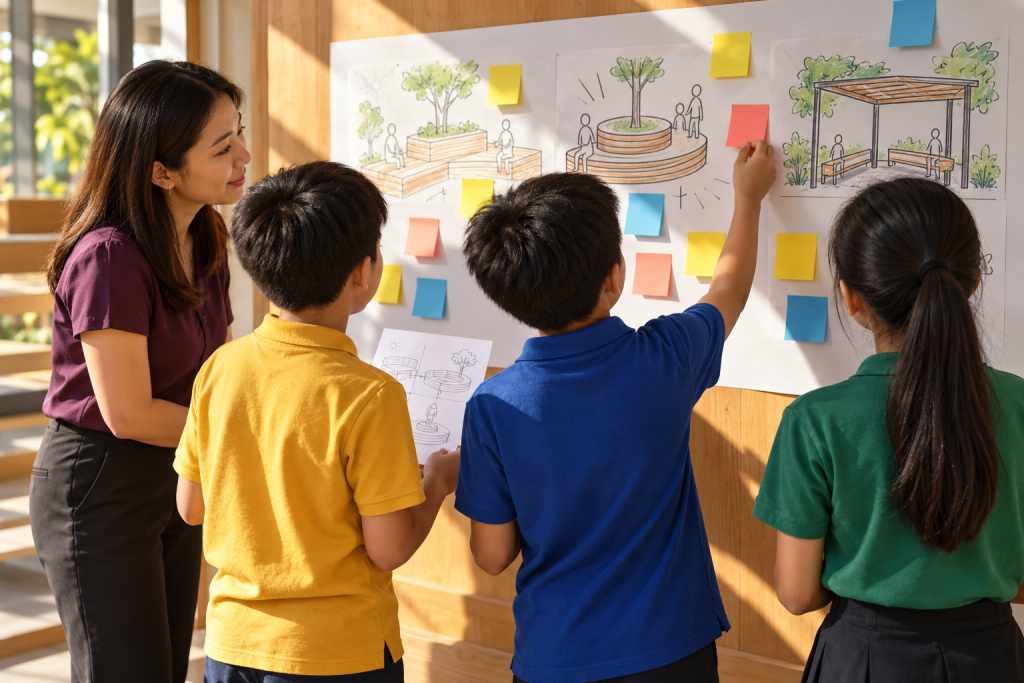
Design thinking and MOE's 21st Century Competencies
The activities map to two of MOE’s emerging 21CC: Critical, Adaptive and Inventive Thinking, and Communication, Collaboration and Information Skills.
Primary School Case Studies
So far we have worked with eight schools: seven secondary schools and Bedok Green Primary School.
Bedok Green Primary School: Turning Sustainability Ideas into Testable Solutions
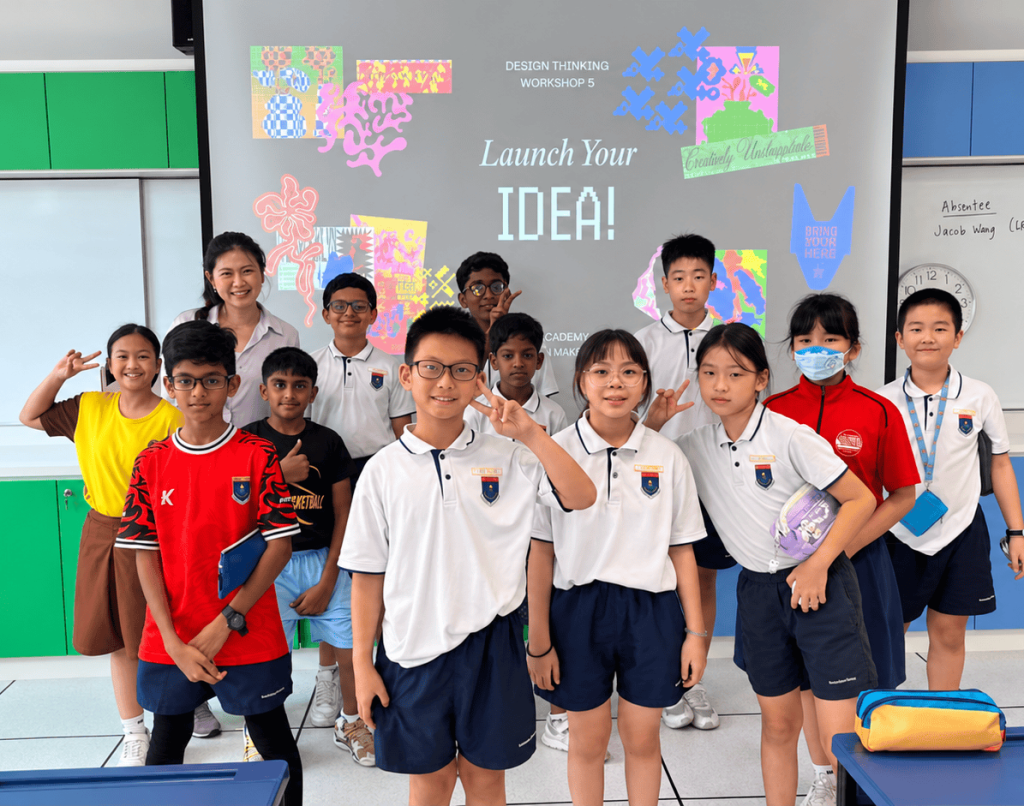
In 2026, the Green Makers Rapid Prototyping Workshop at Bedok Green Primary School guided Primary 3-5 students in developing their sustainability ideas through EDIT Design Thinking®
Through making, testing and peer feedback, students explored how to turn sustainability concepts into practical actions. The programme encouraged creative problem-solving and helped them consider how their ideas could better meet users’ needs.
- 5 hands-on sessions
- Sustainability ideas into prototypes
Why schools work with C-Academy

Practitioners
Learn with practising consultants from C-Academy, the education arm of Creativeans.

EDIT
A four-stage design thinking method supported by our Random Cards and Idea Dice.

Core Team
Workshops are delivered by our core team, with care and attention to each school’s needs.

8 Schools
Experience working with eight schools, from primary to secondary.

500+ Participants
More than 500 students and educators have participated, with over 200 prototypes built.
Master Trainers
Every programme is facilitated by certified trainers who are also practising consultants, ensuring learners get both theory and real-world practice.

Yulia Saksen
Lead Consultant
- Council Member of Institute of Management Consultants (Singapore)
- Registered Management Consultant (Enterprise Singapore)
- Certified WIAL Action Learning Coach
- Certified WSQ ACLP Trainer

Kimming Yap
Co-Founder & Lead Trainer
- Vice President of Design Business Chamber Singapore
- Academic Advisory Committee at Nanyang Academy of Fine Arts and Institute of Technical Education
- Distinguished Professor from Shanghai Academy of Fine Arts
- 50+ design awards
- Master in Design, Domus Academy.
- Campaign Asia 40 Under 40 (2025).

Mavis Chew
Design and Creative Teacher
- Branding Specialist & Illustrator
- Arts Educator & Curriculum Developer
- Advocate for Children’s Development through Creative Learning
Yulia Saksen
Lead Consultant
- Council Member of Institute of Management Consultants (Singapore)
- Registered Management Consultant (Enterprise Singapore)
- Certified WIAL Action Learning Coach
- Certified WSQ ACLP Trainer
Kimming Yap
Co-Founder & Lead Trainer
- Vice President of Design Business Chamber Singapore
- Academic Advisory Committee at Nanyang Academy of Fine Arts and Institute of Technical Education
- Distinguished Professor from Shanghai Academy of Fine Arts
- 50+ design awards
- Master in Design, Domus Academy.
- Campaign Asia 40 Under 40 (2025).
Mavis Chew
Design and Creative Teacher
- Branding Specialist & Illustrator
- Arts Educator & Curriculum Developer
- Advocate for Children’s Development through Creative Learning
FAQ
Which primary levels do you work with?

Primary 1 to Primary 6.
Can you run a post-PSLE programme for P6 students?
Yes. We plan it around your school’s post-PSLE schedule in Term 4.
Can the workshop be part of our ALP or VIA programme?
Yes. We customise the challenge to your ALP theme or VIA focus, your students’ level and the time available.
How many students can join one workshop?
Each facilitator usually works with up to 30 students. Let us know how many students you have, and we can discuss a suitable arrangement for your workshop.
What does the school need to provide?
The school should provide a space where students can work in groups and move around. We will discuss any equipment and other requirements with you when planning the workshop.
How long is a design thinking workshop for primary students?
The duration depends on the students’ level, the activities and your school’s timetable. Share your preferred duration with us, and we can discuss a suitable format.
How do we get a proposal?
Contact us with the students’ level, the number of participants, your preferred dates and what you would like students to work on. We will prepare a proposal based on your school’s needs.