



WHO RUNS THIS PROGRAMME
C-Academy runs EDIT Design Thinking® workshops and programmes for Singapore secondary schools, aligned to MOE’s 21st Century Competencies, ALP and VIA.
1. Why Traditional Cyber Wellness Briefings Often Don’t Stick
Ask any HOD (Student Development) in Singapore whether their students can recite the school’s rules on gaming addiction, the use of smartwatches during school hours, screen time, screen-free time, cyberbullying, and responsible sharing — most can. Ask whether those students apply those rules under social pressure at 11 PM on a Friday night — the answer is far less confident.
The gap is not knowledge. It is internalised understanding.
Traditional cyber wellness delivery in secondary schools tends to follow a familiar arc: a guest speaker or form teacher presents a set of guidelines, students view case studies drawn from the media, and a worksheet or quiz follows. This format works efficiently for coverage. It does not work well for behaviour change.
Research on adolescent decision-making consistently confirms what experienced educators already observe: teenagers process risk differently from adults. Consequences that are distant, abstract, or hypothetical register weakly. Social norms — what peers do, what peers approve of — register strongly. A presentation about the dangers of oversharing personal information online is processed as information. Watching a peer act out the moment they realise their private message was screenshotted and shared — and then being asked to redesign that experience — is processed as experience.
This is the distinction C-Academy’s facilitators encounter repeatedly in secondary school delivery. Students who had previously attended standard cyber wellness talks arrived already familiar with the terminology — cyberbullying, digital footprint, screen addiction. But when asked to empathise with a real-use scenario from the perspective of the person most affected, many acknowledged they had never considered that perspective before. Acquiring relevant skills through cyber wellness education requires more than passive delivery. Standard cyber wellness lessons rarely create the conditions for this kind of empathy. The vocabulary was there; the empathy was not.
What is covered in a cyber wellness workshop for students from primary to pre-university levels matters less than how it is structured. Coverage of MOE’s baseline cyber wellness topics — positive online behaviour, managing screen time, protecting privacy, safe use of technology, handling cyberbullying — is necessary but not sufficient. The question for school leaders evaluating providers should be: does the workshop produce behavioural change, or does it produce recall?
2. What a Design Thinking Approach to Cyber Wellness Actually Looks Like
Design thinking applied to cyber wellness does not mean making safety posters or building apps. It means applying a structured problem-solving process to real, human-centred digital dilemmas that students recognise from their own lives.
C-Academy’s EDIT Design Thinking® methodology — Empathise, Define, Ideate, Test — maps directly onto the complexity of digital wellness challenges. Each phase addresses a gap that passive delivery cannot fill.
Empathise
Students begin by interviewing peers, family members, or community members about their actual digital experiences: not what they think they should say about online safety, but what they genuinely encounter. In a typical Learning Journey session structured around this theme, C-Academy facilitators use guided prompts that surface underreported experiences: the discomfort of being excluded from a group chat, the pressure to maintain a curated social media identity, the pull of algorithmic content delivery, the anxiety of constant connectivity, and the challenge to manage negative influences in digital spaces.
C-Academy offers digital break workshops as part of extended programmes, giving students structured offline time to reflect on their digital habits. This phase consistently generates insights that surprise even educators.
Define
From their empathy data, students frame a “How Might We” (HMW) problem statement. This is where cyber wellness shifts from abstract to specific. Rather than addressing “cyberbullying” as a category, a group might frame: “How might we help Year 2 students who feel pressured to respond to messages immediately, even during study time?” The specificity forces students to consider the real human being at the centre of the problem — which is, structurally, what empathy training aims to do.
Ideate and Test
Student-generated ideas for peer-led cyber wellness interventions are routinely more practical than top-down school policies because they are grounded in how students actually use their devices. Prototypes have included peer support signal systems (a shared vocabulary for telling a friend “I need help with something online”), classroom norms cards co-created by the class rather than dictated by a teacher, and awareness campaigns designed specifically for the platforms students use — not the platforms adults assume they use.
The difference between cyber safety and cyber wellness for teenagers is precisely this: safety focuses on avoiding harm; wellness focuses on developing discerning users of technology and building the capacity to navigate a digital environment that is not going away. Design thinking develops the second.
3. How C-Academy Structures Its Cyber Wellness Design Thinking Workshop
C-Academy’s Cyber Wellness theme sits within its “Let Out Your Creativity” Design Thinking Workshop series, delivered to Singapore secondary school and Junior College students. A standard workshop runs across at least four sessions, with a minimum four-session structure ensuring sufficient depth for genuine empathy work and prototype development — a one-day briefing cannot replicate this.
The typical four-session structure for a Cyber Wellness Design Thinking Workshop:
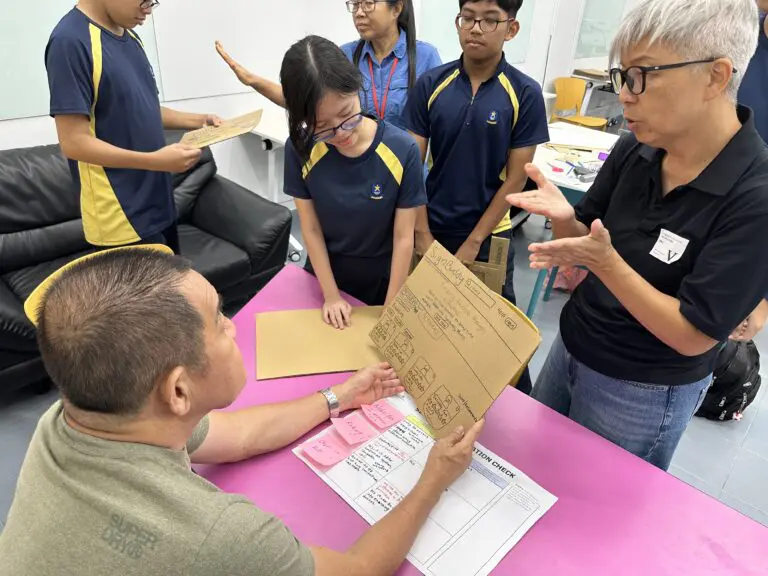
Session 1, Learning Journey: Students explore the landscape of digital wellness through structured observation and primary research. They interview peers, review real scenarios, and document empathy insights using C-Academy’s EDIT Design Thinking® empathy maps. Facilitators from C-Academy’s core team — practitioners who work across design consultancy and education — guide students through the distinction between symptomatic digital behaviours (excessive screen time, public oversharing) and underlying needs (connection, validation, boredom management).
Session 2, Introduction to EDIT Design Thinking®, Empathise, and Problem Definition: The EDIT Design Thinking® framework is introduced formally. Students synthesise their empathy research into HMW problem statements, working in groups of four to five. C-Academy’s facilitators have found consistently that groups of five or fewer generate more specific, human-centred problem statements than larger groups, because each voice has space within the definition discussion.
Session 3, Ideation, Prototyping, and Testing: Students generate ideas using structured ideation tools — including C-Academy’s Random Cards and Idea Dice — before selecting, building, and testing low-fidelity prototypes of their peer-led cyber wellness interventions. Testing with real peers (often students from adjacent classes or the wider school community) grounds the feedback in authentic responses.
Session 4, Final Presentation: Groups present their solutions to a panel that may include school leadership, HODs, or community representatives. The presentation format mirrors real-world pitch structures, developing communication competencies alongside cyber wellness understanding. Outputs include empathy maps, HMW statements, prototypes, and a value proposition for each proposed intervention.
This structure is aligned with MOE’s Applied Learning Programme (ALP) framework, and C-Academy is an established ALP provider for secondary schools in Singapore.
4. What Students Learn That Goes Beyond MOE’s Baseline Cyber Wellness Guidelines
MOE’s cyber wellness framework for secondary schools addresses five key areas: maintaining positive online presence, protecting personal information, recognising online risks, managing cyber relationships, and balancing online and offline activities. These are the floor, not the ceiling.
How does MOE’s cyber wellness framework apply to secondary schools? In practice, schools are required to address these areas across the curriculum and through co-curricular touchpoints. The framework provides what to cover; it does not prescribe how deeply.
What design-thinking-integrated cyber wellness workshops develop, beyond the MOE baseline, falls into three areas that are difficult to develop through instruction alone.
Perspective-taking under social pressure. MOE guidelines teach students that cyberbullying is wrong. A design thinking workshop gives students practice in recognising the social dynamics that make cyberbullying easy to participate in passively — the group chat silence when someone is excluded, the retweet that amplifies a rumour — and builds the habit of pausing to consider impact before acting. This is a practised skill, not a memorised rule.
Agency in digital environment design. Standard cyber wellness lessons and cyber wellness education positions students as users navigating a risky environment. EDIT Design Thinking® positions them as potential designers of that environment. Students who have prototyped a peer support system or co-created classroom digital norms understand that digital culture is built by people and can be changed by people. This shift in self-perception is measurable. Across C-Academy’s workshops, students consistently demonstrate higher post-programme scores in problem-framing and ideation — two competencies that correlate directly with this sense of agency. C-Academy’s impact data shows an average improvement of 37% in overall design thinking competence across cohorts, pre- to post-programme.
Across C-Academy’s Cyber Wellness programme, students develop six interconnected capacities: responsible digital leadership, through learning to set norms and model healthy online behaviour; empathy and perspective-taking, by listening deeply to how online interactions affect real wellbeing; practical intervention design, creating solutions safe to pilot in school with measurable outcomes; behaviour change thinking, designing micro-nudges that help peers pause and act more responsibly online; prototype and test skills, building cards, scripts, booth mockups, and journey maps then refining them through peer feedback; and the ability to communicate with clarity — presenting ideas as real programmes with a clear problem, insight, solution, and next steps.
Cross-disciplinary application. The EDIT Design Thinking® process students learn in a cyber wellness context applies directly to other 21st Century Competency challenges — environmental issues, community problems, personal challenges. MOE’s 21CC framework — which encompasses character and citizenship education — explicitly values adaptive and inventive thinking and collaborative communication. A design thinking workshop that uses cyber wellness as its context is simultaneously a 21CC development programme.
5. How to Evaluate Whether a Cyber Wellness Workshop Will Have Lasting Impact
School leaders evaluating providers for cyber wellness programmes should apply a consistent set of questions that go beyond the agenda and the facilitator’s credentials.
Does the programme include a structured empathy phase? If the workshop begins with information delivery rather than student research into real peer experiences, it is structured for coverage, not behaviour change. Ask the provider: how do students engage with people affected by the digital challenges being addressed?
Are students producing outputs, or receiving content? Workshops in which students leave with a handout are coverage programmes. Workshops in which students leave having built, tested, and presented a prototype — however low-fidelity — are design programmes. The act of building and testing creates accountability and recall that passive reception cannot.
Is the facilitator a practitioner or a presenter? There is a meaningful difference between a facilitator who works in design and education professionally and one who delivers a scripted programme. C-Academy’s core team includes practitioners with backgrounds in brand strategy, design consultancy, and education — Kimming Yap holds the position of Vice President at the Design Business Chamber Singapore and has over 15 years of experience; Yulia Saksen is a Registered Management Consultant with Enterprise Singapore and a qualified WIAL Action Learning Coach. These credentials matter not for status but because practitioner experience produces the kind of in-session adaptability that genuine student engagement requires.
Does the provider measure outcomes? Ask any prospective provider for pre/post data on student competency change. C-Academy uses independent assessors to evaluate student performance against a design thinking competency rubric before and after each programme, measuring empathy, problem-framing, ideation, and prototyping. Programmes without this kind of measurement have no basis for claiming lasting impact.
Is the programme length sufficient for depth? A single half-day session can introduce design thinking concepts. It cannot develop empathy practice, produce tested prototypes, and build communication competency. A minimum four-session programme is the appropriate structure for secondary school cyber wellness work that aims at behaviour change.
6. Planning a Cyber Wellness Workshop for Your Secondary School
For school leaders and HODs considering a cyber wellness design thinking programme, the planning considerations fall into three areas.
Timing and integration. Cyber wellness workshops integrate most effectively when timed to complement, rather than duplicate, existing MOE-mandated touchpoints. Many schools schedule enrichment-level programmes alongside co-curricular activities and Values in Action (VIA) initiatives, or as part of Safer Internet Day events. These co-curricular activities benefit from the depth that design thinking brings in Term 2 or Term 3, after mid-year assessments and before the intensity of end-of-year preparation. Post-examination periods offer an additional window in which student engagement tends to be higher and the pressure to cover curriculum content is lower.
Cohort selection. C-Academy’s Cyber Wellness Design Thinking Workshop is available for Secondary 1 to Secondary 5 cohorts. The appropriate entry point depends on the school’s current cyber wellness coverage and student readiness. Secondary 1 and 2 cohorts benefit from the empathy and problem-definition phases as a foundation. Secondary 3 and 4 cohorts, who typically have greater social complexity in their digital environments, often generate more nuanced prototypes and more compelling Final Presentation outputs.
Alignment with ALP and 21CC goals. Schools running an Applied Learning Programme can integrate a Cyber Wellness Design Thinking Workshop as an ALP strand, with C-Academy providing the structured EDIT Design Thinking® framework, facilitator team, and assessment data. This alignment allows the school to evidence 21CC competency development — particularly Adaptive and Inventive Thinking and Communication — through the workshop outcomes.
Schools interested in exploring this programme can contact C-Academy directly to discuss cohort size, session structure, and school calendar integration.
Cyber wellness is not a problem schools can solve alone. It requires a whole-of-society effort — with schools playing a central role, but working alongside efforts to work with parents and the wider community to reinforce healthy digital habits at home and beyond the classroom.