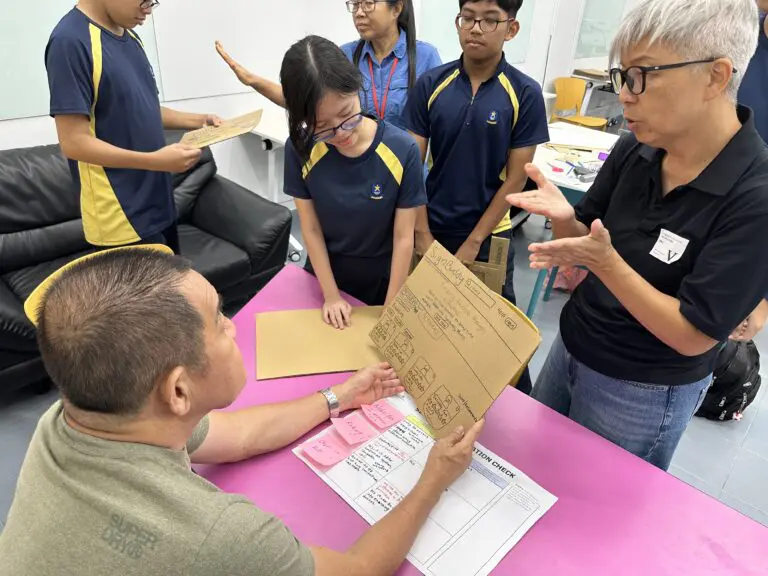




Student council leadership training in Singapore secondary schools builds motivated, committed student leaders. Design thinking adds something different: a structured method for developing problem solving skills to tackle real, ambiguous challenges that don’t have textbook answers. C-Academy’s design thinking workshops complement existing student council leadership development by giving student leaders a new set of practical skills and leadership qualities — empathising deeply, building communication skills, defining problems clearly, generating creative solutions, and testing them with the people affected.
WHO RUNS THIS PROGRAMME
C-Academy runs EDIT Design Thinking® workshops and programmes for Singapore secondary schools, aligned to MOE’s 21st Century Competencies, ALP and VIA.
1. Why Conventional Student Council Training Falls Short
Ask most secondary school HODs what their student council training looks like, and you will hear familiar answers: public speaking modules, team-building games, a talk from an alumni leader, perhaps a personality profiling exercise. These are not without value. But they share a common weakness — they teach leadership as a status to inhabit rather than a discipline to practise.
Many student council leadership programmes — from leadership camp formats to mentorship-based frameworks — are strong on structure, reflective practice, and leadership skills development. Design thinking offers a complementary set of leadership skills: it asks student leaders to identify a real problem facing their school community, engage directly with the people experiencing that problem, and prototype a response. When students practise this alongside their existing leadership training, leadership activities, and leadership experience, they leave with both the knowledge of leadership principles and the hands-on experience of applying them under conditions of real uncertainty.
This matters enormously in the Singapore secondary school context, where MOE’s 21st Century Competencies framework explicitly calls for students to develop Adaptive and Inventive Thinking — the capacity to generate novel responses to unfamiliar challenges. A student council that has only ever been trained to follow procedures and deliver speeches is poorly equipped to apply that competency when something unexpected happens during a school event, or when a genuine student welfare issue surfaces and no one knows the right answer.
C-Academy has worked with students from schools including Sembawang Secondary School, Ngee Ann Secondary, and Hougang Secondary. A consistent pattern emerges across cohorts: students who develop design thinking skills in a workshop context carry those leadership skills into every leadership role and across different leadership roles they take on. If general secondary school students can significantly improve their problem-framing and empathy capabilities through a single design thinking programme, student leaders at every stage — from leadership probation through to senior leadership roles and leadership positions — gain an additional edge: they can apply the same skills to initiating, leading, and improving things for their peers, creating new leadership opportunities in the process.
The gap between knowing about leadership and practising it shows up in a predictable place: student-led initiatives that miss the mark. Events planned for the student body without meaningful input from the student body. Welfare campaigns designed around what leaders assume their peers need rather than what peers have actually said. Design thinking addresses this directly, because it builds the habit of empathy before action — as a skill, not a value statement.
2. What Design Thinking Adds to Student Leadership Development
Design thinking is not a creativity exercise. It is a structured problem-solving discipline that begins with human understanding and ends with tested, iterable solutions. For student council leadership training, this distinction is critical: it gives students a method for leading, not just a mindset.
The reason design thinking works particularly well for student leaders is that it mirrors what effective leadership actually demands. When a student council president has to respond to a conflict between CCAs, or when a welfare team needs to address rising stress levels before major examinations, they cannot solve the problem by applying a generic leadership principle. They need to understand the specific people involved, define the specific problem in a way that is accurate and actionable, generate options, and then test their response before committing resources to it.
Design thinking trains exactly this sequence. It gives student leaders a repeatable process they can apply to any human-centred problem — which is, in practice, all the problems student leaders face.
There is also a second advantage specific to Singapore’s education landscape. MOE’s Applied Learning Programme (ALP) framework encourages schools to connect learning to authentic real-world contexts. C-Academy’s design thinking workshops are not an ALP programme, but they can be structured to align with a school’s ALP goals and intended outcomes — the programme structure is flexible and open to discussion with each school. When designed this way, leadership development and applied learning happen simultaneously, making it easier for HODs to justify the programme within the school’s academic calendar and to demonstrate outcomes to school leadership.
C-Academy facilitators have observed a consistent shift in student behaviour across multiple school cohorts: students who complete a design thinking-based leadership programme are more likely to ask “who else should we speak to before we decide?” before launching an initiative. That question — small as it sounds — is one of the clearest behavioural indicators of genuine leadership development.
3. How EDIT Design Thinking® Is Structured for Student Council Programmes
C-Academy’s EDIT Design Thinking® is the methodology used in every C-Academy design thinking workshop — including the Let Out Your Creativity workshop, which is available in themes relevant to schools such as community, cyber wellness, and sustainability. The methodology moves through four phases — Empathise, Define, Ideate, and Test — and when applied to student council leadership training, a full programme includes six stages, each producing a concrete output:
1. Learning Journey. Students visit a real community or school context as observers and interviewers — not to pitch solutions, but to listen. Site visits or guest organisations relevant to the workshop theme provide the real-world grounding for the rest of the programme. This stage is deliberately uncomfortable for students accustomed to being the ones with answers; that discomfort is intentional and pedagogically important.
2. Empathise. Back in the workshop, students consolidate what they observed and heard, building empathy maps and surfacing the human insights that will anchor their problem definition.
3. Problem Definition (Define). Students work through the Define phase to produce a How Might We (HMW) statement — a precisely framed problem validated against real evidence, not assumptions. The HMW statement is not a solution; it is the starting point for generating one.
4. Ideation. Using Idea Dice and Random Cards — C-Academy’s proprietary ideation tools — students generate a wide range of potential responses to their HMW statement. Structured divergent thinking comes before convergence; quantity of ideas comes before quality judgement.
5. Prototyping and Testing. Students build low-fidelity prototypes and test them with real users, gathering feedback and iterating. This is not hypothetical: student council members test their ideas with actual schoolmates during the session.
6. Final Pitch Presentation. Teams present their validated solutions to school leadership, developing public speaking skills as they articulate the problem they identified, the evidence they gathered, the options they considered, and the solution they are recommending. The presentation is structured around a value proposition and assessed against a Sweet Spot of Innovation framework.
The duration and number of sessions is flexible and open to discussion with each school. What defines a full programme is the presence of all six stages, each building on the previous one.
4. What Student Leaders Actually Gain: Skills Beyond the Session
The skills developed through a design thinking-based student council leadership programme extend well beyond the workshop itself. This is one of the strongest arguments for incorporating design thinking into a student council leadership development programme: the competencies are transferable, measurable, and complement what students already build through existing leadership training.
Structured empathy. Student leaders learn to gather and synthesise qualitative information from real people before forming judgements. In practice, this means running student surveys, conducting short interviews, and building empathy maps as a standard part of planning any initiative. This habit, once formed, does not disappear after the workshop.
Problem precision. The ability to write a good HMW statement sounds minor. It is not. A student council that frames its work around precisely defined, evidence-based problems will consistently produce more relevant outcomes than one that defaults to solutions shaped by the loudest voice in the room. Several student leaders across C-Academy’s partner schools have described the HMW exercise as the most practically useful thing they learned in the entire programme.
Collaborative ideation. Design thinking workshops require students to generate ideas in structured conditions — not just free-form brainstorming, but guided ideation using tools like the Idea Dice that prompt divergent thinking. Student leaders who have practised this can facilitate ideation sessions with their council independently, without external support.
Resilience through iteration. One of the most significant observable outcomes from C-Academy’s school delivery is a shift in how student leaders relate to failure. In some learning contexts, getting something wrong can feel like a personal inadequacy. In design thinking, an idea that does not test well is simply a data point that improves the next iteration. Student council members who have gone through the prototype-and-test cycle are notably less defensive about peer feedback on their initiatives.
C-Academy’s impact data supports this: across cohorts, schools have seen an average 37% improvement in overall design thinking competence from pre- to post-programme assessment, measured via an independent pre/post student survey assessing teamwork and collaboration, empathy, problem-framing, ideation, and prototyping. At Sembawang Secondary School specifically, overall design thinking competence scores rose from 13.5% to 69.5% — a 56% improvement across the cohort.
5. How to Know If Your School’s Leadership Training Is Working
This is a question most schools cannot answer with confidence — and that is a problem in itself. If student council leadership training is worth the time, budget, and displacement from curriculum, it should produce observable changes in student behaviour and capability.
Here are three practical indicators HODs and VPs can use to assess whether their current leadership training is delivering:
1. Do student council members ask better questions before launching initiatives? If leaders are still planning events based on assumptions rather than peer input, the training has not shifted the core behaviour. Look for evidence of empathy-gathering: surveys, peer conversations, observations.
2. Can students articulate a problem they are trying to solve? A strong indicator of design thinking capability is the ability to frame a problem statement that is specific, human-centred, and distinct from a solution. Ask a student council president to describe what problem their most recent initiative was addressing. Vague answers suggest the training is not building problem-definition skills.
3. Are initiatives improving over time? Leadership development should produce compounding outcomes — each cohort learning from the previous one, each initiative better calibrated to actual student needs — and students stepping into more meaningful leadership roles over time. If your student council’s events look the same year after year and generate similar levels of engagement, the training is maintaining the status quo rather than developing capability.
C-Academy’s assessment approach uses independent pre/post surveys that measure overall design thinking competence across the cohort. The assessors are external to the facilitating team, which removes facilitation bias from the results. Schools that want to move beyond anecdote and gut-feel when evaluating leadership programme effectiveness should look for providers who use this kind of structured, independent measurement.
6. Choosing the Right Partner for Student Council Leadership Training in Singapore
For HODs and school leaders evaluating external providers, the decision involves more than comparing programme outlines. The quality of facilitation, the rigour of the methodology, and the provider’s understanding of Singapore’s secondary school context all affect whether the training produces lasting change or a positive-but-forgettable workshop experience.
Practitioner delivery matters. C-Academy’s workshops are facilitated by its core team — Kimming Yap, Yulia Saksen, and Mavis Chew — rather than outsourced to freelance trainers. Kimming, who serves as Vice President of the Design Business Chamber Singapore and holds an advisory role at NAFA and ITE, brings a professional design practice lens to every leadership session. Yulia, a WIAL-certified Action Learning Coach and WSQ ACLP Trainer, ensures the facilitation approach meets adult and youth learning standards. The result is a materially different experience from a generic trainer delivering off-the-shelf content.
Methodology specificity matters. EDIT Design Thinking® is a proprietary methodology developed through years of practice in Singapore schools and with the business clients of Creativeans, C-Academy’s parent company. It is not a repackaged version of the Stanford d.school model or a generic design thinking framework pulled from a certification course. The phases, tools, and facilitation approaches have been refined through real delivery with Singapore secondary school students.
MOE alignment matters. Providers who understand the Applied Learning Programme framework, the 21CC competencies, and the constraints of the Singapore school calendar will build programmes that fit within your school’s existing structure rather than requiring significant disruption to accommodate them. C-Academy’s ALP-aligned programmes are designed with these constraints built in, and the team has direct experience working within secondary school timetables and with HODs managing competing priorities.
For schools considering student council leadership training as part of their ALP or enrichment calendar, C-Academy’s workshops with our EDIT Design Thinking® methodology provide a starting point for understanding what a structured, measurable, practitioner-led programme looks like in practice.