



Not all cyber wellness workshops leave students thinking differently on Monday morning. Cyber safety and cyber wellness in Singapore are priorities for MOE and school leaders alike, but the gap between a good-looking programme and one that actually shifts student behaviour is significant. For Singapore secondary school HODs evaluating providers, the real question is not what topics a workshop covers — it is whether students will actually behave differently online after attending. The answer depends far less on content and far more on how that content is delivered.

WHO RUNS THIS PROGRAMME
C-Academy runs EDIT Design Thinking® workshops and programmes for Singapore secondary schools, aligned to MOE’s 21st Century Competencies, ALP and VIA.
1. Why Most Cyber Wellness Workshops Fail to Change Behaviour
The most common cyber wellness workshop format follows a predictable pattern: a speaker presents slides on screen time, cyber bullying, and privacy risks; students listen; students complete a reflection worksheet; the session ends. These sessions often form the entirety of a school’s cyber wellness curriculum, without a structured cyber wellness framework to ensure lasting impact. Awareness goes up temporarily. Behaviour rarely changes.
This is not a content problem. Most providers cover the right topics. The failure is structural — these sessions are designed for knowledge transfer, not behaviour change. There is a meaningful difference between the two, and conflating them is why many schools find that the same issues resurface among students three months after a workshop.
C-Academy’s facilitators have observed this pattern directly when working with secondary school students across Singapore. When students are asked, post-session, what they remember from a previous cyber wellness talk, the most common responses are slogans and statistics — not personal decisions or changed habits. The information was received. It simply was not integrated into how students make choices online.
Schools that rely solely on cyber awareness talks without a behaviour-change structure find that cyber ethics conversations remain surface-level. The structural problem is passive delivery. When students are positioned as an audience rather than participants, they process the session as external information rather than a personal challenge. Behaviour change requires a different cognitive process — one that involves reflection, decision-making, and practice.
2. The Difference Between Awareness and Behaviour Change
What is cyber wellness? At its core, it is the ability to use technology in a way that is safe, responsible, and positive for oneself and others. Awareness means a student knows that oversharing personal information online carries risk. Behaviour change means that same student pauses before posting and makes a different decision.
The gap between those two outcomes is not filled by more information. It is filled by experience, reflection, and personal relevance. Research in behavioural psychology consistently shows that people change habits when they connect new information to their own lived experience — not when they receive it abstractly.
For cyber wellness specifically, this means workshops need to create conditions where students examine their own online behaviours, including how they manage their digital footprint, how they present their digital identity, and how they navigate issues like netiquette and online harassment — not hypothetical ones — and experience the consequences of different choices in a safe environment.
This is where design thinking becomes relevant. C-Academy’s EDIT Design Thinking® methodology begins with Empathise — a structured process of deep observation and reflection. When applied to cyber wellness, this means students spend time genuinely examining how they use technology, what drives certain online behaviours, and how their digital choices affect themselves and others. That empathy process, applied to the student’s own experience, is what bridges awareness and behaviour change.
What should a cyber wellness workshop include? Beyond topic coverage, it should include structured reflection on personal behaviour, peer discussion that surfaces real tensions students face, and a decision-making exercise that is personally relevant — not a scenario about a fictional character.
3. What Research and Classroom Experience Tell Us About Lasting Impact
Research on behaviour change programmes — from health education to financial literacy — consistently identifies three conditions for lasting impact: personal relevance, social norms, and self-efficacy (the belief that one can act differently).
Generic cyber wellness programmes often miss all three. The scenarios feel distant, the peer discussion is surface-level, and students leave without having practised making a different choice.
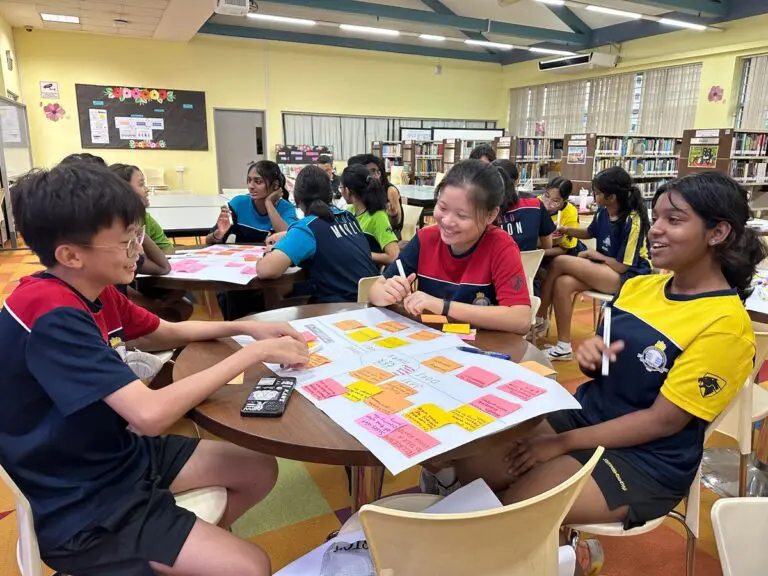
C-Academy’s experience delivering workshops with students from schools including Sembawang Secondary School and Hougang Secondary School has reinforced this. Topics that resonate most with secondary students include online grooming, online predators, pathological gaming, cyber relationships, and the role of digital parenting in shaping healthy digital habits. When students are given genuine agency in the workshop — when they define the problem themselves, generate solutions, and test their thinking against peer feedback — the engagement shifts noticeably. Students who might disengage from a lecture-format session become active participants when the problem is framed as theirs to solve.
Facilitator Kimming Yap, co-founder of C-Academy and VP of the Design Business Chamber Singapore, has observed that students who articulate the problem in their own words are far more likely to retain and act on their conclusions than students who are told what the problem is. This insight shapes how C-Academy structures every cyber wellness session — the Define phase of EDIT Design Thinking® requires students to arrive at their own “How Might We” problem statements, grounded in their empathy research.
How do you measure the effectiveness of a cyber wellness programme? Pre- and post-session surveys measuring changes in reported behaviour intentions are a baseline. Stronger indicators include: whether students can articulate why a behaviour is risky in their own words, whether peer discussion reflects genuine attitude shifts, and whether teachers observe changed behaviour in the weeks following.
4. Six Things to Look For When Evaluating a Cyber Wellness Workshop
When assessing a cyber wellness provider, HODs should look beyond topic lists and delivery credentials. These six indicators distinguish behaviour-focused programmes from awareness-only sessions:
- Student agency. Are students solving a problem, or receiving a presentation? Behaviour change requires active participation, not passive attendance.
- Personal relevance. Does the session address students’ actual online behaviours, or generic scenarios? The closer the content is to students’ real digital lives, the stronger the impact.
- Structured reflection. Is there a deliberate process for students to examine their own habits — not just evaluate a fictional character’s choices?
- Peer dialogue. Does the format create genuine peer-to-peer discussion? Social norms are one of the strongest drivers of adolescent behaviour; programmes that leverage peer influence are more effective.
- A decision-making component. Students should practise making different choices, not just identify the “correct” answer to a multiple-choice question.
- Post-session reinforcement. Does the provider offer any follow-through — a teacher guide, a classroom activity, or a reflection prompt students can revisit?
C-Academy’s cyber wellness design thinking workshop is structured around all six. The programme incorporates cyberwellness frameworks aligned with MOE’s Touch Cyber Wellness approach, and addresses digital citizenship, cyber security awareness, and the role of parental controls as part of a holistic cyber wellness ecosystem. The programme aligns with MOE’s 21st Century Competencies framework, specifically the Civic Literacy, Global Awareness and Cross-Cultural Skills domain, and supports schools’ Values in Action (VIA) outcomes by grounding the work in real-world impact.
5. How Design Thinking Strengthens Cyber Wellness Outcomes
Design thinking is not a subject — it is a problem-solving process. Applied to cyber wellness, it reframes the session from “here are the risks online” to “here is a real challenge in how we use technology — let us understand it, define it, and develop better approaches.”
C-Academy’s EDIT Design Thinking® methodology moves through four phases: Empathise, Define, Ideate, and Test. In a cyber wellness context:
Empathise
Students observe and reflect on their own and peers’ digital behaviours without judgement. This surfaces the real tensions they face — peer pressure to share, fear of missing out, unclear boundaries around privacy.
Define
Students frame the problem in their own words using a “How Might We” statement. This step is critical: a student who defines the problem owns it. “How might we help our peers make more intentional choices about what we share online?” is a fundamentally different cognitive position from “cyberbullying is wrong.”
Ideate
Students generate practical solutions — not policies, but personal habits, peer norms, or tools they could realistically adopt. This is where Random Cards and Idea Dice (C-Academy’s proprietary ideation tools) accelerate divergent thinking.
Test
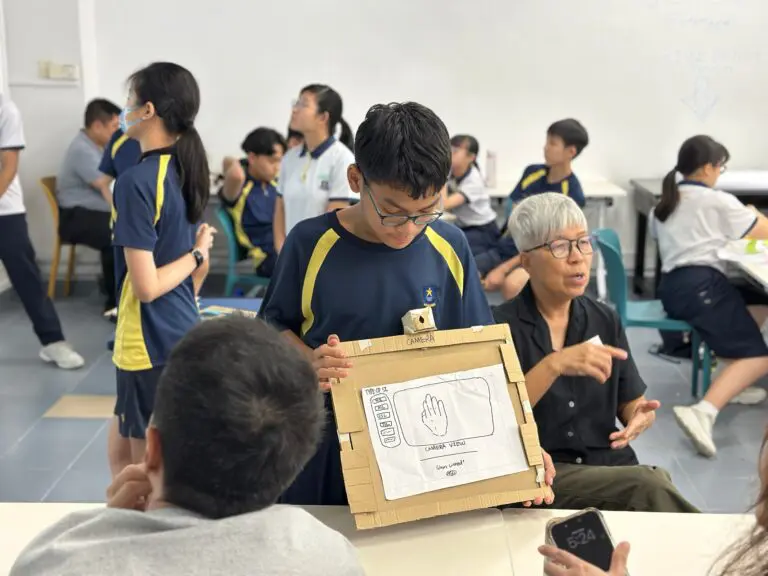
Students share their ideas with peers and receive feedback, refining their approach based on real reactions. This rehearsal of decision-making under social conditions mirrors the actual challenge of online behaviour.
What is the difference between cyber wellness and digital literacy? Digital literacy, sometimes referred to as cyberlite capability, focuses on skills and knowledge — understanding how platforms work, how to evaluate information, how to protect privacy technically. Cyber wellness encompasses the behavioural and emotional dimensions — how students manage relationships, wellbeing, and ethical decisions in digital spaces. The strongest programmes address both.
6. What a Behaviour-Focused Cyber Wellness Session Looks Like in Practice
A standard C-Academy cyber wellness design thinking workshop for secondary schools runs across at least four sessions:
- Session 1, Learning Journey: Students visit or engage with an organisation working on digital wellbeing or civic responsibility — grounding the topic in a real-world context beyond the classroom.
- Session 2: Introduction to EDIT Design Thinking®, guided Empathise activities examining students’ own digital behaviours, and Problem Definition using How Might We statements.
- Session 3: Ideation using structured creative tools, followed by rapid prototyping of a chosen solution — which might be a peer campaign, a classroom norm, or a personal commitment framework.
- Session 4, Final Presentation: Students pitch their solutions to peers and teachers, articulating their reasoning and receiving feedback. The presentation process requires students to defend their thinking — the strongest possible reinforcement of ownership.
This structure is what separates a session students experience from a session students merely attend.
7. Questions to Ask a Cyber Wellness Provider Before You Book
Before committing to a provider, HODs should ask:
- What is your theory of change? How does your programme move students from awareness to different behaviour?
- What does student participation look like? Are students solving a problem or receiving content?
- How do you measure impact? Can you share pre/post data from previous school deliveries?
- How does your programme align with MOE’s 21CC framework? Specifically, which competencies does it target and how?
- What happens after the session? Is there a teacher guide, follow-up activity, or reinforcement mechanism?
- Who delivers it? Are facilitators practising professionals with school delivery experience, or trainers working from a script?
A provider who cannot answer these questions confidently is likely running an awareness programme. A provider who answers them with specifics — including outcome data and a clear pedagogical rationale — is running something designed to change behaviour.
C-Academy’s cyber wellness programme has been delivered to secondary school students across Singapore. For schools considering a workshop that goes beyond awareness, the [cyber wellness education programme](/let-out-your-creativity/cyber-wellness-education-singapore/) page outlines the full approach.