



WHO RUNS THIS PROGRAMME
C-Academy runs EDIT Design Thinking® workshops and programmes for Singapore secondary schools, aligned to MOE’s 21st Century Competencies, ALP and VIA.
1. Why Communication Skills Are a Design Thinking Outcome, Not a Side Effect
Most discussions about design thinking in schools focus on creativity and problem-solving. Communication tends to be treated as incidental, something students pick up along the way. In practice, it is far more deliberate than that.
Communication is embedded in the structure of design thinking, not bolted on. Every phase requires students to communicate in a different mode: listening, questioning, framing, pitching, and defending ideas. When a student conducts an empathy interview, they are practising active listening and open-ended questioning. When they write a “How Might We” statement, they are learning to articulate a problem statement with precision. When they present a prototype to peers, they are practising structured persuasion under pressure.
C-Academy’s facilitators observe this consistently across Singapore secondary school deliveries. Students who struggle to speak up in classroom settings often find their voice during empathy interviews, because the task is concrete: they are listening to a real person, asking about a real experience. The communication demand is purposeful, not performative.
This distinction matters for HODs and teachers evaluating programmes. A workshop that only asks students to present at the end develops one communication skill. A programme that builds communication at every stage, as C-Academy’s EDIT Design Thinking® methodology does, develops a full repertoire. This is what separates innovation workshops that deliver measurable outcomes from those that remain surface-level activities.
The design thinking process itself functions as a communication training framework. Each phase demands a different communication mode, building critical thinking and team communication in parallel with creative problem solving.
2. How the EDIT Design Thinking® Methodology Develops Communication at Every Stage
C-Academy’s proprietary EDIT Design Thinking® methodology moves through four phases (Empathise, Define, Ideate, and Test), each of which targets a specific communication capability. This design thinking framework is structured to build communication strategies progressively, not as isolated skills.
Empathise: Building Active Listening and User Research Skills
Students conduct structured empathy interviews with real stakeholders or community members during the Learning Journey session. This builds active listening, the ability to ask follow-up questions, and the discipline of not projecting assumptions onto what is heard. Facilitators at C-Academy use empathy mapping exercises immediately after interviews to help students translate what they heard into written observations, bridging spoken and written communication simultaneously.
The empathy interview stage also introduces students to user experience design principles. They learn to observe not just what people say, but what they do, a core skill in professional design thinking training. This dual focus on verbal and observational communication sets the foundation for the entire design thinking process.
Define: Developing Precision in Problem Framing
The Define phase requires students to craft a “How Might We” (HMW) statement, a single sentence that captures the core problem without prescribing a solution. This is one of the most communication-intensive tasks in the programme. Students must be precise, concise, and accurate. Vague HMW statements produce vague solutions, so facilitators push students to revise and sharpen their language repeatedly. This iterative drafting process mirrors professional written communication in ways that most school writing tasks do not.
The HMW framing exercise builds critical thinking by forcing students to distinguish between symptoms and root causes. It also introduces feedback loops: students present their problem statements to peers, receive critique, and refine. This cycle of articulation, feedback, and revision is central to both the design thinking methodology and professional communication strategies.
Ideate: Practising Verbal Fluency and Collaborative Creativity
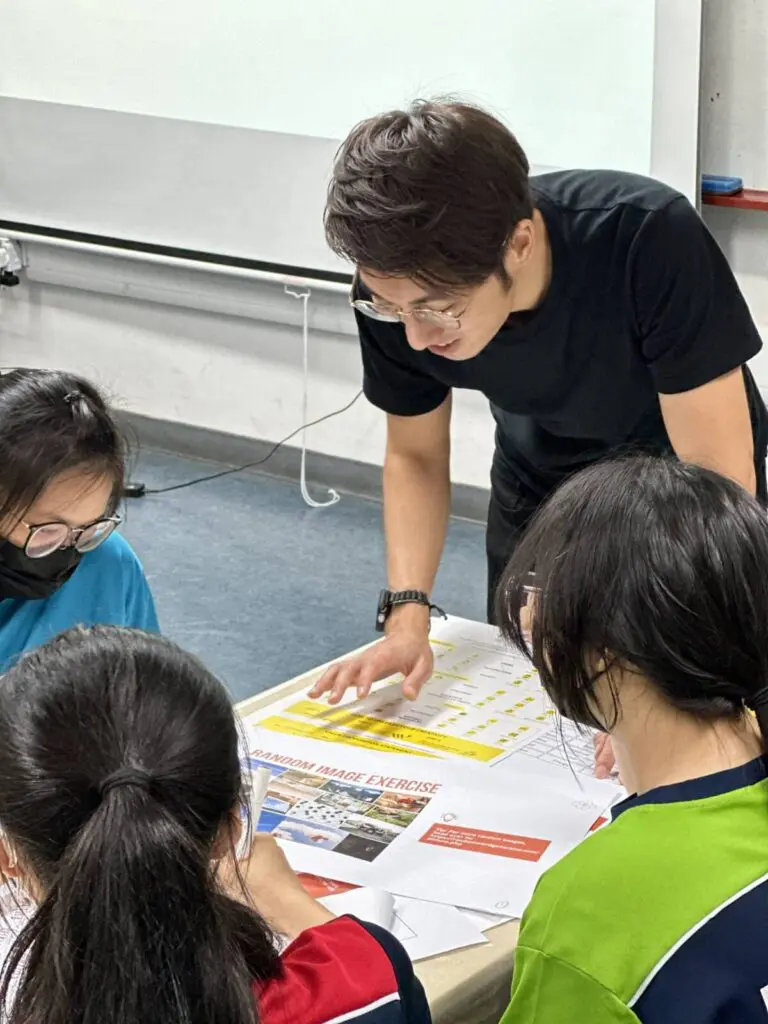
Using tools such as C-Academy’s Random Cards and Idea Dice, students generate ideas rapidly and then advocate for their strongest concepts to the group. This builds verbal fluency and persuasion in a low-stakes environment. Because no single idea is precious at this stage, students learn to articulate ideas quickly and clearly without over-investment in the outcome.
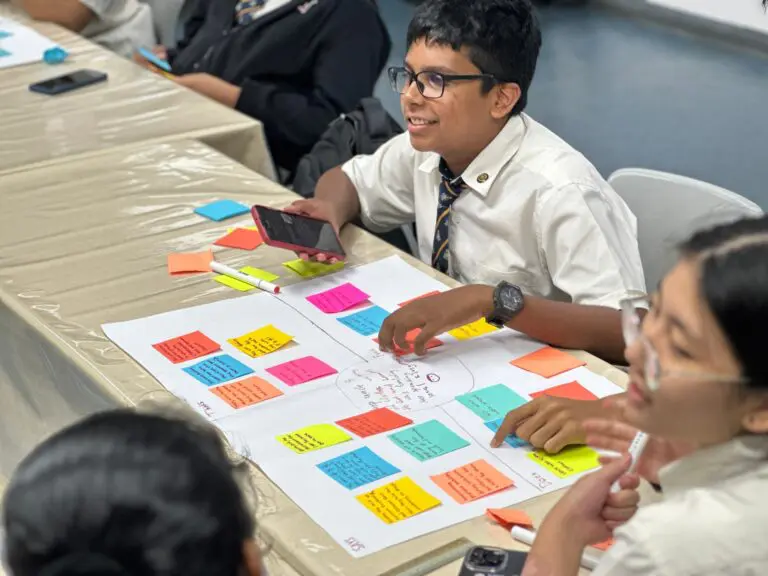
The ideation phase also introduces visual thinking and graphic facilitation techniques. Students sketch concepts, use sticky notes to cluster ideas, and present rough prototypes to peers. This multi-modal communication (verbal, written, and visual) builds a communication repertoire that extends far beyond traditional classroom presentation skills.
Facilitation skills are modelled by C-Academy’s practitioners during this phase. Students observe how facilitators manage idea generation, encourage cross-collaboration, and keep the workshop agenda moving without stifling creative thinking. These are transferable skills that students apply in subsequent group work across subjects.
Test: Learning to Receive and Integrate Feedback
Students present prototypes to peers and facilitators, receive structured feedback, and iterate. This phase develops the ability to receive critique without defensiveness and to explain design decisions under questioning, skills that transfer directly to professional and academic contexts.
The Test phase also introduces students to agile methodologies in practice. Rather than perfecting a solution in isolation, students test early, gather feedback, and iterate. This rapid prototyping cycle mirrors professional design sprint practices and builds creative confidence, the belief that ideas can be improved through iteration rather than abandoned at the first sign of critique.
3. From Empathy Interviews to Final Pitch: A Communication Skills Progression
One of the strongest features of a full C-Academy Design Thinking Workshop is the communication skills arc students travel across all four sessions.
- Session 1, Learning Journey: Students observe and interview stakeholders in a real-world setting. Communication skill: listening, questioning, field note-taking.
- Session 2, Empathise and Problem Definition: Students share findings with their group and co-create HMW statements. Communication skill: summarising, synthesising, precise written articulation.
- Session 3, Ideation, Prototyping and Testing: Students pitch ideas within teams and explain prototype decisions to peers. Communication skill: verbal persuasion, visual explanation, receiving feedback through structured feedback loops.
- Session 4, Final Pitch Presentation: Students present their value proposition and prototype to a panel. Communication skill: structured public speaking, responding to panel questions, sustained narrative.
By the time students reach the final pitch, they have practised communication in at least six distinct modes. C-Academy facilitators at schools including Sembawang Secondary School and Ngee Ann Secondary School have observed that students who are notably quiet in classroom settings often demonstrate confident, structured delivery in the final pitch. This is precisely because the earlier stages built their confidence incrementally rather than asking for performance from the outset.
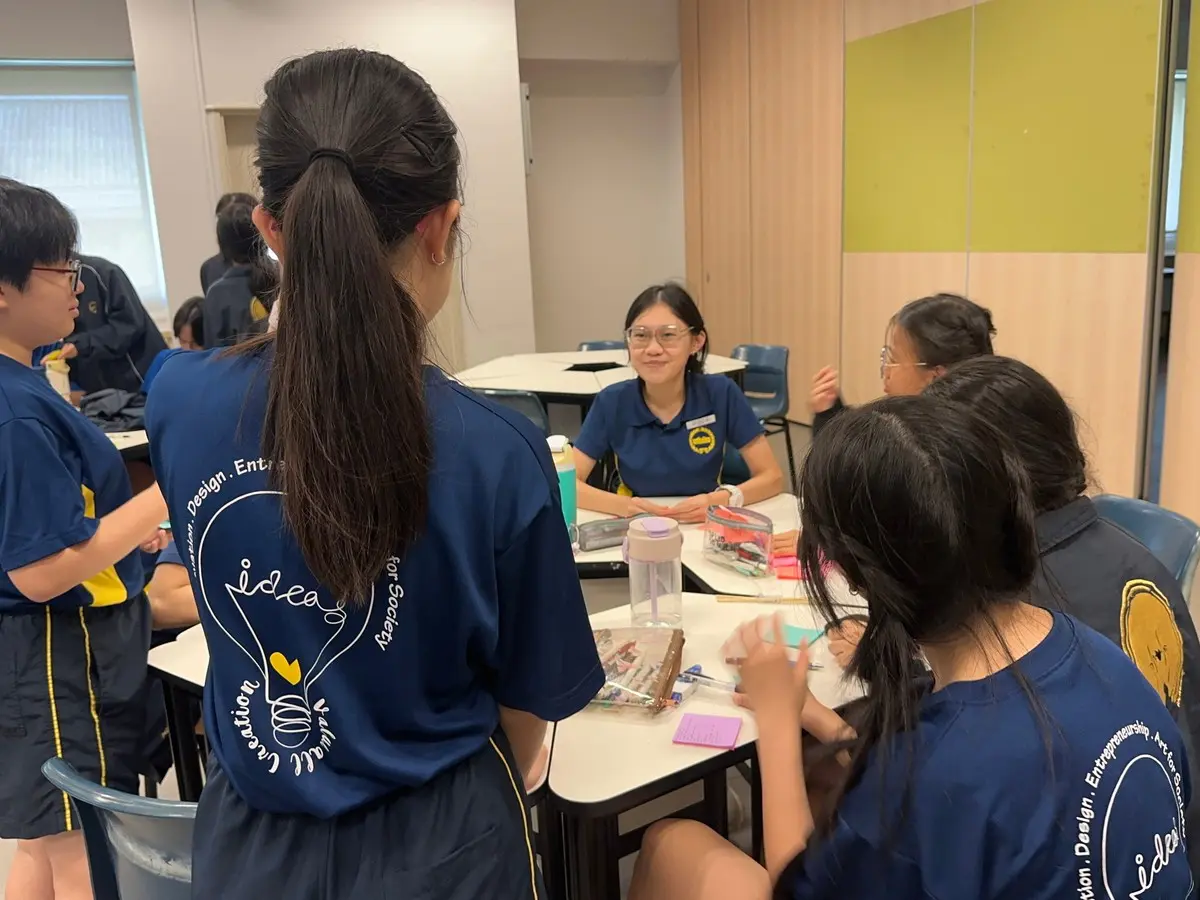
This progression also builds team building and team collaboration skills. Students learn to divide communication roles within their group: one student may lead the empathy interview, another may anchor the HMW drafting, a third may present the prototype. This distributed communication responsibility ensures that every student develops multiple communication capabilities, not just the naturally confident speakers.
4. What Singapore Secondary School Educators Observe After Design Thinking Workshops
Across C-Academy’s school deliveries, teachers and HODs consistently highlight communication-related changes as among the most visible outcomes, often more immediately apparent than changes in creative output.
Common educator observations following C-Academy Design Thinking Workshops include:
- Improved ability to explain reasoning. Students shift from giving one-word answers to articulating why they made a decision, because the workshop trained them to justify design choices at every stage. This reflects stronger critical thinking and communication integration.
- More confident public presentation. Teachers note that students approach subsequent class presentations, in unrelated subjects, with greater structure and less visible anxiety after going through the final pitch experience. The creative confidence built during the design thinking process transfers to other academic contexts.
- Better group communication. Students apply the listening disciplines from empathy interviews to group discussions, leading to fewer dominance patterns and more balanced contribution. The collaborative creativity practices from the ideation phase become habits that students carry into other group work.
- Stronger written articulation. The HMW drafting process has a visible carry-over effect on other writing tasks, particularly in humanities and social studies subjects where framing an issue precisely is a core skill.
C-Academy’s pre- and post-programme assessments measure overall design thinking competence, with Sembawang Secondary School recording an improvement from 13.5% to 69.5%, a +56% gain. While this measure covers the full design thinking competency spectrum, facilitators note that communication and articulation are among the specific behaviours assessed within that framework.
5. Aligning Communication Skill Development to MOE’s 21st Century Competencies Framework
How does design thinking support 21st century competencies in Singapore schools? The answer is grounded in MOE’s published 21CC framework, which identifies Communication, Collaboration, and Information Skills (CCI) as a core competency domain alongside Adaptive and Inventive Thinking (AIT).
The communication outcomes of a structured design thinking workshop map directly onto MOE’s CCI competency descriptors:
|—|—|
| Active listening during empathy interviews | Communication: listening and interpreting |
|---|---|
| Pitch presentation | Communication: persuasive speaking, audience awareness |
| Peer feedback in Test phase | Communication: constructive dialogue, civic literacy |
C-Academy’s EDIT Design Thinking® methodology was not designed in isolation from Singapore’s education context. Kimming Yap, Co-Founder and Managing Director of C-Academy, brings 15+ years of professional design practice to workshop facilitation. This means the communication skills developed are those that practising designers and consultants actually use, not a simplified classroom approximation. This practitioner grounding is what connects the workshop outcomes to the real-world communication demands described in MOE’s 21CC framework.
The design thinking tools used in C-Academy’s workshops (Random Cards, Idea Dice, empathy mapping templates) are not generic classroom props. They are adapted from professional design thinking training materials, ensuring that students experience the same idea generation and communication strategies that professional design thinking facilitators use in industry settings.
6. How to Maximise Communication Outcomes in Your School’s Design Thinking Programme
What skills do students learn from design thinking workshops? The honest answer is: it depends on how the programme is structured. A one-day event with a single presentation at the end will build some confidence, but not the full communication repertoire described above. A 4-session structured programme with progressive communication demands at each stage produces measurably different results.
Checklist for Evaluating Design Thinking Workshop Quality
For HODs and programme coordinators evaluating design thinking workshops for their school, here is a practical checklist:
- Does the programme include a real-world empathy or stakeholder interaction component? If students only interview classmates about hypothetical scenarios, the listening skills developed are shallower.
- Is there an iterative drafting process for problem statements? Single-pass HMW exercises do not build the precision that comes from revision and feedback loops.
- Does every student present — not just team representatives? Individual accountability in the final pitch is what builds individual communication confidence and creative confidence.
- Are students asked to respond to questions, not just deliver a prepared script? Responding to live panel questions is qualitatively different from rehearsed presentation.
- Is the workshop delivered by practitioners with real design experience? Facilitation quality directly shapes the quality of the communication learning environment. A design thinking facilitator with professional design sprint experience will model communication strategies that classroom teachers cannot.
Workshop Best Practices for Communication Skill Development
C-Academy’s Design Thinking Workshops are designed to meet all five criteria. The full programme, grounded in the EDIT Design Thinking® methodology, is structured specifically for Singapore secondary and JC students, with explicit alignment to MOE’s 21CC competency framework and school programme objectives.
Additional workshop best practices that maximise communication outcomes include:
- Structured workshop agenda with clear communication milestones. Students know in advance when they will be expected to present, interview, or defend ideas, reducing anxiety and allowing for preparation.
- Explicit facilitation of cross-collaboration. C-Academy facilitators actively manage group dynamics to ensure quieter students have structured opportunities to contribute verbally, not just in writing.
- Use of professional design thinking tools. Random Cards, Idea Dice, and empathy mapping templates give students concrete communication scaffolds, making abstract communication tasks tangible.
- Post-workshop reflection on communication growth. The final session includes a facilitated reflection where students identify which communication skills they developed, making the learning explicit rather than implicit.
For schools seeking design thinking certification or design thinking training for teachers, C-Academy also offers professional development workshops that equip educators with the same facilitation skills and communication strategies used in student programmes. This ensures that the communication-building approach can be sustained beyond a single workshop engagement.