



Student leadership development in Singapore secondary schools often focuses on formal roles — prefects, student councillors, CCA captains. These structures have real value, but they reach a limited number of students and tend to develop leadership skills in students who already show confidence. Design thinking offers a complementary approach: a structured methodology that builds leadership development and character development in every student who goes through the process, regardless of whether they hold a formal title.
At C-Academy, we have facilitated design thinking programmes with secondary school cohorts across Singapore, including students from Hougang Secondary, Sembawang Secondary, Methodist Girls’ School (Secondary), and Northbrooks Secondary. We consistently observe that the methodology activates leadership behaviours and social emotional learning outcomes that traditional enrichment programmes do not. This article explains five specific ways this happens, and what educators can look for as evidence. Think of it as a practical design thinking guide for secondary school HODs who want to understand what leadership development through this methodology actually looks like in the classroom.
WHO RUNS THIS PROGRAMME
C-Academy runs EDIT Design Thinking® workshops and programmes for Singapore secondary schools, aligned to MOE’s 21st Century Competencies, ALP and VIA.
1. How Design Thinking Builds Empathy and Human-Centred Leadership
Leadership that ignores the people being led is not leadership, it is direction. The Empathise phase of C-Academy’s EDIT Design Thinking® methodology is the first and most important step in developing genuinely human centred design thinkers — and one of the most direct drivers of emotional intelligence and character development in secondary school students.
In a typical secondary school session, students are asked to interview a real person — a classmate, a teacher, a community member, or a user of the product or service they are designing for. They use a structured interview guide to explore that person’s needs, frustrations, and aspirations. They take notes, ask follow-up questions, and resist the urge to jump to solutions.
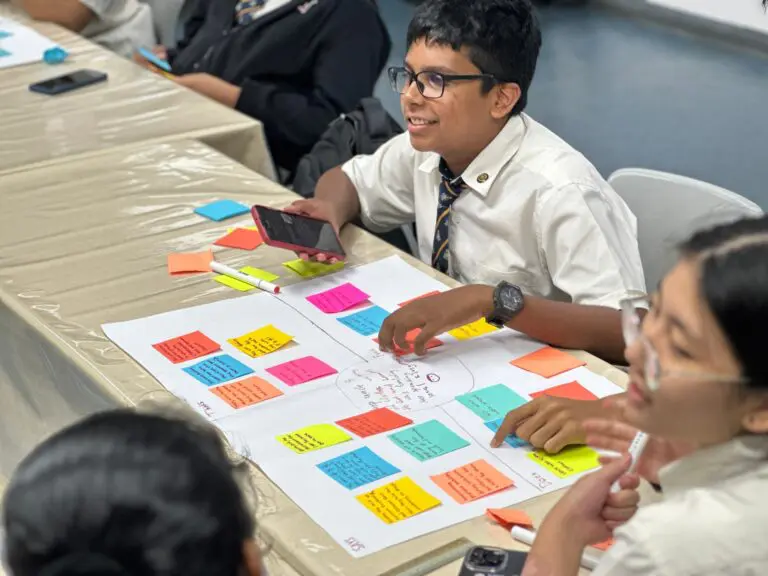
For many Sec 2 and Sec 3 students, this is genuinely unfamiliar. The Empathise phase makes perspective-taking a concrete leadership skill with observable outputs — an empathy map that captures what a user thinks, feels, says, and does.
The student agency this creates is direct: students who can genuinely empathise with others are better equipped to motivate, collaborate with, and advocate for the people they lead. This is the foundation of all meaningful leadership development — whether the future role is a student council president, a project team lead, or a community volunteer.
2. Problem Definition Develops Critical Thinking and Decisiveness
One of the most common leadership failures — at school and beyond — is acting on the wrong problem. Leaders who address symptoms rather than causes, who frame challenges narrowly and miss the bigger picture, often do so not from lack of effort but from insufficient critical thinking and problem solving skills.
The Define phase of the EDIT methodology addresses this directly. Students synthesise their empathy research into a How Might We (HMW) statement — a specific, actionable question that frames the problem from the user’s perspective without prescribing a solution.
Writing a good HMW statement requires the kind of self directed learning and analytical rigour that defines strong leaders. Too broad and there is no useful direction. Too narrow and the opportunity is missed. The skill is finding the reframe that opens genuine creative space.
In our facilitation experience, the moment a student writes a genuinely good HMW statement — one that makes their group say “yes, that’s exactly it” — is one of the most visible turning points in a programme. It produces clarity, ownership, and student voice. The student who defined the problem feels responsible for solving it. That is leadership.
3. Ideation Develops Creative Confidence and an Innovation Mindset
Many students, particularly those who do not identify as naturally creative, have learned to self-censor before they speak. This is the opposite of the behaviour you want in a future-ready leader who needs to think inventively under uncertainty.
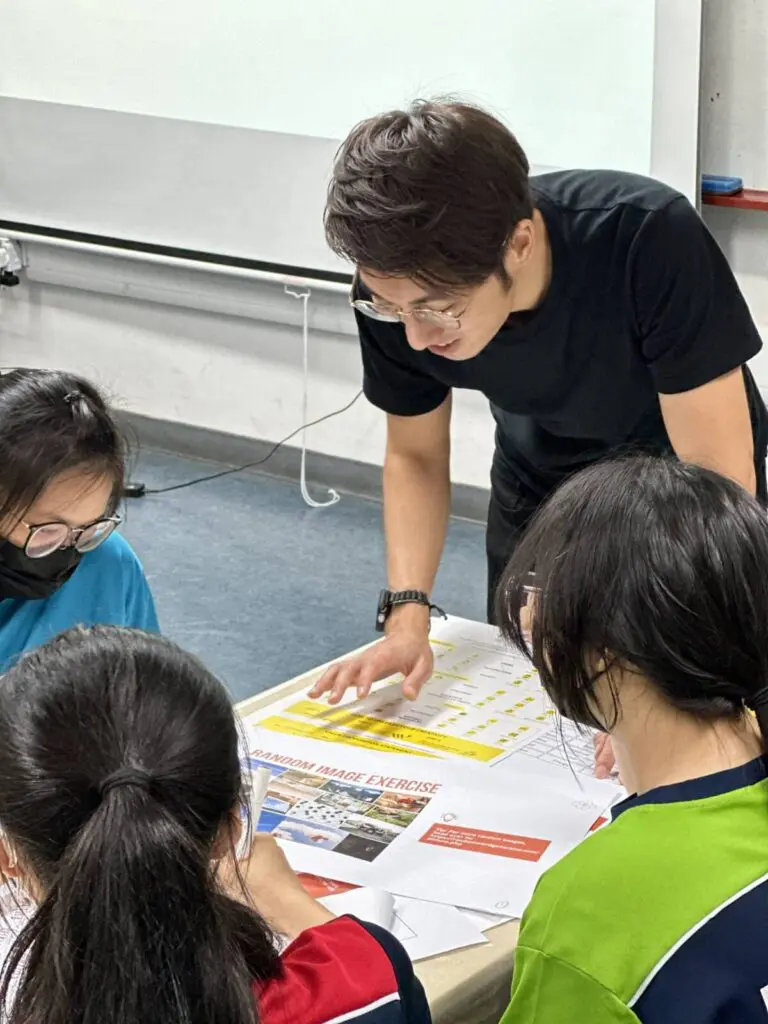
The Ideate phase of the EDIT methodology uses structured tools — including C-Academy’s Random Cards and Idea Dice — to build creative confidence and an innovation mindset. These tools introduce randomness and constraint into the ideation process, removing the pressure of being clever. When you are generating ideas in response to a random card prompt, the bar is “what does this make me think of?” rather than “is this idea good enough to say out loud?”
In groups of four to five students (the size we have found most effective for secondary school ideation), this creates visible peer learning in action. Students who said almost nothing in the first session begin contributing freely. Louder students discover that quantity beats quality in the divergent phase.
By the end of a full Ideate session, students have experienced collaborative learning at its most generative — building on each other’s thinking to produce ideas none of them would have arrived at alone. This experience builds the creative confidence and innovation mindset that defines leaders who can think under pressure.
4. Design Thinking Prototyping and Testing Develop Resilience and Adaptability
Leadership requires the ability to act, receive feedback, and adjust — without treating feedback as failure. This is one of the hardest skills to develop in young people, particularly in a high-stakes academic environment where feedback has historically meant marking down.
The Test phase of the EDIT methodology develops resilience and a growth mindset by reframing feedback as information. Students build a low-fidelity prototype — something quick and rough — and present it to real users or a panel for structured feedback. The explicit expectation is that the first version will have problems. The goal is not a perfect prototype; it is learning what to improve.
This reframe is culturally significant in a Singapore secondary school context. Students who have grown up in an environment that rewards correct answers over creative attempts often approach the Test phase with anxiety. The facilitator’s role is to model the growth mindset: every piece of feedback is information, not a grade.
Our Impact Report data shows that this shift is measurable. Across C-Academy-facilitated programmes, students show an average improvement of 37% in design thinking competence, measured through pre and post student surveys across empathy, problem-framing, ideation, and prototyping. At Sembawang Secondary School, design thinking competence rose by 56%, from 13.5% to 69.5%.
Students who go through this process develop active learning habits — the adaptability of adjusting confidently in response to new information — which MOE’s 21CC framework identifies as Adaptive and Inventive Thinking.
5. Pitching Develops Communication, Influence, and Student Voice
The final output of most C-Academy secondary school programmes is a student pitch — a structured presentation of the problem, the solution, and the rationale, delivered to a panel or audience. This is not a report read aloud. It is active learning at its most visible: a persuasive communication designed to move an audience.
Developing this communication skill matters for student leadership development beyond the classroom. Whether a student is advocating for a cause, presenting a CCA proposal to teachers, or one day making a case to an employer, the ability to communicate with clarity and conviction is foundational to all 21st century skills frameworks.
The design process itself is what makes the pitch powerful. Students who have conducted the research, defined the problem, built the prototype, and tested it with real users pitch with genuine authority. They are not presenting someone else’s work. They are defending ideas they developed through their own human centred design inquiry.
For students who hold leadership roles, this is an immediate practical skill. For students who do not yet see themselves as leaders, successfully delivering a pitch to an audience is often the most formative experience in their leadership development journey.
What Teachers and HODs Observe
Educators who have participated in C-Academy programmes as co-facilitators or observers consistently report that the students who show unexpected leadership during the programme are often not the same students who hold formal leadership roles.
Design thinking creates a context where different kinds of intelligence and contribution are valued — the student who notices an emotional nuance during an interview, the student who reframes a problem in a way no one else had considered, the student who stays calm and decisive when the group loses direction.
This is one of the most valuable social emotional learning outcomes for a school’s broader leadership development programme: surfacing student agency and leadership potential that formal structures would not have reached.
The Role of the Facilitator in Student Leadership Development
It is worth being specific about what makes design thinking an effective leadership development tool rather than just an engaging activity: it is the facilitator’s role in naming and reflecting leadership behaviours as they occur.
When a student defuses a group conflict by redirecting attention to the user’s needs, that is leadership. When a student says “I think we need to go back and question our assumptions,” that is critical thinking. When a student advocates for a quieter group member’s idea because they recognised its value, that is emotional intelligence in action.
A skilled facilitator notices these moments, names them, and connects them to the broader leadership skills the school is developing. At C-Academy, our facilitators are practitioners, not trainers — bringing real-world experience that makes the debrief richer and the learning more transferable.