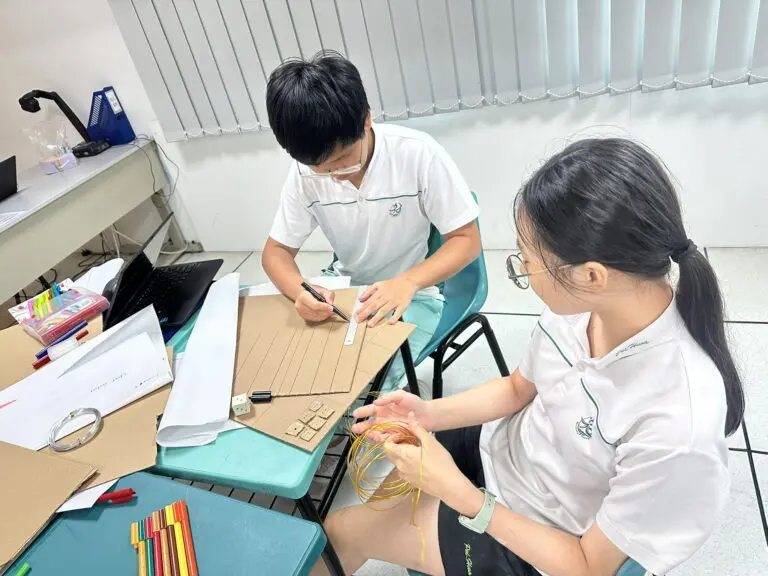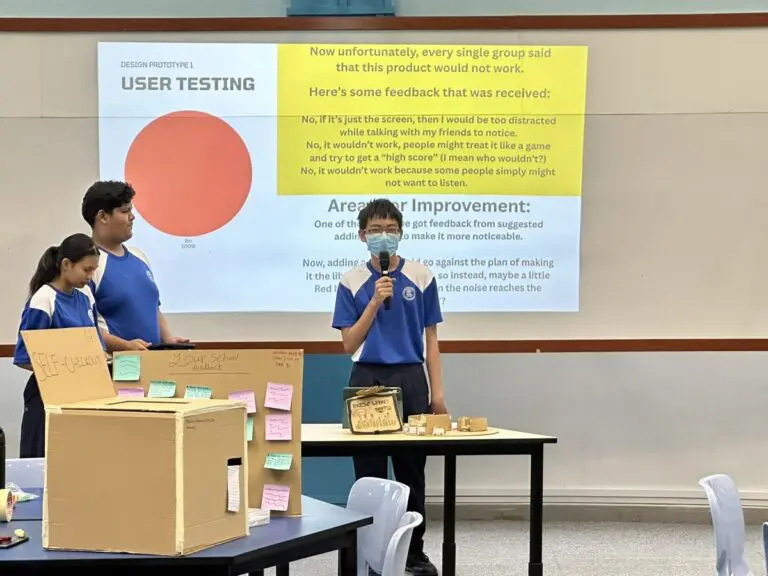




A single school day is enough time to give students a genuine, hands-on experience of the design thinking process — if the session is structured well. C-Academy’s Design Thinking Challenge Sprint is built for exactly this: a half-day programme that moves secondary school students through all four phases of EDIT Design Thinking®, from first empathy exercise to tested prototype, without sacrificing depth for pace.
WHO RUNS THIS PROGRAMME
C-Academy runs EDIT Design Thinking® workshops and programmes for Singapore secondary schools, aligned to MOE’s 21st Century Competencies, ALP and VIA.
1. What Is a Design Thinking Challenge Sprint — and Is It Right for Your School?
The Challenge Sprint is C-Academy’s condensed design thinking workshop format for Singapore secondary schools. Rather than spreading learning across multiple sessions, it concentrates the full EDIT Design Thinking® experience — Empathise, Define, Ideate, and Test — into focused, fast-paced exercises that give students a real feel for each phase of the process.
This format suits schools that want to introduce design thinking fundamentals to a cohort quickly: as a taster before committing to a full programme, as a post-examination enrichment activity, or as a standalone session within an existing Applied Learning Programme (ALP) calendar. It is not a deep-dive; it is a purposefully compressed experience designed to build the design thinking mindset and generate observable student engagement within a single session.
For HODs evaluating providers, the key question is often whether a half-day format can cover enough ground to be genuinely useful. The answer lies in facilitation design. C-Academy’s facilitators — including Kimming Yap, who brings over 15 years of design and education experience, and Yulia Saksen, a WSQ ACLP-certified trainer and WIAL Action Learning Coach — structure each phase so that students complete a real output, not just a listening activity. By the end, every group has produced an empathy map, a problem statement, a set of ideas, and a rough prototype they have tested against user feedback.
2. How the Four Phases of EDIT Design Thinking® Fit Into One Session
The structure of the Challenge Sprint maps directly onto C-Academy’s proprietary EDIT Design Thinking® methodology. Each phase is time-boxed and activity-driven, so students are always producing something rather than passively absorbing content. The facilitation approach is deliberately hands-on: groups of four to five students work through collaborative ideation and user research exercises together, with facilitators coaching rather than lecturing.
Empathise
Students begin with a structured user research activity. Rather than abstract discussion, they conduct short empathy interviews with a designated “user” within the group — practising the skill of listening for unspoken needs rather than stated preferences. This persona mapping exercise introduces a core design thinking principle: that effective problem-solving starts with genuine understanding of the people affected. C-Academy’s facilitators have observed that this phase consistently produces the highest student engagement, particularly when the challenge topic connects to experiences students recognise from their own lives.
Define
With empathy data in hand, groups move to problem definition. Students synthesise their interview insights into a “How Might We” (HMW) statement — a structured problem framing technique that keeps the challenge human-centred and open to multiple solutions. This phase builds skills directly aligned with MOE’s 21st Century Competencies framework, particularly Adaptive and Inventive Thinking and Communication Collaboration. The output is a single, clear problem statement that every group member has contributed to and understands.
Ideate
The ideation phase opens into structured brainstorming sessions using C-Academy’s ideation tools, including its Random Cards — a deck designed to break cognitive patterns and push groups toward creative thinking beyond their first instincts. Students learn that quantity precedes quality in ideation: the goal is to generate as many ideas as possible before evaluating. Groups of four to five tend to produce the strongest idea sets in this format, as the discussion stays focused while still drawing on diverse perspectives. After the brainstorm, groups apply a simple prioritisation matrix to select the idea they will prototype.
Test
The final phase introduces rapid prototyping and iterative testing. Students build a rough physical or paper prototype of their chosen idea and present it to another group acting as users. The feedback loop — prototype, test, refine — happens within a single short cycle, giving students a direct experience of the iterative design process. Even in compressed form, this phase generates the kind of learning that sticks: students discover that their first solution rarely matches what users actually need, which is the central lesson of design thinking fundamentals.
3. What Students Produce and Why It Matters to HODs
One concern HODs raise when evaluating short-format programmes is whether a half-day session produces meaningful student outputs or simply activity for its own sake. In C-Academy’s Challenge Sprint, every group leaves the session with four tangible artefacts: an empathy map, a HMW problem statement, an idea shortlist, and a tested prototype. These are not polished products — they are not meant to be. They are evidence that students have moved through a complete design thinking process under their own collaborative effort.
This matters for several reasons. First, it gives teachers something observable to assess against learning objectives. Second, it gives students a concrete reference point for future design thinking work — they have done it, not just heard about it. Third, it creates a natural entry point for follow-on sessions if the school decides to progress to a full Design Thinking Workshop across multiple sessions.
C-Academy’s impact data shows that schools which use the Challenge Sprint as an introduction and then follow up with a structured multi-session programme see stronger overall outcomes in design thinking competence. At Sembawang Secondary School, students who went through C-Academy’s full programme showed a 56% improvement in design thinking competence (from 13.5% to 69.5%) in pre- and post-programme assessments. The Challenge Sprint plants the foundation that makes that kind of growth possible.
4. How Does the Challenge Sprint Support the Applied Learning Programme?
Many Singapore secondary schools are looking for Applied Learning Programme (ALP) providers that can deliver meaningful student experiences within the constraints of a school calendar. The Challenge Sprint fits naturally within ALP planning as a high-impact, low-disruption option: it requires no extensive pre-session preparation from teachers, runs within a standard half-day block, and produces measurable student outputs aligned to ALP learning objectives.
The EDIT Design Thinking® methodology underpins all of C-Academy’s ALP delivery. For schools exploring what a longer programme might look like, the Challenge Sprint serves as a direct demonstration of C-Academy’s facilitation approach and the student experience — making it a practical evaluation tool as much as a learning experience. C-Academy’s core team handles all facilitation directly; no freelancers are involved in delivery, which means schools receive consistent quality regardless of cohort size or scheduling variation.
For HODs and teachers who want to see how design thinking can support 21st Century Competencies development — particularly in building students’ capacity for creative thinking, collaborative ideation, and real-world problem-solving — the Challenge Sprint offers a structured, low-risk starting point.
5. Taking the Next Step With C-Academy’s Design Thinking Programmes
The Challenge Sprint is one part of C-Academy’s broader suite of design thinking workshops for Singapore secondary schools. Whether a school is looking for a single introductory session or a full multi-session Applied Learning Programme, C-Academy’s programmes are built around the EDIT Design Thinking® methodology and delivered by a core team of experienced facilitators.
Schools interested in exploring how a Challenge Sprint or full Design Thinking Workshop could fit their programme calendar are welcome to reach out to the C-Academy team through the contact page. C-Academy works with schools across Singapore to design programmes that match their students’ needs, their ALP objectives, and their available time — starting from a single half-day and building from there.